

 Türkçe
 Русский
 Español
 العربية
1 Ton Hydraulic Cylinder
A 1 ton hydraulic cylinder needs a bore of at least Ø27.9 mm at 160 bar; the nearest standard FDH bore is Ø40 mm, which delivers 2.1 metric tonnes (2.3 US tons). At the optional 250 bar, Ø40 mm is enough (3.2 t). The bore follows from F = p × A.
Fenitsa builds FDH series and special-bore hydraulic cylinders (rams) in this class as double acting units with flange, foot or clevis mountings; check your own load with the force calculator.
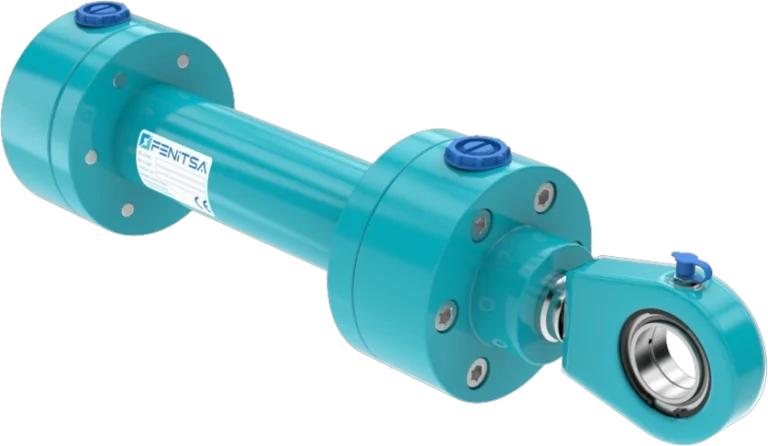
Bore Required for 1 Tons
Required bore D = √(4F / πp). The standard bore is the next larger FDH catalogue size.
| Pressure | Required bore | Standard FDH bore | Force of that bore |
|---|---|---|---|
| 100 bar | Ø35.3 mm | Ø40 mm | 1.3 t |
| 160 bar | Ø27.9 mm | Ø40 mm | 2.1 t |
| 250 bar | Ø22.3 mm | Ø40 mm | 3.2 t |
Push and Pull Force of Nearby Standard Bores
| Bore / rod | Push 160 bar | Push 250 bar | Pull 160 bar |
|---|---|---|---|
| Ø40 / Ø25 | 2.1 t | 3.2 t | 1.2 t |
| Ø50 / Ø28 | 3.2 t | 5.0 t | 2.2 t |
Buckling: Maximum Free Length by Rod Diameter
Euler buckling with a steel rod (E = 210,000 N/mm²) and a safety factor of 3.5; the value is the buckling length Lk between two pivoted ends.
| Rod diameter | Force (160 bar) | Max. buckling length Lk |
|---|---|---|
| Ø25 mm | 20.1 kN | 750 mm |
| Ø28 mm | 20.1 kN | 940 mm |
Speed and Pump Flow
| Extend speed | Required flow | Hydraulic power (160 bar) |
|---|---|---|
| 25 mm/s | 1.9 L/min | 0.5 kW |
| 50 mm/s | 3.8 L/min | 1.0 kW |
| 100 mm/s | 7.5 L/min | 2.0 kW |
Where Is a 1 Ton Hydraulic Cylinder Used?
- Typical machines: clamping fixtures, small bench presses, hatch and door lifting mechanisms
Workshop presses, clamping fixtures, lifting tables and light forming work sit in this class. The small bore keeps the cylinder compact and a low-flow power unit is enough.
Worked example: for 1 t, a 300 mm stroke and a 10 L/min pump, a Ø40 mm cylinder extends at about 132.6 mm/s, finishes the stroke in 2.3 s and moves 0.38 litres of oil per stroke.
Frequently Asked Questions
What bore do I need for a 1 ton hydraulic cylinder?
At least Ø27.9 mm at 160 bar; the standard choice is Ø40 mm, which gives 2.1 t. At 250 bar, Ø40 mm is enough (3.2 t).
Does 250 bar allow a smaller bore?
Yes. Force is proportional to pressure, so 250 bar gives about 56 % more force than 160 bar from the same bore. The cylinder, hoses and pump must all be rated for 250 bar. 1 t: Ø40 mm @160 bar → Ø40 mm @250 bar.
Does the stroke change the force?
No, but it changes buckling. On a Ø40 mm cylinder with a Ø25 mm rod the maximum buckling length is about 750 mm; a longer stroke needs a thicker rod or guidance.
What pump flow is needed?
About 3.8 L/min moves a Ø40 mm cylinder at 50 mm/s. More flow means more speed; it does not change the force.
Send Us Your Cylinder Data
Bore, rod, stroke, working pressure, mountings and quantity — or a drawing or photo of the cylinder you want to replace. Our engineers reply with a technical proposal and a quotation.
Related Pages
Hydraulic Cylinders
All series and sizes
FDH
Standard series, Ø40–Ø200 mm
Force Calculator
Calculate bore and force
5 Ton Hydraulic Cylinder
Next tonnage
5 Ton Hydraulic Cylinder
Next tonnage