


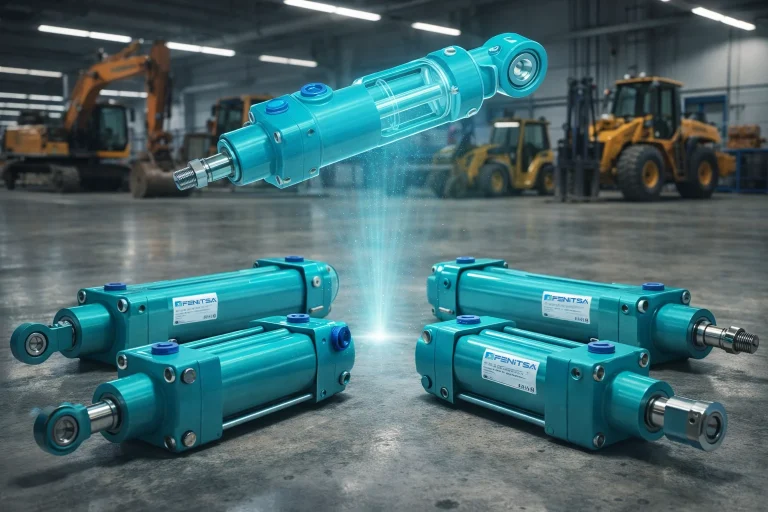


Hydraulic Cylinder, Hydraulic Ram or Hydraulic Piston?
All three names describe the same product. “Hydraulic cylinder” is the engineering term; “hydraulic ram” is common in the UK, Australia and New Zealand, and is also used for single acting plunger cylinders; “hydraulic piston” is how many buyers refer to the whole cylinder, although strictly the piston is the part inside the barrel that the oil pushes — see hydraulic cylinder parts.
Types of Hydraulic Cylinders
Cylinders are classified by how they are powered (single or double acting), how they are built (tie rod or welded) and what they do (telescopic, plunger, double rod, tandem). The types of hydraulic cylinders guide compares them in one table; the main pages are:
- Single acting hydraulic cylinders — powered one way, returned by load or spring.
- Double acting hydraulic cylinders — push and pull under pressure.
- Tie rod cylinders and welded cylinders — the two main constructions.
- Telescopic cylinders — long stroke from a short body.
Hydraulic Cylinders by Tonnage
The smallest standard bore that reaches each load, from F = p × A. 100 t is above the Ø200 mm standard series: it is met with two Ø160 mm cylinders at 250 bar in parallel (2 × 51.3 ≈ 102.5 t) or a special-bore cylinder quoted per project.
| Load | At 160 bar | At 250 bar |
|---|---|---|
| 10 ton hydraulic cylinder | Ø100 mm (12.8 t) | Ø80 mm (12.8 t) |
| 20 ton hydraulic cylinder | Ø125 mm (20.0 t) | Ø100 mm (20.0 t) |
| 30 ton hydraulic cylinder | Ø160 mm (32.8 t) | Ø125 mm (31.3 t) |
| 50 ton hydraulic cylinder | Ø200 mm (51.3 t) | Ø160 mm (51.3 t) |
| 100 ton hydraulic cylinder | special bore or 2 cylinders | special bore or 2 cylinders |
Every bore at 100–250 bar, in metric tons and US tons, is in the hydraulic cylinder sizes and tonnage chart.
Long Stroke Hydraulic Cylinders up to 5,000 mm
Standard FDH strokes are 100 to 500 mm, and cylinders are built with strokes up to 5,000 mm. Above roughly ten times the rod diameter, a pushing cylinder must be checked for buckling: the free length, the mounting style and the rod diameter decide whether a thicker rod or guidance is needed. The long stroke hydraulic cylinders page shows the check with worked examples.
Hydraulic Cylinder Force at 100, 160 and 250 bar
| Bore (mm) | Area (cm²) | 100 bar | 160 bar | 250 bar |
|---|---|---|---|---|
| Ø40 | 12.6 | 1.3 t | 2.1 t | 3.2 t |
| Ø50 | 19.6 | 2.0 t | 3.2 t | 5.0 t |
| Ø63 | 31.2 | 3.2 t | 5.1 t | 7.9 t |
| Ø80 | 50.3 | 5.1 t | 8.2 t | 12.8 t |
| Ø100 | 78.5 | 8.0 t | 12.8 t | 20.0 t |
| Ø125 | 122.7 | 12.5 t | 20.0 t | 31.3 t |
| Ø160 | 201.1 | 20.5 t | 32.8 t | 51.3 t |
| Ø200 | 314.2 | 32.0 t | 51.3 t | 80.1 t |
F = P × A, with 1 bar = 0.1 N/mm² and 1 metric ton-force = 9.807 kN. At 160 bar (2,320 psi) a Ø100 mm cylinder pushes about 12.8 t; at 250 bar about 20 t. Pull force is lower by the rod area.
Standard Bore and Rod Combinations
| Bore (mm) | Rod (mm) | Area ratio | Pull force at 160 bar |
|---|---|---|---|
| Ø40 | Ø28 | 1.96 | 1.0 t |
| Ø50 | Ø28 | 1.46 | 2.2 t |
| Ø63 | Ø36 | 1.48 | 3.4 t |
| Ø80 | Ø45 | 1.46 | 5.6 t |
| Ø100 | Ø56 | 1.46 | 8.8 t |
| Ø125 | Ø70 | 1.46 | 13.7 t |
| Ø160 | Ø90 | 1.46 | 22.4 t |
| Ø200 | Ø110 | 1.43 | 35.8 t |
The area ratio sets how much faster the cylinder retracts than it extends with the same pump flow. Thicker rods raise buckling resistance but reduce pull force.
Supplying the Middle East, Europe and the Americas
Fenitsa ships hydraulic cylinders to customers across the Middle East, Europe and the Americas. Road and sea freight are arranged per order, depending on weight, urgency and destination.
Quotations state price, production lead time and the agreed Incoterm (for example EXW, FCA, CPT or CIF). Shipments are packed for export with plugged ports and protected rods, and commercial invoice, packing list and certificate of origin are prepared with each order.
Hydraulic Cylinders – FAQ
What is a hydraulic cylinder?
A hydraulic cylinder is a linear actuator that converts hydraulic oil pressure into force and straight-line motion. Oil pumped into the cylinder pushes a piston connected to a rod; reversing the flow retracts it. Because oil pressure is high (typically 100–250 bar), even compact cylinders produce many tonnes of force.
Is a hydraulic piston the same as a hydraulic cylinder?
In everyday use, yes — many buyers say “hydraulic piston” or “hydraulic ram” for the whole cylinder. Technically the piston is the part inside the tube that the oil pushes against; the complete assembly of tube, piston, rod, heads and seals is the hydraulic cylinder.
What are the main types of hydraulic cylinders?
By function: single-acting and double-acting. By construction: tie-rod, welded body, bolted flanged heads and telescopic. Fenitsa builds tie-rod cylinders, the FDH standard series with round flanged heads, THS welded-body and KHS heavy-duty cylinders, and telescopic cylinders; see types of hydraulic cylinders and how a hydraulic cylinder works.
How long does a hydraulic cylinder last?
Service life depends on pressure, cycle count, oil cleanliness and side loads. With clean oil, correct alignment and timely seal replacement, industrial cylinders run for many years; tie-rod designs are especially easy to reseal.
How do I choose the right bore size?
Divide the required force by the working pressure to get the piston area, add a 20–30 % margin, and pick the next standard bore. For long strokes, also check rod buckling. The force chart below and our force calculator do this for you.

