

 Türkçe
 Русский
 Español
 العربية
32 mm Pneumatic Cylinder: Force Chart and Air Consumption
A 32 mm bore pneumatic cylinder (≈ 1.26 in) has a Ø12 mm rod and, per the Fenitsa catalogue, pushes 48 kg and pulls 41 kg at 6 bar (87 psi). Its piston area is 8.0 cm².
Typical uses: pick-and-place units, small clamps and stops, sorting gates on conveyors. Standard strokes 50–500 mm; any stroke on request up to 3,000 mm for Ø32.
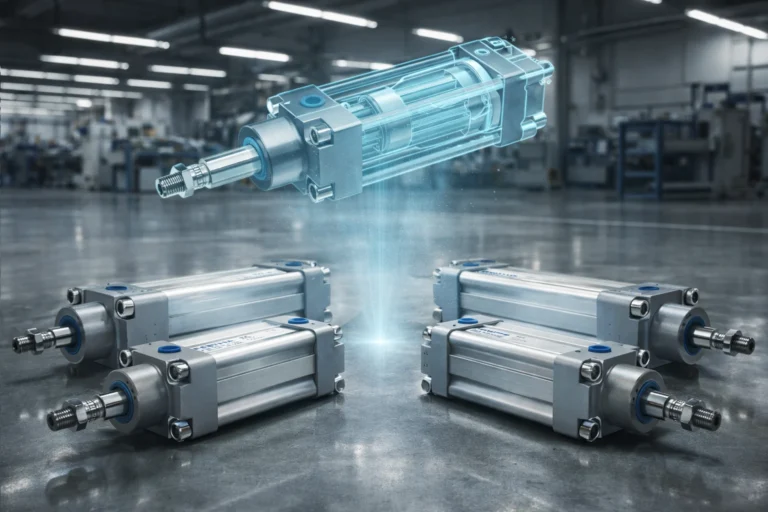
Force Chart by Pressure
Theoretical values; catalogue 6 bar figures allow for friction.
| Pressure | Push (N) | Push (kgf) | Push (lbf) | Pull (kgf) |
|---|---|---|---|---|
| 4 bar (58 psi) | 322 | 33 | 72 | 28 |
| 6 bar (87 psi) | 483 | 49 | 108 | 42 |
| 8 bar (116 psi) | 643 | 66 | 145 | 56 |
| 10 bar (145 psi) | 804 | 82 | 181 | 70 |
Catalogue at 6 bar: push 48 kg, pull 41 kg.
Air Consumption (6 bar, double stroke)
Free air in litres.
| Stroke (mm) | Air (L) |
|---|---|
| 50 | 0.5 |
| 100 | 1.0 |
| 200 | 2.1 |
| 300 | 3.1 |
| 500 | 5.2 |
Series and Mountings in This Bore
FMY (ISO 15552, magnetic piston, adjustable cushioning), PAG-PAGY (CETOP RP 43P, aluminium body) and PNS-PNSY (CETOP RP 43P, steel body); every series also as double rod (C), tandem (T) and two-position (D). Mountings: clevis, flange, foot, trunnion, rod-end clevis and spherical eye.
Application Example
To move a 20 kg load at a 50 % load ratio (usual for moving loads), a Ø32 cylinder needs about 4.9 bar (71 psi).
Compared with Neighbouring Bores
| Bore | Rod | Push 6 bar (kg) | Pull 6 bar (kg) |
|---|---|---|---|
| Ø32 ◄ | Ø12 | 48 | 41 |
| Ø40 | Ø16 | 75 | 63 |
Frequently Asked Questions
How much force does a 32 mm pneumatic cylinder produce?
Per the catalogue, 48 kg push and 41 kg pull at 6 bar; at 10 bar the theoretical push is 82 kgf (181 lbf).
What rod size does a 32 mm cylinder have?
Ø12 mm (0.47 in).
How much air does a 32 mm cylinder use?
About 1.0 litres of free air per double stroke for a 100 mm stroke at 6 bar.
What load can a Ø32 cylinder move at 6 bar?
About 25 kg as a moving load at a 50 % load ratio; for static clamping up to the catalogue 48 kg.
Send Us Your Cylinder Data
Bore, rod, stroke, working pressure, mountings and quantity — or a drawing or photo of the cylinder you want to replace. Our engineers reply with a technical proposal and a quotation.
Related Pages
Pneumatic cylinder sizes
All bores
Air cylinder calculator
Force at any pressure
40 mm Pneumatic Cylinder
Neighbouring bore
Pneumatic Cylinders
All series