

 Türkçe
 Русский
 Español
 العربية
Custom Hydraulic Cylinders
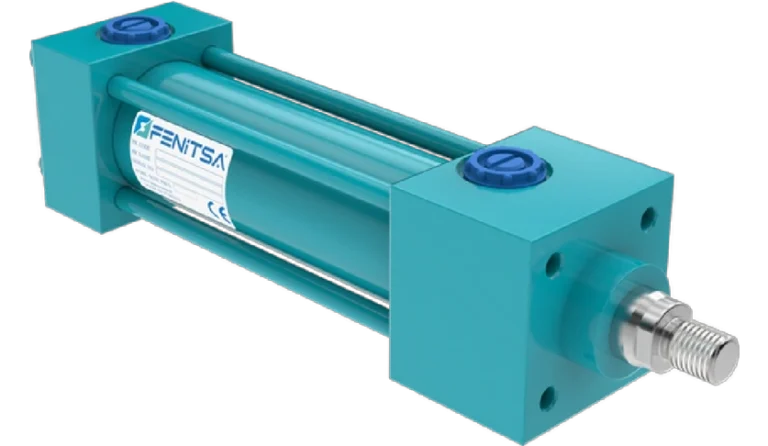
Custom hydraulic cylinders built to your drawing, your sample or just your application data. When a catalogue cylinder does not fit the space, the load or the environment, Fenitsa engineers and manufactures one that does — from a single prototype to repeat series production.
Every design is checked for force, rod buckling and mounting loads before you approve the drawing, and every cylinder is pressure tested before shipment.
What We Can Customise
Component-by-component options for a custom-built hydraulic cylinder.
| Component | Options |
|---|---|
| Bore and stroke | Any bore in our production range; strokes to suit the machine, including long strokes with stop tubes |
| Piston rod | Oversized rods against buckling, special rod-end threads and forms; hard-chrome-plated Ck45 as standard |
| Mounting | Clevis, spherical bearing, rod eye, front/rear flange, trunnion at any position, foot, threaded or welded-on brackets |
| Ports | Position, size and thread type (BSP, metric or to your specification), extra bleed ports |
| Body design | Tie-rod, welded or bolted heads, compact short-body designs |
| Seals | Seal packages for standard (−20/+80 °C) or high-temperature (up to +200 °C) service and for your hydraulic fluid |
| Cushioning | Adjustable end-of-stroke cushioning at one or both ends |
| Special functions | Double rod, tandem, adjustable stroke, hydraulic blocks mounted on the cylinder |
| Finish | Industrial or marine paint systems, customer colour, protected rod ends for shipping |
Custom or Standard? A Quick Rule
A standard cylinder is the right choice when the bore, stroke and mountings fit your machine as they are — it is faster to deliver and easier to replace. Go custom when the installation space is fixed, the mounting geometry is unusual, the environment is hot, wet or abrasive, or when you need extra functions such as a double rod or built-in valves.
In practice many projects end up in between: a catalogue FDH, KHS or THS cylinder with a special stroke, rod end or port position. Tell us what has to change and we will keep everything else standard to control cost and lead time.
What to Send With Your Enquiry
The more of this we have, the faster and more accurate the quotation.
- Force and pressureRequired push and pull force, or the load, plus the working pressure of your power unit.
- Bore, rod and strokeOr the closed and open lengths the cylinder must fit between.
- Mounting at both endsType, pin diameters, flange dimensions or a sketch of the connection points.
- Speed and duty cycleCycles per hour or per day, and extension and retraction speed.
- EnvironmentTemperature range, outdoor use, water, dust, chemicals, hydraulic fluid type.
- QuantityPrototype, annual volume and expected repeat orders.
- Drawings or samplesPDF, DWG or STEP files, photos, or the existing cylinder itself.
Our Custom Engineering Process
Five steps from enquiry to series production.
- 1
Requirement review
An engineer reviews your data and asks for anything that is missing before the design starts.
- 2
Design and calculation
Force, speed, rod buckling and mounting loads are calculated; seals and materials are selected for your conditions.
- 3
Drawing approval
You receive a dimensioned drawing and quotation. Nothing is produced until you approve it.
- 4
Prototype or first article
For new designs we build and test a first unit so you can check fit and function on the machine.
- 5
Series production
Approved designs go into repeat production with the same drawing, test procedure and documentation.
Replacing a Cylinder Without a Drawing
How to measure an existing cylinder so we can rebuild it.
| Measure | How |
|---|---|
| Closed length | Pin centre to pin centre (or mounting face to rod end) with the rod fully retracted |
| Stroke | Extend fully and subtract the closed length, or read it from the old nameplate |
| Bore and rod | Rod diameter with a calliper; bore from the tube outside diameter and wall, or from the head |
| Mountings | Pin diameters, clevis gap, eye width, flange bolt pattern and thickness |
| Ports | Thread type and size, and their position relative to the ends |
| Working pressure | From the machine’s relief valve setting or hydraulic diagram |
Add photos from the side and both ends with a tape measure in view. With that information we can prepare a drawing for your approval, even when the original cylinder is badly worn.
Design Checks on Every Custom Cylinder
What our engineers verify before a drawing is released.
Force and pressure margin
Push and pull force at your working pressure, with a margin for friction, pressure drop and dynamic load.
Rod buckling
Euler buckling for the real mounting case and fully extended length; the most common reason a long cylinder fails early.
Mounting and pin loads
Stress in clevis pins, trunnions and flange bolts, including side loads caused by misalignment.
Port size and oil velocity
Ports sized so the flow needed for your speed does not create excessive pressure loss or heat.
Cushioning energy
End-of-stroke cushioning matched to moving mass and speed, protecting heads and the machine frame.
Seals and fluid
Seal compound checked against temperature, speed and hydraulic fluid type.
What Drives the Price of a Custom Cylinder
- Size and strokeBore, rod diameter and length set the amount of tube, bar and machining time.
- How far from standardA modified catalogue cylinder costs less than an all-new design with new heads and mountings.
- Mountings and extrasTrunnions, spherical bearings, double rods, cushioning and mounted blocks add parts and machining.
- Seals and finishHigh-temperature seal packages and special paint systems cost more than the standard package.
- Quantity and repeatabilityTooling and programming are shared across the batch, so repeat orders are cheaper per unit.
Typical Custom Cylinder Projects
Examples of the kind of cylinders we are asked to engineer.
Replacement for an obsolete cylinder
Reverse-engineered from a worn sample when the original machine builder no longer supplies spares.
Long-stroke cylinder with stop tube
For gates, lifting platforms and conveyors where a thin rod would buckle over the stroke.
Double-rod synchronised cylinder
Equal area on both sides for equal speed and force in both directions.
Compact welded cylinder
Shortest possible closed length for mobile machines with limited mounting space.
High-temperature cylinder
High-temperature seal package (up to +200 °C) for presses and machines near heat sources.
Cylinder with mounted block
A hydraulic block mounted directly on the cylinder to remove hoses and leak points.
Custom Hydraulic Cylinders – FAQ
What makes a hydraulic cylinder "custom"?
Any change to the catalogue design: a non-standard bore or stroke, special mounting geometry, ports in a different position, integrated valves or sensors, special seals for temperature or fluid, or different materials and coatings. Many custom cylinders are 80 % standard parts with one or two engineered changes.
Can you copy an existing cylinder from a sample?
Yes. Send the cylinder or a set of photos with key dimensions (closed length, stroke, bore, rod, pin diameters, port threads). We measure it, produce a drawing for your approval and build the replacement — useful when the original supplier no longer exists.
Is there a minimum order quantity?
No fixed minimum. Single prototypes and one-off replacement cylinders are quoted as well as series orders; the unit price falls as the quantity and repeatability increase.
Which pressures and sizes can be customised?
Our standard series are rated 160 bar working / 240 bar test with a 250 bar option, bores Ø40–Ø200 mm and strokes up to 5,000 mm. Requirements outside this envelope are reviewed case by case by our engineering team.
How do you make sure a long cylinder will not buckle?
Every custom design is checked with the Euler buckling method for its real mounting style and stroke. If the margin is too low we increase the rod diameter, add a stop tube or change the mounting.
Do I get a drawing before production?
Yes. Production only starts after you approve our dimensioned drawing, which then becomes the reference for every repeat order.
Send Your Drawing
Upload your drawing or describe the application and we will come back with a technical proposal and quotation.