


How Much Force Does a 160 Bar Hydraulic Cylinder Generate?
- Home
- How Much Force Does a 160 Bar Hydraulic Cylinder Generate?
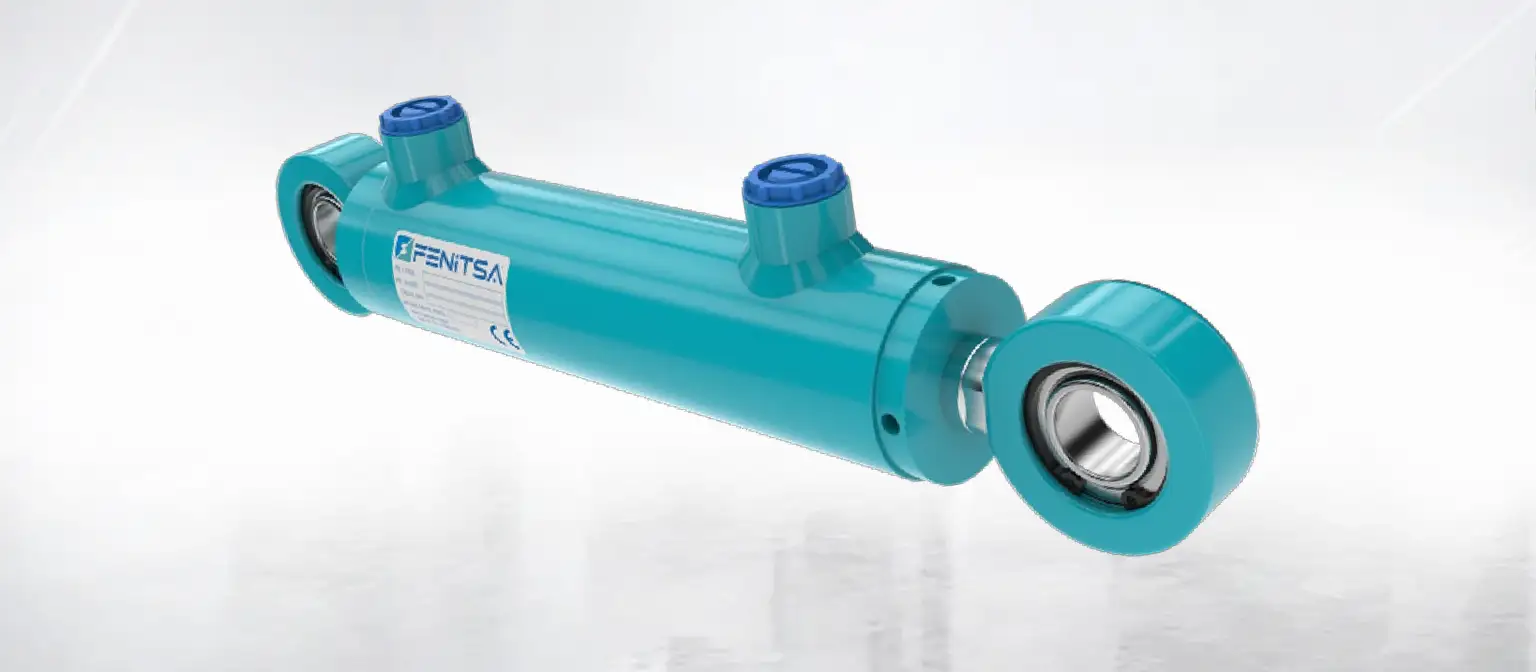
The force that a hydraulic cylinder can generate is not determined solely by system pressure. The piston diameter, piston rod diameter, direction of movement, and pressure losses within the system also affect the final result. Therefore, the question “How much force can a 160 bar hydraulic cylinder generate?” cannot be answered with a single value. At the same operating pressure, as the piston diameter increases, the surface area exposed to pressure also increases, resulting in a higher theoretical cylinder force.
The Fenitsa THS hydraulic cylinder series is available with piston diameter options of Ø40, Ø50, Ø63, Ø80, Ø100, Ø125, Ø160, and Ø200 mm. The standard operating pressure of the series is 160 bar, the test pressure is 240 bar, and the optional pressure rating is 250 bar. Selecting the correct piston diameter for the application is important for machine safety, energy consumption, and cylinder service life.
How Is the Force of a 160 Bar Hydraulic Cylinder Calculated?
Hydraulic cylinder force is calculated by multiplying the operating pressure by the effective piston surface area. The piston area is proportional to the square of the piston diameter. For this reason, even a small increase in piston diameter can create a significant increase in the generated force.
At a pressure of 160 bar, the approximate theoretical extension forces of the Fenitsa THS series are as follows:
| Piston Diameter | Theoretical Force | Approximate Ton-Force |
|---|---|---|
| Ø40 mm | 20.1 kN | 2.05 tons |
| Ø50 mm | 31.4 kN | 3.20 tons |
| Ø63 mm | 49.9 kN | 5.09 tons |
| Ø80 mm | 80.4 kN | 8.20 tons |
| Ø100 mm | 125.7 kN | 12.81 tons |
| Ø125 mm | 196.3 kN | 20.02 tons |
| Ø160 mm | 321.7 kN | 32.80 tons |
| Ø200 mm | 502.7 kN | 51.26 tons |
For example, a 160 bar hydraulic cylinder with a Ø100 mm piston diameter theoretically generates approximately 125.7 kN, equivalent to around 12.8 tons of force. When the piston diameter is increased to Ø200 mm, the force reaches approximately 502.7 kN. Although the diameter is doubled, the force increases by approximately four times because the piston area increases in proportion to the square of the diameter.
These values represent theoretical extension forces. Under actual operating conditions, the usable force may be lower due to seal friction, valve and pipeline losses, oil temperature, and the actual pressure reaching the cylinder.
Is Tonnage Alone Sufficient When Selecting a Hydraulic Cylinder?
Selecting the correct 160 bar hydraulic cylinder is not limited to calculating the required tonnage. During the retraction movement, the area occupied by the piston rod is subtracted from the total piston area. Therefore, the retraction force is lower than the extension force. In machines where the load must both be pushed and pulled, both directions of movement should be calculated separately.
Stroke length and piston rod diameter should also be included in the selection process. In long-stroke applications in particular, the piston rod may be exposed to a buckling risk under compressive loads. The Fenitsa THS series offers stroke lengths of up to 5,000 mm and piston rod diameter options ranging from 28 to 125 mm. The maximum piston speed of the series is specified as 0.5 m/s.
If the net force required for an application is 10 tons, selecting a cylinder that theoretically generates exactly 10 tons is not sufficient. An appropriate safety margin should be included to account for pressure fluctuations, mechanical friction, and variable loads. The mounting type, load alignment, operating frequency, oil temperature, and environmental conditions should also be evaluated.
THS type hydraulic cylinders offered by Fenitsa can be configured for various industrial applications thanks to their CETOP-R58-compliant design and different mounting options. When selecting the correct piston diameter and stroke, the decision should not be based solely on the theoretical force table. An engineering calculation based on the machine’s actual operating conditions should also be carried out.

