


How Does Pneumatic Cylinder Rod Diameter Affect Force and Strength?
- Home
- How Does Pneumatic Cylinder Rod Diameter Affect Force and Strength?
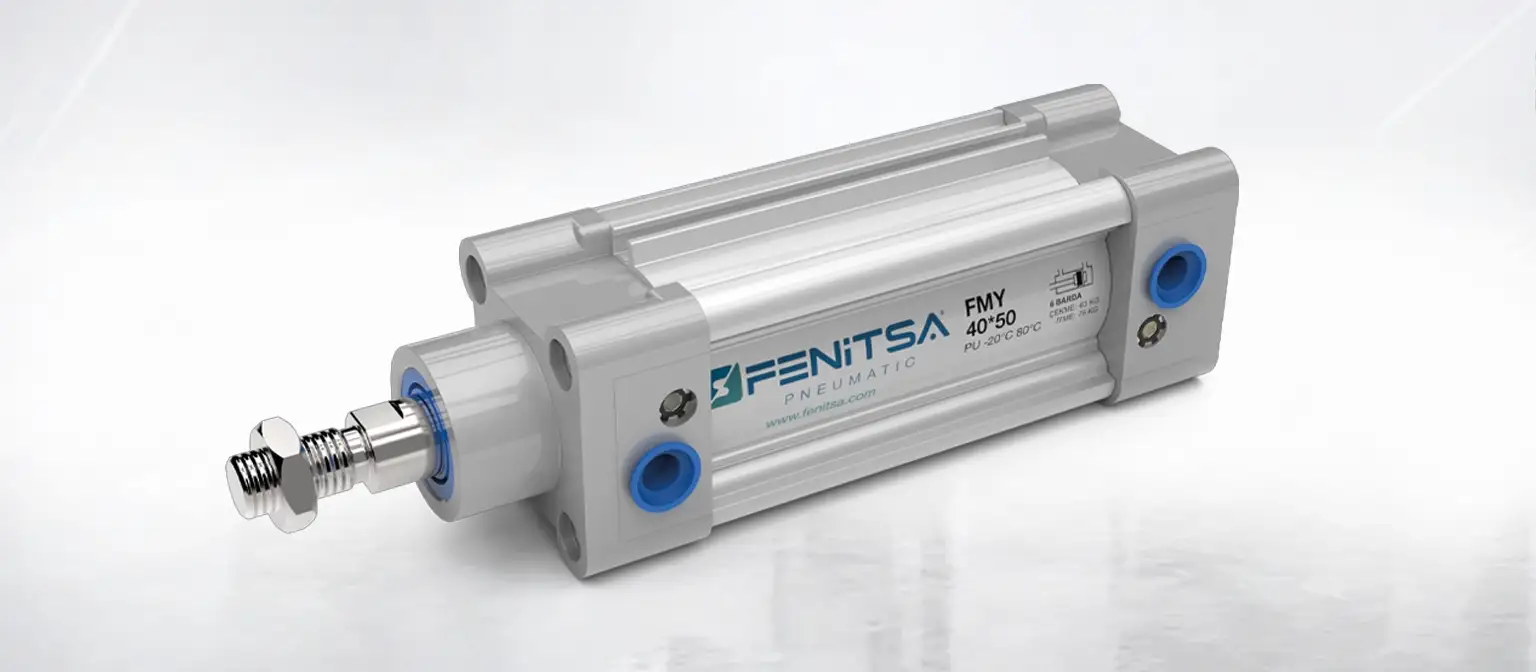
When selecting a pneumatic cylinder, piston diameter, stroke length, and operating pressure are usually the main considerations. However, the pneumatic cylinder rod diameter also has a direct effect on force, mechanical strength, bearing stability, and service life. The piston rod transfers the linear force generated by compressed air to the machine mechanism. Therefore, it should not be considered merely as a connection element. Especially in applications with long strokes, high cycle rates, or exposure to side loads, an incorrectly selected rod diameter may cause bending, vibration, uneven seal wear, and positioning errors.
How Does Rod Diameter Affect Extension and Retraction Force?
During the extension stroke of a double-acting pneumatic cylinder, pressure acts on the entire piston surface. The theoretical extension force depends on the operating pressure multiplied by the piston area. During the retraction stroke, however, the cross-sectional area occupied by the piston rod is subtracted from the total piston area. Therefore, at the same operating pressure, the retraction force is lower than the extension force. As the rod diameter increases, the effective area available for retraction decreases, and the difference between the two forces becomes greater.
The dimensions used in the Fenitsa FMY series clearly demonstrate this relationship. In the model with a Ø32 mm piston diameter, a 12 mm rod is used. At a pressure of 6 bar, the extension force is 48 kg, while the retraction force is 41 kg. The difference is approximately 14.6%. In the Ø40/16 and Ø50/20 combinations, the reduction in retraction force is approximately 16%. This ratio decreases to around 10.2% in the Ø63/20 model, 9.6% in the Ø80/25 model, and 6.4% in the Ø100/25 model. The reason for this variation is the proportion of the rod cross-sectional area relative to the piston area. Fenitsa’s ISO Cylinder FMY Ø32–Ø100 series uses rod diameters ranging from 12 to 25 mm.
For example, in a cylinder with a Ø50 mm piston and a Ø20 mm rod, the rod area corresponds to 16% of the piston area. Therefore, the theoretical retraction force is approximately 16% lower than the extension force. If the machine needs to pull the load during the return stroke, the calculation should not be based solely on extension force.
How Does the Correct Rod Diameter Affect Strength and Service Life?
The pneumatic cylinder rod diameter does not only determine retraction force; it also affects resistance to buckling under compressive loads. When the cylinder pushes a load, the rod is subjected to compression. As the stroke length increases and the rod extends further, the risk of buckling rises. A larger-diameter rod provides greater rigidity and improved resistance to bending. However, simply increasing the rod diameter is not the correct solution for every application. The piston diameter, stroke length, mounting method, load direction, cycle speed, and side forces must be evaluated together.
Side loads place stress on both the piston rod and the guide bushing. If the rod axis and load axis are not aligned, one-sided wear may occur on the sealing surfaces, leading to air leakage and surface damage. In such applications, the cylinder should not be used as a load-bearing slide. It should instead be supported by an external linear slide or guiding system. A thicker rod may provide some additional strength, but it does not eliminate misalignment.
In machines with long strokes, high speeds, or frequent cycling, an appropriate safety margin should be considered when selecting the pneumatic cylinder rod diameter. The Fenitsa FMY series offers custom stroke lengths from 1 to 3000 mm, adjustable cushioning, and various mounting accessories. When determining the correct model, buckling resistance, mounting conditions, and guiding requirements should be evaluated together with extension and retraction forces. A correctly selected pneumatic cylinder rod diameter provides more stable movement, lower maintenance requirements, and a longer service life.

