


CETOP Cylinder Models and Their Industrial Applications
- Home
- CETOP Cylinder Models and Their Industrial Applications
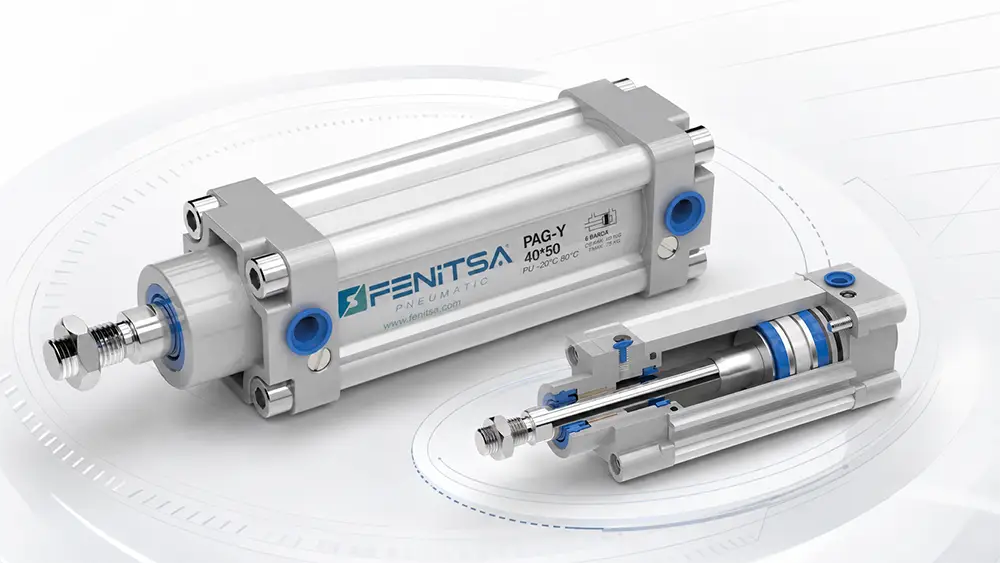
In pneumatic systems, selecting the right cylinder is a critical engineering decision for generating linear motion in a controlled, repeatable, and application-specific manner. Operating pressure, required force, stroke length, cycle frequency, mounting configuration, and available installation space should all be evaluated together. An incorrectly selected cylinder may reduce system efficiency, increase air consumption, or create unnecessary mechanical loads. Fenitsa offers pneumatic cylinder solutions developed for a wide range of industrial machinery and automation requirements, with different configurations designed around standardized dimensions and operating conditions.
A CETOP Cylinder is commonly used in industrial machinery where standardized dimensions, mounting compatibility, and reliable linear motion are required. Cylinders designed according to the CETOP-R58 standard support a more systematic approach to machine design by providing standardized mechanical dimensions and mounting arrangements. This standardization is valuable not only when designing new equipment but also when replacing cylinders or planning maintenance in existing production systems.
Fenitsa PAG and PAGY series are available with Ø32, Ø40, Ø50, Ø63, Ø80, and Ø100 mm bore options. These different bore sizes make it possible to select a cylinder according to the thrust and pulling force required by the application. As the piston diameter increases, the effective piston area also increases, allowing greater force to be generated at the same operating pressure. For this reason, cylinder selection should not be based solely on the available installation space. Load characteristics, operating pressure, required acceleration, and movement direction must also be taken into consideration.
Stroke length is another fundamental parameter in pneumatic cylinder selection. The required stroke is determined according to the total linear travel demanded by the machine, the position of the workpiece, and the geometry of the mechanism. While standard stroke lengths can meet many applications, custom machine designs may require different dimensions. Fenitsa provides solutions that allow the cylinder configuration to be adapted to different stroke requirements and machine layouts.
Different CETOP Cylinder configurations are available for different operating principles. In addition to standard double-acting designs, double-rod, tandem, and two-position tandem options can be used according to the requirements of the machine. Standard double-acting cylinders are suitable for a broad range of automation processes where both extension and retraction movements are controlled by compressed air.
Double-rod designs can be preferred when linear movement is required on both sides of the cylinder or when the mechanical arrangement requires a more symmetrical operating structure. Because the piston rod extends from both sides, certain applications can benefit from improved guidance, balanced effective areas, or specific installation configurations.
Tandem cylinders provide another solution for applications where greater output force is required without significantly increasing the cylinder bore. By combining the effective force generated by multiple piston sections, tandem configurations can deliver higher thrust within a relatively compact installation envelope. They can therefore be considered for pressing, clamping, positioning, forming, and similar industrial operations where increased force is required.
Two-position tandem systems are suitable for specialized machine designs where more than one defined travel position is needed within a single actuator configuration. This allows pneumatic motion to be adapted to production processes requiring intermediate positions or different movement stages.
Selecting the Right CETOP Cylinder for Industrial Systems
The industrial applications of CETOP Cylinder systems are not limited to a single machine type or sector. They can be integrated into packaging machinery, assembly stations, automated production lines, material handling systems, clamping units, pressing mechanisms, lifting and lowering systems, product transfer mechanisms, and custom-built machinery. The decisive factor is not simply the industry in which the cylinder will operate, but the force, stroke, speed, and cycle characteristics required by the specific application.
In a packaging line, for example, the cylinder may be responsible for pushing or separating products at a defined point. In an assembly machine, its primary function may be accurate positioning or clamping. In production equipment, it may be used to move a mechanical component repeatedly between two positions. Although these systems use the same basic pneumatic operating principle, their required bore, stroke, mounting arrangement, and cylinder configuration may differ considerably.
Fenitsa evaluates cylinder selection by considering these parameters together. The relationship between operating pressure and piston diameter is particularly important. The force generated by a pneumatic cylinder depends on the compressed-air pressure acting over the effective piston area. A larger bore can generate greater force at the same pressure, but increasing cylinder size unnecessarily may also increase compressed-air consumption and equipment dimensions.
The difference between extension and retraction forces should also be considered. Because the piston rod occupies part of the effective area on the rod side of the piston, the available retraction force is normally lower than the extension force. This becomes especially important in machines where significant resistance is present during both directions of movement.
End-of-stroke behavior is another important aspect of CETOP Cylinder selection. Depending on the operating conditions, cylinders can be configured with different cushioning arrangements. Adjustable cushioning can help control piston behavior as it approaches the end of the stroke, particularly in applications with high cycle speeds or greater moving masses. Reducing mechanical impact at the end positions can contribute to smoother operation and help limit unnecessary loads on the cylinder and surrounding machine components.
Mounting configuration must also be evaluated as part of the complete machine design. Standardized mounting dimensions simplify mechanical integration and allow designers to work with defined connection geometries. This is one of the main advantages of using cylinders based on established CETOP standards, especially in industrial equipment where interchangeability and maintenance planning are important.
Reliable cylinder operation also depends on the condition of the complete pneumatic system. Air preparation, filtration, pressure regulation, valve sizing, tubing dimensions, and regular maintenance all influence cylinder performance. A cylinder with insufficient bore may fail to generate the required force, while an unnecessarily oversized cylinder may consume more compressed air than necessary and increase system operating costs.
At Fenitsa, cylinder selection is approached by considering bore, stroke, operating pressure, required force, mounting method, cycle frequency, and movement characteristics as a complete system rather than as independent parameters. PAG and PAGY configurations, including standard, double-rod, and tandem designs, provide different engineering options for adapting pneumatic actuation to the specific requirements of industrial machinery.
A correctly configured CETOP Cylinder is therefore more than a component that simply converts compressed air into linear motion. It directly influences motion characteristics, system efficiency, machine reliability, and production continuity. By matching bore diameter, stroke length, force requirements, cushioning characteristics, and cylinder configuration to actual operating conditions, Fenitsa pneumatic solutions can be integrated into industrial systems with a technically appropriate and application-oriented approach.

