

 Türkçe
 Русский
 Español
 العربية
What Is Pneumatics? How a Pneumatic System Works
Pneumatics is the use of compressed air to transmit power and create motion. A compressor stores air under pressure, valves direct it and a pneumatic cylinder turns it into straight-line force.
Pneumatic systems typically work between 1.5 and 10 bar. They are fast, clean and simple, which is why they dominate automation, packaging and assembly lines.
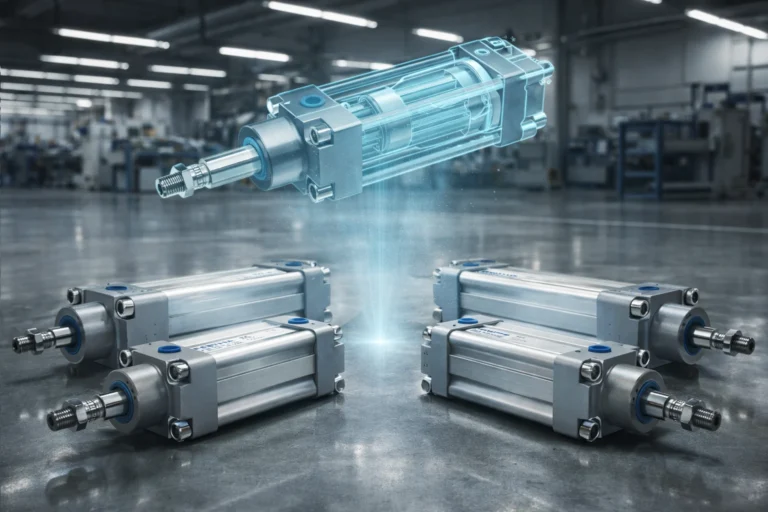
Components of a Pneumatic System
- Compressor — compresses atmospheric air.
- Receiver tank and dryer — store air and remove moisture.
- FRL unit — filter, regulator and lubricator condition the air before the machine.
- Directional valves — 3/2 and 5/2 valves start, stop and reverse the cylinder.
- Flow control valves — set the cylinder speed.
- Pneumatic cylinder — converts air pressure into linear force.
How It Works
Air is compressed, cleaned and dried, then a valve sends it to one side of the cylinder piston. Force equals pressure times piston area: F = p × A. When the valve switches, air enters the other side and the rod returns while the used air is exhausted to atmosphere.
Air consumption matters for compressor sizing. A Ø63 cylinder with a 200 mm stroke at 6 bar uses about 8.2 litres of free air per double stroke.
Pneumatics vs Hydraulics
| Pneumatic | Hydraulic | |
|---|---|---|
| Working pressure | 1.5–10 bar | 160 bar (250 bar option) |
| Ø63 push force | 187 kg at 6 bar | 5.09 t at 160 bar |
| Speed | Fast | Controlled, max. 0.5 m/s |
| Medium | Air, exhausted to atmosphere | Mineral oil in a closed circuit |
| Typical use | Automation, packaging | Presses, mobile and heavy machinery |
At the same bore the hydraulic cylinder pushes about 27 times harder. Choose pneumatics for speed and light loads, hydraulics for force.
Pneumatic Cylinder Types
- Double-acting cylinders — air drives both strokes.
- Single-acting cylinders — air extends, a spring returns.
- ISO 15552 profile cylinders (Ø32–Ø320) — standard mounting dimensions, magnetic piston for sensors.
- Compact cylinders — short body for tight spaces.
- Double-rod and tandem cylinders — tandem doubles the force in the same bore.
Frequently Asked Questions
What does pneumatic mean?
Pneumatic means operated by air. In industry it refers to machines and systems driven by compressed air.
What are the main components of a pneumatic system?
Compressor, receiver tank, dryer, FRL unit, directional and flow control valves, and actuators such as pneumatic cylinders.
What is the difference between pneumatics and hydraulics?
Pneumatics uses compressed air at 1.5–10 bar and is fast and clean; hydraulics uses oil at 160 bar or more and gives far higher force — about 27 times more at the same Ø63 bore.
How much force does a pneumatic cylinder produce?
Force = pressure × piston area. A Ø100 cylinder at 6 bar pushes about 471 kg; a Ø320 pushes 4,823 kg.
Send Us Your Cylinder Data
Bore, rod, stroke, working pressure, mountings and quantity — or a drawing or photo of the cylinder you want to replace. Our engineers reply with a technical proposal and a quotation.
Related Pages
Pneumatic Cylinders
Series Ø32–Ø320
Pneumatic cylinder sizes
Bore and force chart
What is hydraulics?
How hydraulic systems work
Air cylinder calculator
Force at any pressure