

 Türkçe
 Русский
 Español
 العربية
Pneumatic Cylinder Force Calculator
Pneumatic cylinder force is air pressure multiplied by piston area (F = P × A). Enter the bore, rod diameter and supply pressure below to get extend and retract force instantly in newtons, pound-force and kilogram-force. The calculator accepts millimetres or inches and bar, psi or MPa.
Below the calculator you will find a force chart for standard bores from 12 to 320 mm at 6 bar (87 psi) and a worked example.
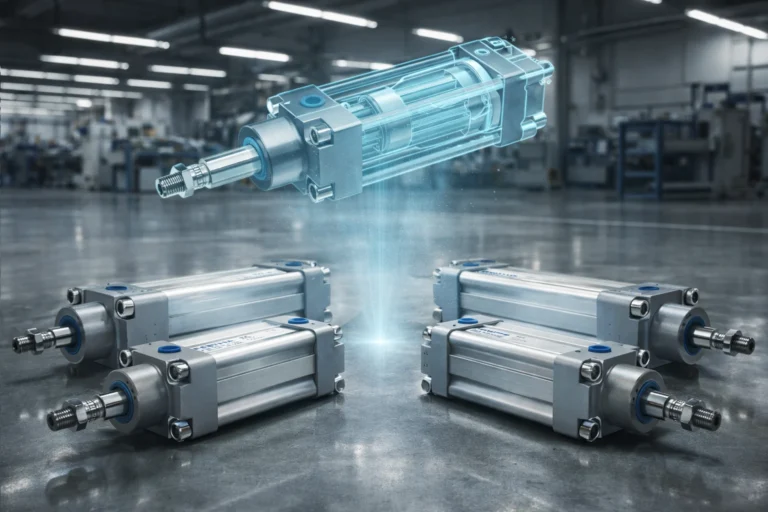
Air Cylinder Force Calculator
Results update as you type.
Pneumatic Cylinder Force Formula
F_extend = P × π × D² / 4F_retract = P × π × (D² − d²) / 4Pneumatic Cylinder Force Chart at 6 bar (87 psi)
Theoretical values for common ISO 15552 / ISO 6432 bore and rod sizes.
| Bore | Rod | Push (N) | Push (lbf) | Pull (N) | Pull (lbf) |
|---|---|---|---|---|---|
| 12 mm (0.47 in) | 6 mm | 68 | 15 | 51 | 11 |
| 16 mm (0.63 in) | 6 mm | 121 | 27 | 104 | 23 |
| 20 mm (0.79 in) | 8 mm | 188 | 42 | 158 | 36 |
| 25 mm (0.98 in) | 10 mm | 295 | 66 | 247 | 56 |
| 32 mm (1.26 in) | 12 mm | 483 | 108 | 415 | 93 |
| 40 mm (1.57 in) | 16 mm | 754 | 170 | 633 | 142 |
| 50 mm (1.97 in) | 20 mm | 1,178 | 265 | 990 | 222 |
| 63 mm (2.48 in) | 20 mm | 1,870 | 420 | 1,682 | 378 |
| 80 mm (3.15 in) | 25 mm | 3,016 | 678 | 2,721 | 612 |
| 100 mm (3.94 in) | 25 mm | 4,712 | 1,059 | 4,418 | 993 |
| 125 mm (4.92 in) | 32 mm | 7,363 | 1,655 | 6,881 | 1,547 |
| 160 mm (6.30 in) | 40 mm | 12,064 | 2,712 | 11,310 | 2,543 |
| 200 mm (7.87 in) | 40 mm | 18,850 | 4,238 | 18,096 | 4,068 |
| 250 mm (9.84 in) | 50 mm | 29,452 | 6,621 | 28,274 | 6,356 |
| 320 mm (12.60 in) | 63 mm | 48,255 | 10,848 | 46,385 | 10,428 |
Air Consumption
A double-acting cylinder consumes roughly 2 × A × stroke × (P + 1.013) / 1.013 of free air per cycle. For a 63 mm bore with a 100 mm stroke at 6 bar this is about 4.3 normal litres per cycle, or 43 Nl/min at 10 cycles per minute. Add 20–30% for line losses when sizing the compressor.
Choosing a Cylinder by Force
- Safety marginAdd 25% for horizontal and 50% for vertical loads.
- Real supply pressureUse the pressure at the cylinder port, not the compressor setting; regulators and hoses can cost 0.5–1 bar.
- Stroke and bucklingLong push strokes need the rod checked for buckling or a guided cylinder.
- CushioningFast, heavy moves need adjustable cushioning or external shock absorbers.
A Pneumatic Cylinder for Your Force
Share force, stroke and mounting; we will supply an ISO 15552, compact or custom air cylinder.
Pneumatic Force FAQ
How do you calculate pneumatic cylinder force?
Push force F = P × A, where A = π × D² / 4. In metric units, bar × 0.1 gives N/mm²; in US units, psi × in² gives lbf. A 63 mm (2.48 in) bore at 6 bar (87 psi) produces about 1,870 N (420 lbf) of theoretical push force.
Why is pull force lower than push force?
On the return stroke the air acts on the annulus around the rod, so the rod area is lost: F = P × π × (D² − d²) / 4.
How much force does an air cylinder produce at 80 psi?
Multiply the piston area in square inches by 80. A 2 in bore (3.14 in²) gives about 251 lbf, a 3 in bore (7.07 in²) about 565 lbf and a 4 in bore (12.57 in²) about 1,005 lbf, before friction losses.
What efficiency should I use?
For moving loads use 85–90% of theoretical force and then add a safety margin of 25% for horizontal and 50% for vertical lifting applications.
Which pneumatic cylinder should I choose?
Pick the next standard bore above the required force. ISO 15552 cylinders cover 32–320 mm bores; compact and mini cylinders suit tight spaces. See our pneumatic cylinders.