

 Türkçe
 Русский
 Español
 العربية
Pneumatic Cylinder Sizes: Bore, Rod and Force Chart
Pneumatic cylinders are sized by bore. The ISO 15552 range runs Ø32, 40, 50, 63, 80, 100, 125, 160, 200, 250 and 320 mm, each with a fixed rod diameter and mounting dimensions, so cylinders from different makers are interchangeable.
The chart below gives each bore with its inch equivalent, rod size and catalogue force at 6 bar.
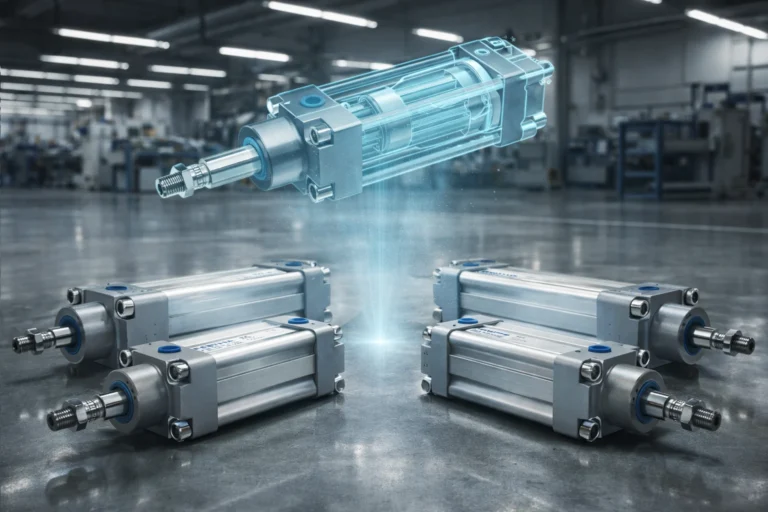
Bore Size Chart
| Bore (mm) | Bore (in) | Rod (mm) | Push (kg) | Pull (kg) |
|---|---|---|---|---|
| Ø32 | 1.26 | Ø12 | 48 | 41 |
| Ø40 | 1.57 | Ø16 | 75 | 63 |
| Ø50 | 1.97 | Ø20 | 118 | 99 |
| Ø63 | 2.48 | Ø20 | 187 | 168 |
| Ø80 | 3.15 | Ø25 | 301 | 272 |
| Ø100 | 3.94 | Ø25 | 471 | 441 |
| Ø125 | 4.92 | Ø32 | 735 | 688 |
| Ø160 | 6.30 | Ø40 | 1,206 | 1,111 |
| Ø200 | 7.87 | Ø40 | 1,884 | 1,789 |
| Ø250 | 9.84 | Ø50 | 2,944 | 2,827 |
| Ø320 | 12.60 | Ø63 | 4,823 | 4,638 |
Ø160 and Ø200 pull forces are given as printed in the catalogue.
Standard Strokes
Standard strokes are 50, 100, 125, 160, 200, 250, 300, 350, 400, 450 and 500 mm; any other stroke is made on request, up to 3,000 mm for Ø32–Ø100 and 2,800 mm for Ø125–Ø320.
Mountings
- Front or rear flange
- Foot mounting
- Rear clevis and rear hinge
- Centre or front trunnion
- Rod-end clevis and rod-end spherical eye
How to Identify an Unknown Cylinder
Measure the tube outside and the rod diameter, then the distance between the mounting holes or the square profile width. Compare these with the chart: the rod diameter alone usually narrows the bore to one or two sizes.
Frequently Asked Questions
What are the standard ISO 15552 bore sizes?
Ø32, 40, 50, 63, 80, 100, 125, 160, 200, 250 and 320 mm.
How do I measure a pneumatic cylinder?
Measure the rod diameter, the profile width and the mounting dimensions, then match them to the bore chart. The stroke is the distance the rod travels.
What size air cylinder do I need?
Divide the load by the force per bore at your pressure and add a safety margin of about 30–50 %. For example, a Ø63 pushes 187 kg at 6 bar.
Can you make non-standard sizes?
Yes — any stroke on request, plus double-rod, tandem and special cylinders.
Send Us Your Cylinder Data
Bore, rod, stroke, working pressure, mountings and quantity — or a drawing or photo of the cylinder you want to replace. Our engineers reply with a technical proposal and a quotation.
Related Pages
Pneumatic Cylinders
All series
What is pneumatics?
How compressed-air systems work
Air cylinder calculator
Force at any pressure
Hydraulic cylinder sizes
Hydraulic bore chart