

 Türkçe
 Русский
 Español
 العربية
Tractor Hydraulic Cylinders: Loader, Linkage and Steering
Tractor hydraulics drive the front loader, the three-point linkage, the steering and every implement connected to the remote valves. Most of these cylinders work at the tractor's own pump pressure.
Fenitsa makes tractor cylinders from Ø40 to Ø100 to drawing or sample, as replacements or for implement builders.
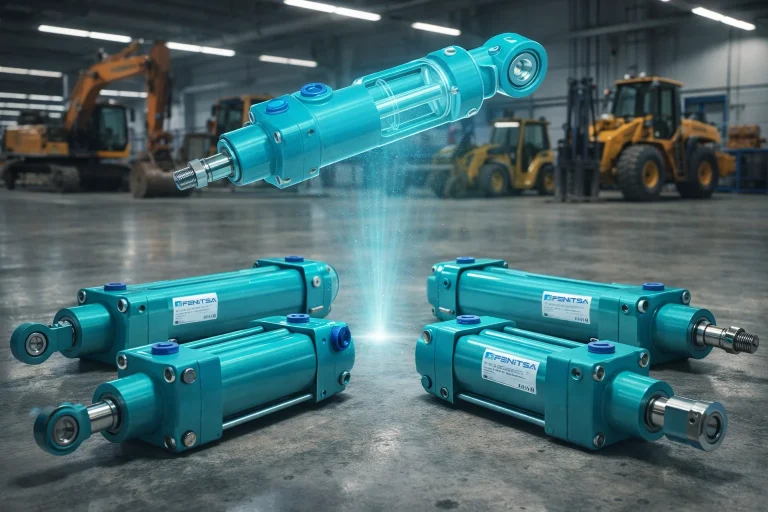
Typical Cylinder Functions
- Front loader — boom and bucket cylinders.
- Hydraulic top link — adjusts implement angle from the cab.
- Steering cylinder — often double-rod for equal speed both ways.
- Implements — ploughs, trailers, mowers and balers.
Force Table
Fenitsa FDH bores; pull force with the smaller standard rod.
| Bore | Rod | Push 160 bar (t) | Pull 160 bar (t) | Push 250 bar (t) |
|---|---|---|---|---|
| Ø40 | Ø25 | 2.1 | 1.2 | 3.2 |
| Ø50 | Ø28 | 3.2 | 2.2 | 5.0 |
| Ø63 | Ø36 | 5.1 | 3.4 | 7.9 |
| Ø80 | Ø45 | 8.2 | 5.6 | 12.8 |
| Ø100 | Ø56 | 12.8 | 8.8 | 20.0 |
Design Requirements
- Clevis and spherical-eye ends for articulated mounting.
- Wipers that keep out field dust and mud.
- Chrome rod against corrosion when stored outdoors.
- Port sizes and threads matching the tractor couplers.
Worked Example
For a push load of 4 t with a 25 % reserve, a Ø63 mm cylinder at 160 bar gives 5.1 t. With a 30 L/min pump it moves at about 160 mm/s and covers a 300 mm stroke in 1.9 s.
Frequently Asked Questions
What pressure do tractor cylinders work at?
They work at the tractor pump pressure; Fenitsa FDH cylinders are rated for 160 bar working pressure with a 250 bar option.
Why is the steering cylinder double-rod?
A double-rod cylinder has the same area on both sides, so the steering moves at the same speed and force left and right.
Can I order a single replacement cylinder?
Yes. Send the bore, rod, stroke, closed length and mounting type.
How much force does a Ø63 hydraulic cylinder produce?
At 160 bar a Ø63 mm cylinder pushes 5.1 t. Force = pressure × piston area; the pull force is lower because the rod reduces the area.
Send Us Your Cylinder Data
Bore, rod, stroke, working pressure, mountings and quantity — or a drawing or photo of the cylinder you want to replace. Our engineers reply with a technical proposal and a quotation.
Related Pages
Hydraulic Cylinders
FDH, Rotlu, KHS, THS
5-ton hydraulic cylinder
Bore and force by tonnage
Force Calculator
Bore, pressure and force
Pull-Type Hydraulic Cylinders
Another application
Cylinder sizing guide
Bore, rod and stroke