

 Türkçe
 Русский
 Español
 العربية
Compact Pneumatic Cylinders: Short Body, Full Force
A compact pneumatic cylinder has a much shorter body than an ISO 15552 profile cylinder of the same bore, so it fits in tight stations, around robots and in fixtures — with the same force per bore.
Fenitsa offers two compact series: FNC (non-magnetic) and FMC (magnetic piston for position sensors).
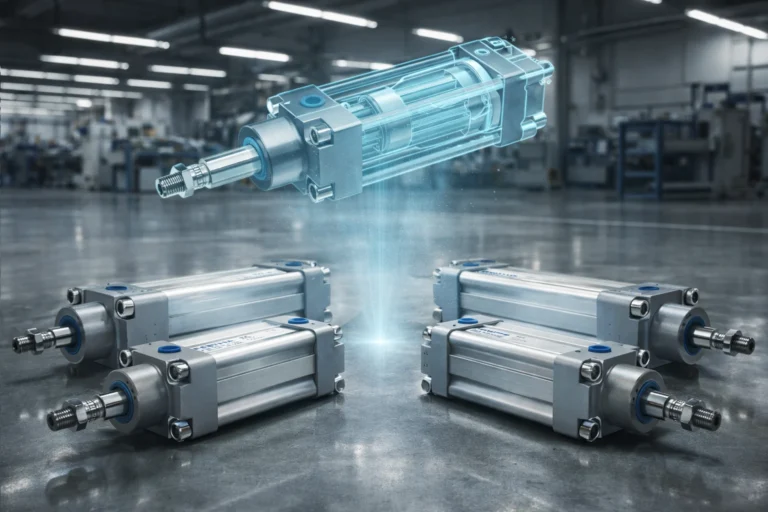
Where Compact Cylinders Fit
- Clamping and fixturing with short strokes.
- Robot grippers and end-of-arm tooling.
- Stops and lifters inside conveyors.
- Retrofits where the installed length is limited.
Compact vs ISO 15552 Profile
Qualitative comparison.
| Compact (FNC / FMC) | ISO 15552 profile (FMY) | |
|---|---|---|
| Body length | Very short | Standard |
| Magnetic piston | FMC yes, FNC no | Yes |
| Cushioning | Fixed / none | Adjustable |
| Typical stroke | Short | Short to long |
Selection Tips
- Choose FMC when you need end-position sensing.
- Keep strokes short — a compact body gives the rod less guidance.
- Check force with the bore table: compact and profile cylinders of the same bore give the same force.
Frequently Asked Questions
What is the difference between FNC and FMC?
FMC has a magnetic piston for reed or magnetic sensors; FNC is the non-magnetic version.
Is a compact cylinder weaker?
No. Force depends on bore and pressure, not on body length.
When should I use an ISO 15552 cylinder instead?
For longer strokes, adjustable cushioning or when interchangeable ISO mounting dimensions are required.
Send Us Your Cylinder Data
Bore, rod, stroke, working pressure, mountings and quantity — or a drawing or photo of the cylinder you want to replace. Our engineers reply with a technical proposal and a quotation.
Related Pages
Pneumatic cylinder sizes
All bores
Air cylinder calculator
Force at any pressure
63 mm pneumatic cylinder
The most used bore
Aluminium Pneumatic Cylinders
Another type