


How Do You Select the Right Hydraulic Cylinder for Your Machine?
- Home
- How Do You Select the Right Hydraulic Cylinder for Your Machine?
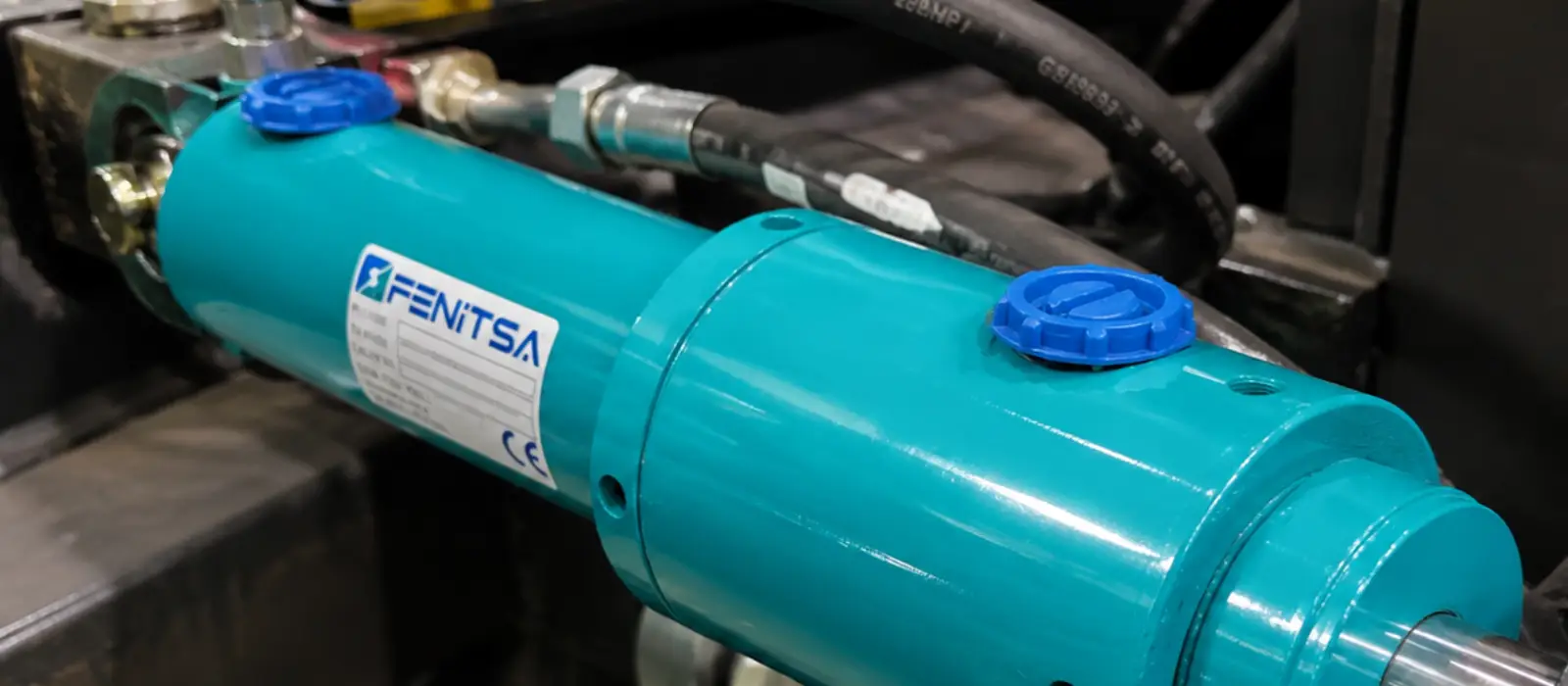
A machine’s ability to perform lifting, pushing, pulling, clamping or positioning operations safely depends on the correct selection of the components used in its motion system. A hydraulic cylinder, one of the key components in this system, converts hydraulic energy into controlled linear motion. However, selecting a cylinder based only on its external dimensions is not sufficient. The load to be moved, operating pressure, stroke length, required speed, mounting arrangement and environmental conditions must all be evaluated together.
Incorrect hydraulic cylinder selection can lead to insufficient force, unstable movement, piston rod bending, oil leakage, premature wear at mounting points and unplanned machine downtime. In addition to standard product options, Fenitsa offers custom solutions designed according to the technical requirements of each machine. For this reason, the selection process should begin with a clear definition of the task the cylinder is expected to perform.
How Should the Machine’s Operating Conditions and Technical Requirements Be Determined?
The first step is to identify the exact function of the cylinder. While clamping force is the primary consideration in a press system, lifting equipment requires careful evaluation of the load weight, direction of movement and safe load-holding requirements. Agricultural machinery, mobile equipment and production lines may also operate under different conditions involving vibration, impact, dust, moisture or variable loads. Therefore, hydraulic cylinder selection should be based not only on the nominal load but also on the machine’s actual operating cycle.
The weight of the load to be moved determines the required pushing or pulling force. Calculations should consider not only the static load but also friction, inclination, losses caused by mechanical linkages and additional resistance during the initial movement. Selecting a cylinder without an adequate safety margin may cause it to operate continuously near its maximum limits and significantly reduce its service life. During a project evaluation with Fenitsa, the load value in kilograms or tonnes, the direction of movement and any variable load range should be provided.
Stroke length refers to the effective distance that the piston rod must travel. A stroke that is too short will prevent the machine from completing its intended movement, while an unnecessarily long stroke may increase installation space, raise costs and create a greater risk of piston rod buckling. The retracted and extended lengths of the cylinder should therefore be checked against the available installation space on the machine. The required movement time, number of cycles per minute and load whether the system operates intermittently or continuously should also be specified.
Operating pressure is another fundamental selection criterion. The system’s normal operating pressure, maximum possible pressure and potential pressure spikes must be known. It is also necessary to determine whether the application requires a single-acting or double-acting cylinder. In single-acting systems, hydraulic pressure produces movement in one direction, while the return stroke is achieved by a spring or an external force. In double-acting systems, hydraulic pressure controls movement in both directions. By reviewing the available hydraulic cylinders, the most suitable product group can be evaluated for standard, heavy-duty, welded, telescopic or custom-motion applications.
How Should Cylinder Dimensions, Materials and Mounting Types Be Selected?
Once the required force and operating pressure have been established, the cylinder bore diameter can be calculated. As the bore diameter increases, the theoretical force generated at the same pressure also increases. However, a larger bore is not always the best solution because oil demand, movement speed, pump capacity, installation space and overall cost will also increase. For balanced hydraulic cylinder selection, bore size, pressure and flow rate must be evaluated together.
Piston rod diameter is particularly important in long-stroke applications and in cylinders operating primarily under compressive loads. A rod that is too thin or too long may buckle under axial force. In systems exposed to side loads, the external guiding arrangement should also be evaluated separately. A cylinder should not be used as a guide element to compensate for mechanical misalignment within the machine. During Fenitsa’s technical assessment, information such as stroke length, load direction, mounting points and operating angle helps determine the appropriate piston rod diameter.
The mounting type determines how the generated force is transferred to the machine frame. Foot-mounted cylinders may be suitable for fixed and linear applications, while articulated or clevis-type mountings can accommodate angular movement during operation. Flange and trunnion mountings may be preferred depending on the machine design, load direction and servicing requirements. An unsuitable mounting method can introduce side loads onto the piston rod and cause premature wear of the seals and bearing components.
The operating environment also determines the selection of materials and sealing elements. High or low temperatures, outdoor operation, humidity, chemical exposure, heavy dust and abrasive particles should be specified in advance. The piston rod surface, cylinder tube, seals and protective components must be evaluated according to these conditions. Particularly in heavy-duty applications, attention should be given not only to the initial investment cost but also to maintenance accessibility, spare-part availability and expected service life. This approach supports more reliable long-term hydraulic cylinder selection.
How Can Cylinder Selection Be Verified Through Hydraulic Calculations?
Collecting technical information is the foundation of the selection process, but the cylinder dimensions and system capacity must also be verified through engineering calculations. The hydraulic force calculation tool can first be used to estimate the theoretical force required to move the load. By checking the relationship between system pressure and bore diameter, it is possible to determine whether the cylinder can generate the required pushing or pulling force.
The amount of hydraulic oil that must be supplied to the cylinder should also be determined so that the required movement can be completed within the specified time. The hydraulic flow rate calculation page helps evaluate the necessary flow based on cylinder volume and movement time. Insufficient flow will cause the machine to operate too slowly, while excessive flow may result in control problems, overheating and energy losses.
The capacity of the pump and drive system can be checked using the hydraulic motor power calculation tool. Determining the power requirement based on pressure and flow rate makes it easier to evaluate whether the motor is suitable for the system’s operating conditions. The hydraulic cylinder piston calculation page can be used to compare the cylinder’s main dimensional parameters. The hydraulic pipe diameter calculation tool can also be used to assess flow velocity and determine an appropriate pipe diameter for the hydraulic line.
These tools are useful for preliminary sizing and comparing different alternatives. However, the final decision should be made by evaluating the machine’s dynamic loads, safety factors, pressure losses, mounting geometry and operating environment together. Fenitsa supports the evaluation of standard and custom-manufactured options based on technical drawings, existing samples or project data. In this way, hydraulic cylinder selection is based not only on theoretical dimensions but also on real operating conditions.
When requesting a quotation or technical evaluation, information such as the load, operating pressure, stroke length, bore and piston rod diameters, retracted and extended lengths, mounting type, movement speed, operating frequency, ambient temperature and application area should be provided. Technical drawings, photographs or the identification plate of an existing cylinder can also help accelerate the process. By providing Fenitsa with accurate technical information, you can identify a solution that fits your machine, operates safely and reduces maintenance requirements. Correctly planned hydraulic cylinder selection directly supports machine performance, reliability and operational continuity.

