

 Türkçe
 Русский
 Español
 العربية
Food Grade Pneumatic Cylinders for Food Processing Lines
Food and beverage plants run on compressed air: pneumatic cylinders sort, push, cut, dose and close packages all day long. But a cylinder near food must also meet hygiene requirements — it will be washed down, it must not shed lubricant or particles, and its surfaces must not trap dirt.
This page explains what to specify for “food grade” pneumatic cylinders and how Fenitsa’s ISO 15552 and CETOP cylinders can be adapted for your line.
Hygiene Zones: Where Is the Cylinder?
The requirement depends on how close the cylinder is to the product.
| Zone | Contact with food | What to specify |
|---|---|---|
| Food zone | Direct or likely contact | Food-contact-compliant materials, hygienic design, cleanable surfaces |
| Splash zone | Possible splash or drip back to product | Wash-down resistance, corrosion-resistant surfaces, food-compatible lubricant |
| Non-food zone | None | Standard industrial cylinders |
What “Food Grade” Usually Means for a Cylinder
- LubricantGrease registered for incidental food contact (for example NSF H1) where the cylinder is in the food or splash zone.
- Materials and surfacesCorrosion-resistant body and rod surfaces that withstand cleaning agents, with no crevices that trap product.
- Wash-downSeals and wipers that keep water and cleaning agents out under high-pressure washing.
- Exhaust airFiltered or ducted exhaust so oil mist does not reach the product.
- DocumentationMaterial and lubricant declarations your quality system requires.
Tell us the zone, cleaning method and chemicals when you request a quotation; material, seal and lubricant options are then confirmed in the technical offer for your line.
Stainless Steel Pneumatic Cylinders for Food and Beverage Lines
In wash-down and splash zones, painted steel or bare aluminium surfaces can corrode or hold residue. For these positions Fenitsa supplies stainless steel pneumatic cylinders, with seals and lubricant chosen for your cleaning method. Typical tasks on food and beverage lines are filling, sorting, conveying, capping, sealing and packaging.
When you request a quotation, tell us the hygiene zone (food, splash or non-food), the cleaning agents and wash pressure, the cycle rate and the motion required. The stainless version, seal compound and lubricant are then confirmed in our technical offer, so the cylinder is specified for the line rather than chosen from a generic list.
Which Fenitsa Series Fit Food Lines?
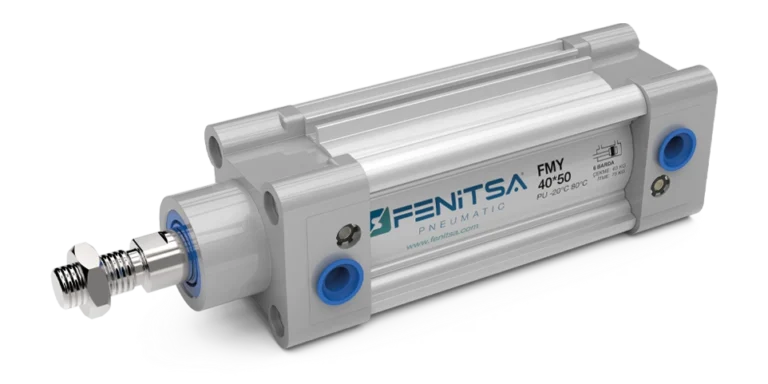
The ISO 15552 FMY series (Ø32–Ø100 mm, magnetic piston for position sensors) is the usual choice for non-food and splash-zone positions because ISO mountings make cylinders easy to swap during maintenance. For special strokes, double-rod or tandem motions see custom pneumatic cylinders.
Typical food-line motions — pushers, diverters, gates, cutters — need small bores at high cycle rates. A Ø40 mm cylinder at 6 bar pushes about 754 N, plenty for diverting cartons or trays.
Which Fenitsa Cylinder Fits Which Function?
| Function | Series | Why |
|---|---|---|
| Non-food zone motions | FMY (ISO 15552) / PAG (CETOP, aluminium) | Standard ISO or economical CETOP cylinders |
| Splash zone | PNS (CETOP, steel) / Custom pneumatic | Robust body; seals and lubricant specified for wash-down |
| Special motions | Custom pneumatic | Double-rod, tandem or adjustable-stroke designs |
Inspection Routine
What to check, and how often, in this application.
- Every cleaning cycleCheck that wipers and rod surfaces are intact after wash-down.
- WeeklyListen for air leaks and check cushioning adjustment.
- MonthlyVerify sensor positions and exhaust filters.
- YearlyReplace seals on high-cycle cylinders in splash zones.
Pneumatic Cylinders for Food Processing Lines – FAQ
What is a food grade pneumatic cylinder?
A pneumatic cylinder whose materials, surfaces, lubricant and seals are suitable for use in or near food production — cleanable, corrosion-resistant and lubricated with food-compatible grease.
Is NSF H1 grease required?
Where incidental food contact is possible (food and splash zones), food-compatible grease such as NSF H1-registered lubricant is the usual requirement.
Can pneumatic cylinders withstand wash-down?
Yes, when seals, wipers and surfaces are chosen for the cleaning method and chemicals — specify them in your enquiry.
Which bore do I need for a food-line pusher?
Usually Ø32–Ø50 mm; calculate the force with our pneumatic cylinder force calculator and allow 1.5–2 × for dynamic motion.
Send Your Application Data
Bore, rod, stroke, pressure, mountings and quantity — or a drawing or photo of the existing cylinder. We reply with a technical proposal and quotation from our plant.