

 Türkçe
 Русский
 Español
 العربية
Forklift Hydraulic Cylinders: Lift, Tilt and Side Shift
A forklift uses three groups of hydraulic cylinders: lift cylinders that raise the mast, tilt cylinders that angle the mast forward and back, and side-shift cylinders that move the forks sideways.
Fenitsa builds replacement and OEM forklift cylinders to drawing or sample, from Ø40 to Ø100 for typical lift trucks.
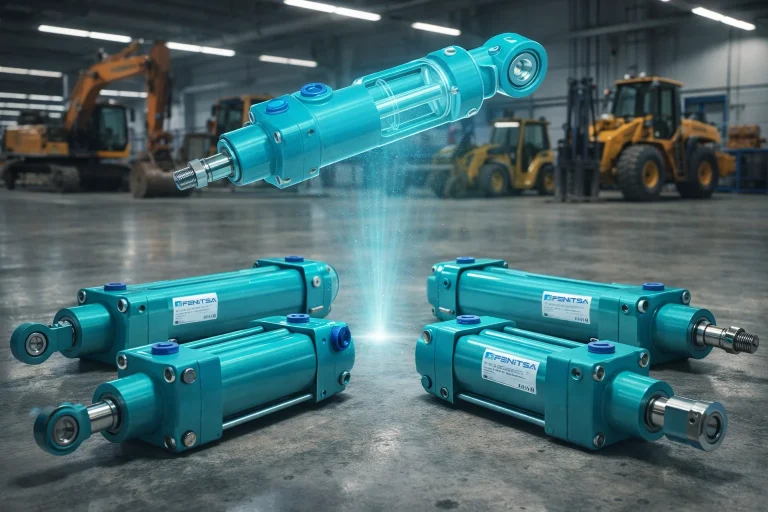
Typical Cylinder Functions
- Lift cylinders — raise the mast and carriage; often single-acting, lowered by the load's own weight.
- Tilt cylinders — double-acting pair that tilts the mast; must hold the load without drifting.
- Side-shift cylinder — short-stroke, compact cylinder on the carriage.
- Attachments — clamps, rotators and push-pull units.
Force Table
Fenitsa FDH bores; pull force with the smaller standard rod.
| Bore | Rod | Push 160 bar (t) | Pull 160 bar (t) | Push 250 bar (t) |
|---|---|---|---|---|
| Ø40 | Ø25 | 2.1 | 1.2 | 3.2 |
| Ø50 | Ø28 | 3.2 | 2.2 | 5.0 |
| Ø63 | Ø36 | 5.1 | 3.4 | 7.9 |
| Ø80 | Ø45 | 8.2 | 5.6 | 12.8 |
| Ø100 | Ø56 | 12.8 | 8.8 | 20.0 |
Design Requirements
- Low internal leakage so the load does not creep down.
- Hard-chrome rod (≥ 20 µm) against wear from frequent cycles.
- Clevis or spherical-eye mountings to absorb mast movement.
- Exact mounting dimensions for direct replacement.
Worked Example
For a push load of 3 t with a 25 % reserve, a Ø63 mm cylinder at 160 bar gives 5.1 t. With a 20 L/min pump it moves at about 107 mm/s and covers a 1,500 mm stroke in 14.0 s.
Frequently Asked Questions
Are forklift lift cylinders single-acting?
Lift cylinders are often single-acting: oil pressure raises the mast and the load lowers it. Tilt cylinders are double-acting.
Why does a forklift mast drift down?
Usually internal leakage in the lift or tilt cylinder seals or a leaking valve. A seal kit or replacement cylinder solves it.
Can you make a replacement forklift cylinder?
Yes. Send a drawing, a photo with the main dimensions, or the old cylinder data: bore, rod, stroke and mountings.
How much force does a Ø63 hydraulic cylinder produce?
At 160 bar a Ø63 mm cylinder pushes 5.1 t. Force = pressure × piston area; the pull force is lower because the rod reduces the area.
Send Us Your Cylinder Data
Bore, rod, stroke, working pressure, mountings and quantity — or a drawing or photo of the cylinder you want to replace. Our engineers reply with a technical proposal and a quotation.
Related Pages
Hydraulic Cylinders
FDH, Rotlu, KHS, THS
5-ton hydraulic cylinder
Bore and force by tonnage
Force Calculator
Bore, pressure and force
Crane Hydraulic Cylinders
Another application
Cylinder sizing guide
Bore, rod and stroke