

 Türkçe
 Русский
 Español
 العربية
Crane Hydraulic Cylinders: Boom, Luffing and Outrigger
On a crane the hydraulic cylinders do the heavy lifting: luffing cylinders raise the boom, extension cylinders telescope it, and outrigger cylinders level and stabilise the machine.
Fenitsa produces crane cylinders from Ø63 to Ø200, with 160 bar standard and 250 bar optional working pressure.
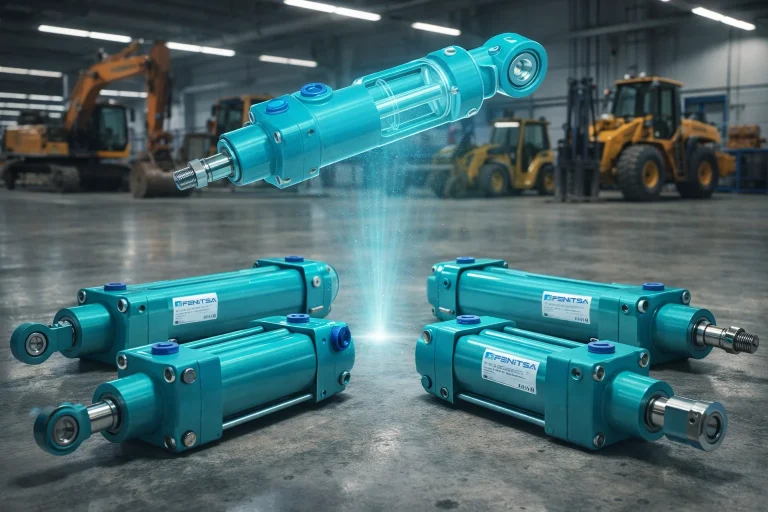
Typical Cylinder Functions
- Luffing (boom lift) cylinder — the most loaded cylinder; usually pivot-mounted at both ends.
- Telescoping cylinders — long-stroke cylinders inside the boom.
- Knuckle and jib cylinders — on knuckle-boom (loader) cranes.
- Outrigger cylinders — vertical jacks that hold the whole machine.
Force Table
Fenitsa FDH bores; pull force with the smaller standard rod.
| Bore | Rod | Push 160 bar (t) | Pull 160 bar (t) | Push 250 bar (t) |
|---|---|---|---|---|
| Ø63 | Ø36 | 5.1 | 3.4 | 7.9 |
| Ø80 | Ø45 | 8.2 | 5.6 | 12.8 |
| Ø100 | Ø56 | 12.8 | 8.8 | 20.0 |
| Ø125 | Ø70 | 20.0 | 13.7 | 31.3 |
| Ø160 | Ø90 | 32.8 | 22.4 | 51.3 |
Design Requirements
- Holding the load safely: load-holding valves on the cylinder ports.
- Rod diameter chosen for buckling on long strokes.
- Spherical bearings to tolerate misalignment.
- Corrosion protection for outdoor use.
Worked Example
For a push load of 10 t with a 25 % reserve, a Ø100 mm cylinder at 160 bar gives 12.8 t. With a 40 L/min pump it moves at about 85 mm/s and covers a 1,000 mm stroke in 11.8 s.
Frequently Asked Questions
Which cylinder on a crane carries the most load?
The luffing (boom lift) cylinder. It is sized for the maximum load moment and checked for buckling.
Why are crane outrigger cylinders critical?
They carry the machine and the load; any internal leakage lets the crane lose level. They are usually fitted with load-holding valves.
Can you build crane cylinders to drawing?
Yes, to drawing or to a sample, with the mountings and port positions of the original.
How much force does a Ø100 hydraulic cylinder produce?
At 160 bar a Ø100 mm cylinder pushes 12.8 t. Force = pressure × piston area; the pull force is lower because the rod reduces the area.
Send Us Your Cylinder Data
Bore, rod, stroke, working pressure, mountings and quantity — or a drawing or photo of the cylinder you want to replace. Our engineers reply with a technical proposal and a quotation.
Related Pages
Hydraulic Cylinders
FDH, Rotlu, KHS, THS
10-ton hydraulic cylinder
Bore and force by tonnage
Force Calculator
Bore, pressure and force
Tractor Hydraulic Cylinders
Another application
Cylinder sizing guide
Bore, rod and stroke