

 Türkçe
 Русский
 Español
 العربية
10 Ton Hydraulic Cylinder
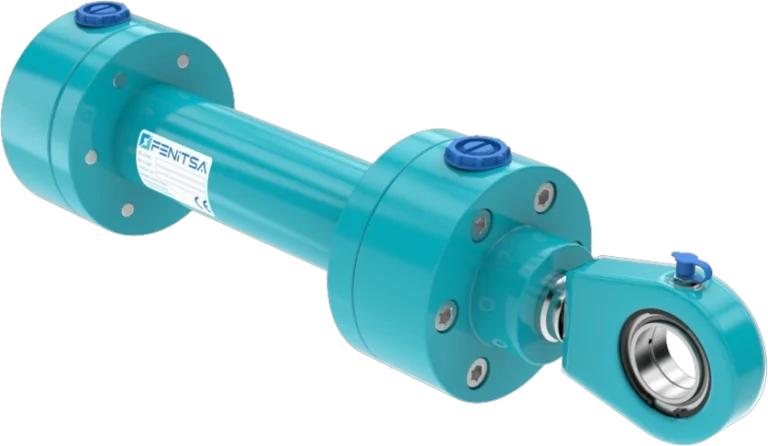
A 10 ton hydraulic cylinder needs a bore of at least 88.3 mm at 160 bar, so the standard size is Ø100 mm, which pushes 12.8 tonnes. With the 250 bar option a Ø80 mm bore is enough and gives the same 12.8 t. Both results follow from D = √(4F / πp).
Fenitsa makes them in the standard FDH series of hydraulic cylinders (hydraulic rams, in British usage). Below: bore by pressure, pull per rod, flow, buckling, and the 700 bar jack difference.
What Bore Does a 10 Ton Cylinder Need?
A = F / (0.1 × p)D = √(4 × A / π)On a 250 bar unit the bore drops to 70.7 mm, and Ø80 mm gives the same force from a lighter cylinder with 36 % less oil per stroke. The circuit must then be rated for 250 bar and the cylinder ordered with that option (standard: 160 bar working, 240 bar test).
Bore vs Pressure Table for 10 Tons
100, 160, 210 and 250 bar; metric tonnes and US tons (1 US ton = 0.907 t).
| Pressure | Target | Calculated bore | Standard bore | Force of the standard bore | Reserve |
|---|---|---|---|---|---|
| 100 bar | 10 t | Ø111.7 mm | Ø125 mm | 12.5 t | +25.1 % |
| 100 bar | 10 US tons | Ø106.4 mm | Ø125 mm | 13.8 US tons | +37.9 % |
| 160 bar | 10 t | Ø88.3 mm | Ø100 mm | 12.8 t | +28.1 % |
| 160 bar | 10 US tons | Ø84.1 mm | Ø100 mm | 14.1 US tons | +41.3 % |
| 210 bar (reference only) | 10 t | Ø77.1 mm | Ø80 mm | 10.8 t | +7.6 % |
| 210 bar (reference only) | 10 US tons | Ø73.4 mm | Ø80 mm | 11.9 US tons | +18.7 % |
| 250 bar | 10 t | Ø70.7 mm | Ø80 mm | 12.8 t | +28.1 % |
| 250 bar | 10 US tons | Ø67.3 mm | Ø80 mm | 14.1 US tons | +41.3 % |
A US “10 ton” load is 9 % lighter, so the same Ø100 mm cylinder has a 41 % reserve. The 210 bar rows are a reference only — Fenitsa rates cylinders at 160 bar, or 250 bar as an option. Every bore is in the hydraulic cylinder sizes chart.
Push vs Pull at 10 Tons
| Bore / rod | Pressure | Push (t) | Pull (t) | Pull (US tons) | Area ratio φ |
|---|---|---|---|---|---|
| Ø100 / Ø56 mm | 160 bar | 12.8 | 8.8 | 9.7 | 1.46 |
| Ø100 / Ø70 mm | 160 bar | 12.8 | 6.5 | 7.2 | 1.96 |
| Ø80 / Ø45 mm | 250 bar | 12.8 | 8.8 | 9.7 | 1.46 |
| Ø80 / Ø56 mm | 250 bar | 12.8 | 6.5 | 7.2 | 1.96 |
Pull acts on the ring around the rod, so it is always lower than push. The Ø70 mm rod pulls less than the Ø56 mm one but is 2.4 times stiffer in buckling. To pull a full 10 t — a puller, or a clamp that opens under load — use Ø125 / Ø70 mm (13.7 t at 160 bar) or Ø100 / Ø56 mm with the 250 bar option (13.7 t).
Stroke, Speed and Flow
Pump flow sets the speed: Q = A × v. The table assumes Ø100 / Ø56 mm and a 500 mm stroke, the longest standard step; strokes up to 5,000 mm are built.
| Rod speed | Extend flow (L/min) | Retract flow (L/min) | Power (kW) | Time for 500 mm (s) |
|---|---|---|---|---|
| 0.05 m/s | 23.6 | 16.2 | 6.3 | 10.0 |
| 0.10 m/s | 47.1 | 32.3 | 12.6 | 5.0 |
| 0.20 m/s | 94.2 | 64.7 | 25.1 | 2.5 |
Stepping up to Ø125 mm “to be safe” costs 56 % more flow for the same speed — a bigger pump for no gain. Piston speed is limited to 0.5 m/s.
Buckling Check for Long Strokes
Pushing at full extension, the rod is a column with Euler load Fk = π² × E × I / Lk² (E = 210,000 N/mm²); a safety factor of 3.5 is common practice. Example: a lifting-table cylinder with rear clevis and rod eye (mounting factor 1), free length = 2 × stroke + an assumed 300 mm dead length.
| Stroke | Free length (mm) | Ø56 rod (t) | Ø70 rod (t) | Result for 10 t |
|---|---|---|---|---|
| 400 mm | 1,100 | 24.1 | 58.8 | Ø56 rod is enough |
| 800 mm | 1,900 | 8.1 | 19.7 | Needs the Ø70 rod |
| 1,200 mm | 2,700 | 4.0 | 9.8 | Neither — see below |
At 1,200 mm even Ø70 mm is allowed only 9.8 t. Step up to Ø125 / Ø90 mm (26.7 t allowed; 10 t then needs 80 bar), or guide the table — see long stroke cylinders.
Where 10 Ton Cylinders Are Used
Workshop presses
Bearings, bushes and pins pressed in and out; short strokes, frequent cycles. Press cylinders
Lifting tables
Vertical loads need a pilot-operated check or counterbalance valve on the cylinder, so the table cannot drop if a hose fails.
Fixtures and clamping
Welding and machining jigs, where a short closed length often matters more than force.
Tippers and trailers
Small tipping bodies; larger dump bodies use telescopic cylinders. Dump truck cylinders
Industrial (160–250 bar) vs Jack-Type (700 bar) 10 Ton Cylinders
Many “10 ton hydraulic cylinder” results are 700 bar jack-type cylinders, usually single acting with a hand pump. At 700 bar, 10 t needs only about Ø42.2 mm, and a 150 mm stroke takes 0.21 L of oil — a few pump strokes — against 1.18 L for a Ø100 mm industrial cylinder.
| 700 bar jack-type | Industrial, 160–250 bar | |
|---|---|---|
| Return stroke | Spring or load return on most models | Oil in both directions |
| Power source | Hand pump or small electric pump | Power unit with directional valves |
| Fixing | Base, collar thread or saddle | Flange, clevis, trunnion or foot |
| Duty | Occasional lifting and service work | Continuous machine cycles |
For occasional lifting a jack is the right tool; a machine that cycles all day needs an industrial cylinder. Fenitsa builds the industrial type, rated 160 bar with a 250 bar option.
How to Order a 10 Ton Cylinder
The code reads FDH-[bore]-[stroke]-[mounting]-[seal]-[rod type]: a 500 mm lifting cylinder with rear clevis, NBR seals and Ck45 chrome rod is FDH-100-500-RSM-NS-CR, plus the rod diameter. Tell us the load, pressure and guidance, and we check pull and buckling before quoting. See FDH type and tie-rod cylinders.
Send Us Your Cylinder Data
Bore, rod, stroke, working pressure, mountings and quantity — or a drawing or photo of the cylinder you want to replace. Our engineers reply with a technical proposal and a quotation. info@fenitsa.com.
10 Ton Hydraulic Cylinder – FAQ
Short answers from our engineers.
Can a Ø80 mm cylinder push 10 tonnes?
Only above the standard rating. A Ø80 mm piston needs 195 bar for 10 t, so it must be ordered with the 250 bar option, which gives 12.8 t. At 160 bar it pushes 8.2 t.
Is a 10 ton hydraulic ram the same as a 10 ton hydraulic cylinder?
Yes. “Hydraulic ram” is the usual British and Australian name for a hydraulic cylinder, so a 10 ton ram needs the same Ø100 mm bore at 160 bar.
Does 10 ton mean metric tonnes or US tons?
It depends on the market: 10 US tons are 9.07 t, and 10 tonnes are 11.02 US tons. A Ø100 mm cylinder at 160 bar covers both, with 12.8 t or 14.1 US tons.
How much pump flow does a 10 ton cylinder need?
With a Ø100 mm bore, 47.1 L/min for every 0.1 m/s of rod speed when extending; retracting needs less, because the rod fills part of that chamber.
Should a 10 ton cylinder be single or double acting?
Double acting if the rod must be driven back or has to pull. For a lifting table that gravity lowers, a single acting cylinder with one hose and a simpler valve is often enough.
Related Pages
Hydraulic Cylinder Sizes
Bore-to-tons chart from Ø40 to Ø200 mm.
20 Ton Hydraulic Cylinder
Why Ø125 mm has no reserve at 20 t.
Hydraulic Cylinder Force Calculator
Push and pull for any bore and pressure.
Single Acting Hydraulic Cylinders
One-hose cylinders for gravity-return lifting.