

 Türkçe
 Русский
 Español
 العربية
Hydraulic Cylinders for Steel Mills and Foundries
Steel mills, rolling mills and foundries combine heavy loads with radiant heat, scale and continuous duty. Cylinders there must hold position precisely and survive high temperatures.
Fenitsa builds Ø80–Ø200 cylinders for steel plants with Viton seal options for oil and ambient temperatures up to +200 °C.
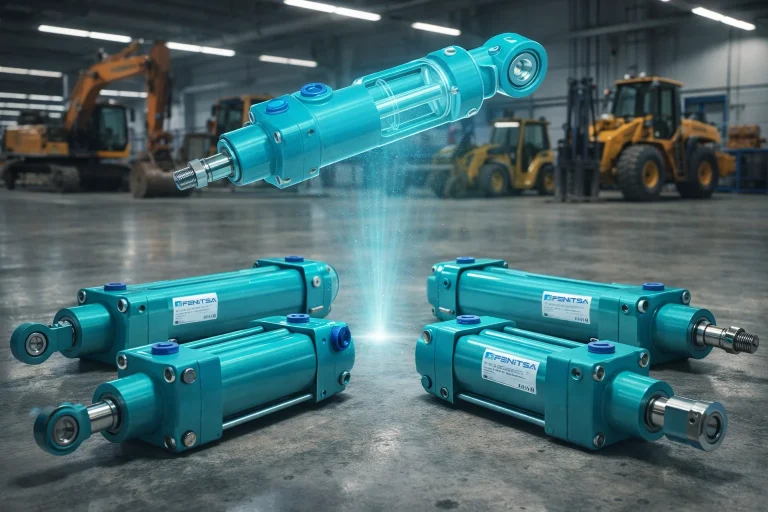
Typical Cylinder Functions
- Rolling mills — roll gap adjustment and roll change.
- Ladle and tundish handling — tilting and lifting.
- Continuous casting — clamping and positioning.
- Scrap and slag handling — shears, balers and doors.
Force Table
Fenitsa FDH bores; pull force with the smaller standard rod.
| Bore | Rod | Push 160 bar (t) | Pull 160 bar (t) | Push 250 bar (t) |
|---|---|---|---|---|
| Ø80 | Ø45 | 8.2 | 5.6 | 12.8 |
| Ø100 | Ø56 | 12.8 | 8.8 | 20.0 |
| Ø125 | Ø70 | 20.0 | 13.7 | 31.3 |
| Ø160 | Ø90 | 32.8 | 22.4 | 51.3 |
| Ø200 | Ø110 | 51.3 | 35.8 | 80.1 |
Design Requirements
- Viton (FKM) seals for heat; NBR is limited to +80 °C.
- Heat shields and rod protection against spatter.
- Flange or trunnion mountings for rigid, aligned installation.
- Easy seal replacement during planned shutdowns.
Worked Example
For a push load of 25 t with a 25 % reserve, a Ø160 mm cylinder at 160 bar gives 32.8 t. With a 60 L/min pump it moves at about 50 mm/s and covers a 500 mm stroke in 10.1 s.
Frequently Asked Questions
What seals are used near furnaces?
Viton (FKM) seals for high temperatures; Fenitsa's special-seal option covers −30 °C to +200 °C.
Can cylinders be repaired at the mill?
Yes; seal kits are supplied and spare parts are supported for 10 years.
Which mounting suits steel plants?
Flange or trunnion mountings, depending on whether the cylinder must stay rigid or pivot.
How much force does a Ø125 hydraulic cylinder produce?
At 160 bar a Ø125 mm cylinder pushes 20.0 t. Force = pressure × piston area; the pull force is lower because the rod reduces the area.
Send Us Your Cylinder Data
Bore, rod, stroke, working pressure, mountings and quantity — or a drawing or photo of the cylinder you want to replace. Our engineers reply with a technical proposal and a quotation.
Related Pages
Hydraulic Cylinders
FDH, Rotlu, KHS, THS
30-ton hydraulic cylinder
Bore and force by tonnage
Force Calculator
Bore, pressure and force
Forklift Hydraulic Cylinders
Another application
Cylinder sizing guide
Bore, rod and stroke