

 Türkçe
 Русский
 Español
 العربية
Pull-Type Hydraulic Cylinders: Sizing for Pulling Force
A pull-type application uses the cylinder's retracting stroke to do the work: pulling, clamping, tensioning or closing. Because the rod takes up part of the piston area, the pull force is always lower than the push force at the same pressure.
The tables below give pull forces for Fenitsa FDH bores so that the cylinder is sized on the annulus area, not the full bore.
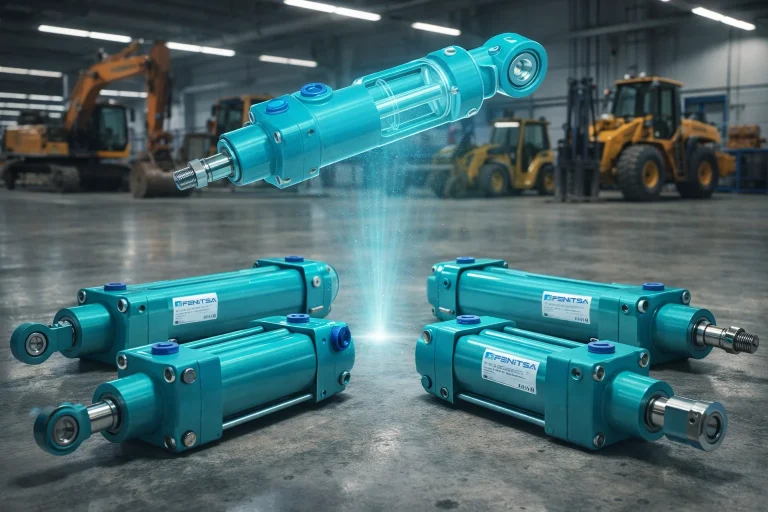
Typical Cylinder Functions
- Clamping and fixtures — pulling a workpiece against a stop.
- Tensioning — belts, chains and cables.
- Doors and gates — closing against a seal.
- Pullers and testing rigs — tensile and extraction work.
Force Table
Fenitsa FDH bores; pull force with the smaller standard rod.
| Bore | Rod | Push 160 bar (t) | Pull 160 bar (t) | Push 250 bar (t) |
|---|---|---|---|---|
| Ø50 | Ø28 | 3.2 | 2.2 | 5.0 |
| Ø63 | Ø36 | 5.1 | 3.4 | 7.9 |
| Ø80 | Ø45 | 8.2 | 5.6 | 12.8 |
| Ø100 | Ø56 | 12.8 | 8.8 | 20.0 |
| Ø125 | Ø70 | 20.0 | 13.7 | 31.3 |
| Ø160 | Ø90 | 32.8 | 22.4 | 51.3 |
Design Requirements
- Size the bore on the annulus area: A = π(D² − d²)/4.
- A pull load cannot buckle the rod, so a thinner rod gives more pull area.
- Strong rod-end thread and rod-end mounting for tensile load.
- Rear flange or rear clevis to take the reaction.
Worked Example
For a pull load of 5 t with a 25 % reserve, a Ø100 mm cylinder at 160 bar gives 8.8 t. With a 30 L/min pump it moves at about 93 mm/s and covers a 400 mm stroke in 4.3 s.
Frequently Asked Questions
Why is the pull force lower than the push force?
On the rod side the rod occupies part of the piston area, so the same pressure acts on a smaller annulus area.
Does a pull cylinder need a thick rod?
No — in tension the rod cannot buckle. A thinner rod leaves more annulus area and more pull force; only the rod strength and thread must be checked.
How is pull force calculated?
F = p × π(D² − d²)/4, with p in N/mm² (bar ÷ 10) and D, d in mm.
How much force does a Ø100 hydraulic cylinder produce?
At 160 bar a Ø100 mm cylinder pushes 12.8 t. Force = pressure × piston area; the pull force is lower because the rod reduces the area.
Send Us Your Cylinder Data
Bore, rod, stroke, working pressure, mountings and quantity — or a drawing or photo of the cylinder you want to replace. Our engineers reply with a technical proposal and a quotation.
Related Pages
Hydraulic Cylinders
FDH, Rotlu, KHS, THS
5-ton hydraulic cylinder
Bore and force by tonnage
Force Calculator
Bore, pressure and force
Tractor Hydraulic Cylinders
Another application
Cylinder sizing guide
Bore, rod and stroke