

 Türkçe
 Русский
 Español
 العربية
Flange Mount Hydraulic Cylinders: Front and Rear Flange
A flange-mounted cylinder is bolted rigidly to the machine through a flange on the front (rod-end) or rear head. It is the standard choice for presses and fixed machinery where the load moves in a straight line.
Fenitsa FDH cylinders are available with front flange (FFM) and rear flange (RFM) mountings, bores Ø40–Ø200, mounting dimensions to CETOP RP 58 H.
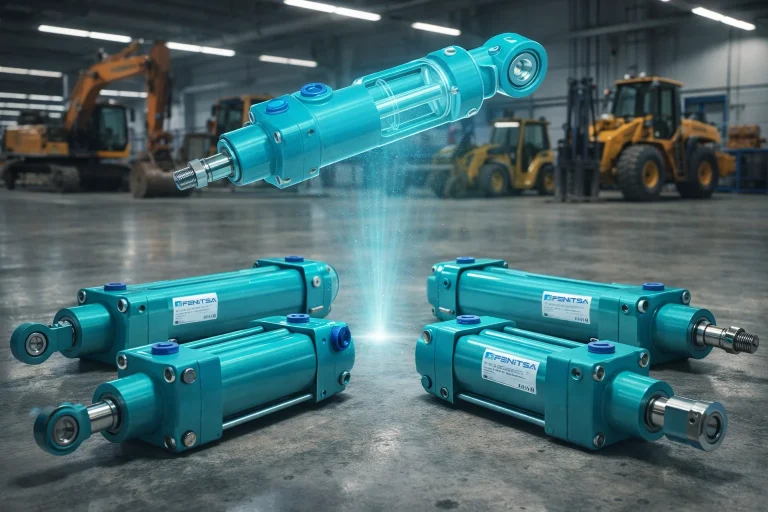
Typical Cylinder Functions
- Front flange (FFM) — best for push loads; shortest buckling length.
- Rear flange (RFM) — for pull loads or where the front must stay free.
- Presses — vertical flange-mounted main cylinders.
- Fixed machinery — clamping units, ejectors and lifting tables.
Force Table
Fenitsa FDH bores; pull force with the smaller standard rod.
| Bore | Rod | Push 160 bar (t) | Pull 160 bar (t) | Push 250 bar (t) |
|---|---|---|---|---|
| Ø40 | Ø25 | 2.1 | 1.2 | 3.2 |
| Ø63 | Ø36 | 5.1 | 3.4 | 7.9 |
| Ø100 | Ø56 | 12.8 | 8.8 | 20.0 |
| Ø160 | Ø90 | 32.8 | 22.4 | 51.3 |
| Ø200 | Ø110 | 51.3 | 35.8 | 80.1 |
Design Requirements
- Load and cylinder axis must be aligned — a flange mount cannot pivot.
- The guided load must not put side loads on the rod.
- Bolts sized for the full push or pull force.
- A front flange reduces buckling length for push loads.
Worked Example
For a push load of 10 t with a 25 % reserve, a Ø100 mm cylinder at 160 bar gives 12.8 t. With a 40 L/min pump it moves at about 85 mm/s and covers a 500 mm stroke in 5.9 s.
Frequently Asked Questions
Front or rear flange?
For pushing, a front flange gives the shortest buckling length. For pulling, a rear flange keeps the bolts in compression-free mounting.
Can a flange-mounted cylinder take side loads?
No. The load must be guided; side loads wear the rod bushing and seals.
What standard are the dimensions?
FDH mounting dimensions follow CETOP RP 58 H.
How much force does a Ø100 hydraulic cylinder produce?
At 160 bar a Ø100 mm cylinder pushes 12.8 t. Force = pressure × piston area; the pull force is lower because the rod reduces the area.
Send Us Your Cylinder Data
Bore, rod, stroke, working pressure, mountings and quantity — or a drawing or photo of the cylinder you want to replace. Our engineers reply with a technical proposal and a quotation.
Related Pages
Hydraulic Cylinders
FDH, Rotlu, KHS, THS
10-ton hydraulic cylinder
Bore and force by tonnage
Force Calculator
Bore, pressure and force
Hydraulic Cylinders for Steel Mills and Foundries
Another application
Cylinder sizing guide
Bore, rod and stroke