

 Türkçe
 Русский
 Español
 العربية
100 mm Stroke Pneumatic Cylinder
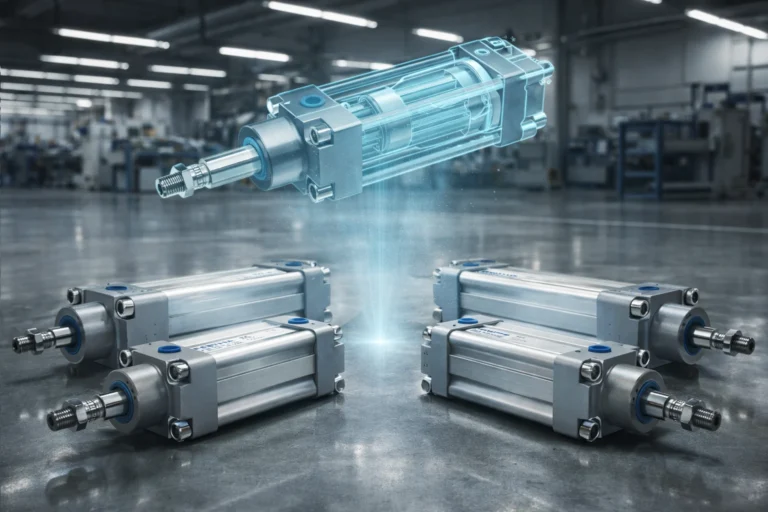
A 100 mm stroke (10 cm, 3.94 in) is a standard catalogue stroke and is available in every Fenitsa bore from Ø32 to Ø320. The stroke sets how far the rod travels and how much air each cycle uses; the bore sets the force.
Typical 100 mm stroke jobs: clamping and holding, pushing parts off a conveyor, short lifts and stops.
Force, Air and Buckling by Bore
Free air per double stroke at 6 and 8 bar; buckling limit with the cylinder pivoted at both ends (Lk ≈ 200 mm, safety factor 3.5).
| Bore / rod | Air 6 bar (L) | Air 8 bar (L) | Buckling limit (kg) |
|---|---|---|---|
| Ø32 / Ø12 | 1.04 | 1.33 | 1,537 |
| Ø40 / Ø16 | 1.60 | 2.06 | 4,856 |
| Ø50 / Ø20 | 2.50 | 3.21 | 11,857 |
| Ø63 / Ø20 | 4.10 | 5.27 | 11,857 |
| Ø80 / Ø25 | 6.62 | 8.51 | 28,947 |
| Ø100 / Ø25 | 10.53 | 13.54 | 28,947 |
| Ø125 / Ø32 | 16.43 | 21.12 | 77,703 |
| Ø160 / Ø40 | 26.97 | 34.66 | 189,706 |
| Ø200 / Ø40 | 42.63 | 54.79 | 189,706 |
At 100 mm every bore's rod carries more than its 6 bar push force, so buckling does not limit a pivoted cylinder.
Compressor Demand
Free air at 6 bar for 10 double strokes per minute.
| Bore | Air (L/min) |
|---|---|
| Ø40 | 16.0 |
| Ø63 | 41.0 |
| Ø100 | 105.3 |
| Ø160 | 269.7 |
Example: a Ø50 cylinder with a 100 mm stroke pushes 118 kg at 6 bar; at 10 cycles per minute it needs about 25.0 L/min of free air, or 1.50 m³/h.
Frequently Asked Questions
Is 100 mm a standard stroke?
Yes. Standard strokes are 50, 100, 125, 160, 200, 250, 300, 350, 400, 450 and 500 mm.
How much air does a Ø63 cylinder with 100 mm stroke use?
About 4.10 litres of free air per double stroke at 6 bar.
Send Us Your Cylinder Data
Bore, rod, stroke, working pressure, mountings and quantity — or a drawing or photo of the cylinder you want to replace. Our engineers reply with a technical proposal and a quotation.
Related Pages
Pneumatic Cylinders
All series
Air Cylinder Calculator
Force and air
200 mm Stroke Pneumatic Cylinder
Other stroke
300 mm Stroke Pneumatic Cylinder
Other stroke
63 mm pneumatic cylinder
Ø63