


What Is a Tie-Rod Hydraulic Cylinder and Where Is It Used?
- Home
- What Is a Tie-Rod Hydraulic Cylinder and Where Is It Used?
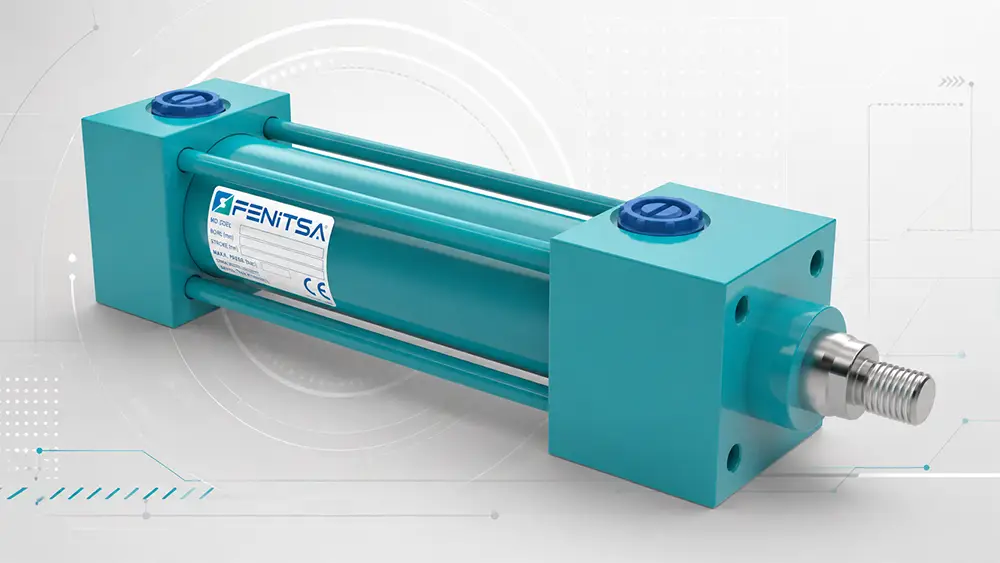
In hydraulic systems, the cylinder is one of the most critical components for generating controlled linear motion under high force. In applications where heavy loads must be moved, lifted, pressed, clamped, or held in position, selecting the correct cylinder configuration directly affects overall machine performance. Fenitsa manufactures different hydraulic cylinder solutions for industrial applications, including tie-rod designs with various bore, stroke, and mounting options.
A Tie-Rod Hydraulic Cylinder is a hydraulic actuator in which the front and rear end caps are mechanically secured by external tie rods running along the cylinder body. These tie rods help maintain the structural integrity between the cylinder tube and end caps while also providing a serviceable construction. This design is widely used in standardized machinery, production lines, hydraulic power systems, and equipment where maintenance accessibility and flexible mounting arrangements are important.
Its operating principle is similar to that of other double-acting hydraulic cylinders. When pressurized hydraulic oil is supplied to one side of the piston, the piston and piston rod move in a linear direction. When hydraulic flow is redirected to the opposite chamber, the cylinder moves in the reverse direction. In this way, both extension and retraction movements can be controlled through hydraulic pressure. The force generated by the cylinder depends mainly on operating pressure, piston bore, and piston rod diameter.
Fenitsa tie-rod cylinder solutions are available with different bore sizes to meet varying force requirements. Bore options ranging from Ø40 mm to Ø200 mm allow the cylinder to be configured for both compact machine designs and applications requiring significantly higher output force. As piston diameter increases, the effective piston area becomes larger, allowing greater force to be produced at the same hydraulic pressure.
For this reason, cylinder selection should not be based solely on the available installation space. The load to be moved, required pushing and pulling forces, operating pressure, and machine geometry should all be evaluated together.
Stroke length is another critical parameter when selecting a Tie-Rod Hydraulic Cylinder. The total travel required from the piston must be calculated according to the machine mechanism and application requirements. Fenitsa can provide stroke configurations up to 5000 mm, offering flexibility for systems requiring extended linear travel. In long-stroke applications, however, piston rod diameter, buckling risk, mounting arrangement, and direction of loading must be considered as part of the engineering calculation.
Industrial Applications of Tie-Rod Hydraulic Cylinders
Tie-rod hydraulic cylinders can be used in a wide range of industrial machines and hydraulic systems requiring high-force linear motion. Typical applications include press machinery, lifting systems, material handling equipment, industrial automation lines, agricultural machinery, custom-built machines, mold systems, clamping units, and various compression mechanisms. However, the most important selection criterion is not the industry itself, but the actual load, force, stroke, and operating characteristics of the application.
In a press system, for example, the cylinder may be required to generate high pushing force. In a lifting application, load direction and safe load control may become more important. In material handling equipment, cycle frequency and motion speed may be key factors, while in custom machinery, installation space and mounting geometry can determine the appropriate cylinder configuration.
Fenitsa therefore evaluates hydraulic cylinder selection not only in terms of bore and stroke but also according to the mechanical connection method and actual operating conditions of the machine.
One of the practical advantages of tie-rod cylinder construction is serviceability. Because the front and rear end caps are secured by external tie rods, the cylinder can be disassembled when necessary for inspection or replacement of seals, wear components, and internal parts. In production facilities with intensive operating cycles, predictable and accessible maintenance procedures can contribute to reducing machine downtime.
Operating pressure is another major factor in system design. Fenitsa tie-rod hydraulic cylinder models are designed for standard operating pressures up to 160 bar, while different configurations can be considered for applications requiring higher pressure levels. Increasing hydraulic pressure can generate greater force at the same piston area; however, the cylinder body, seals, mounting elements, fittings, valves, hoses, and the entire hydraulic circuit must all be suitable for the selected pressure level.
A Tie-Rod Hydraulic Cylinder must also be selected with the piston rod diameter in mind. This is particularly important in long-stroke cylinders subjected to compressive loads, where buckling may become a critical engineering consideration. Load magnitude, stroke length, mounting arrangement, and whether the load acts axially must be evaluated together. Selecting a cylinder based only on nominal output force can lead to inappropriate sizing if these mechanical factors are ignored.
Side loads should also be minimized. Hydraulic cylinders are primarily designed to operate with loads applied along the cylinder axis. Excessive lateral forces can cause uneven wear on the piston rod, guide elements, seals, and bearing surfaces. Where angular movement occurs within the mechanism, suitable articulated mounting arrangements should be incorporated into the machine design.
Mounting accessories also affect the operating characteristics of the cylinder. Fixed mounting configurations may be suitable for rigid mechanisms, whereas systems involving angular movement may require clevis, eye, trunnion, or other articulated mounting solutions. Incorrect mounting can introduce unnecessary side loads and accelerate wear in both the piston rod and sealing system.
Cylinder performance also depends on the condition of the complete hydraulic circuit. Oil cleanliness, filtration level, operating temperature, valve capacity, hydraulic fluid selection, and regular maintenance directly affect service life. Contaminated hydraulic fluid can accelerate wear on sealing surfaces and internal components, while improper filtration can reduce long-term system reliability.
At Fenitsa, hydraulic cylinder projects are evaluated by considering piston bore, rod diameter, stroke, working pressure, mounting configuration, load characteristics, and machine geometry as a complete system. A properly configured Tie-Rod Hydraulic Cylinder not only produces the required force but also supports controlled movement, easier maintenance planning, and reliable integration into the mechanical structure of industrial machinery.
The correct hydraulic cylinder is therefore more than a component that converts hydraulic energy into linear motion. It directly influences force transmission, movement stability, machine reliability, and production continuity. By matching bore diameter, piston rod size, stroke length, operating pressure, and mounting arrangement to the actual working conditions, Fenitsa develops tie-rod hydraulic cylinder solutions suited to a wide range of industrial applications.

