

 Türkçe
 Русский
 Español
 العربية
Dump Truck and Dump Trailer Hydraulic Cylinders
A dump truck or dump trailer is tipped by a hoist cylinder that lifts the front of the body about a rear hinge. Most hoists are single acting telescopic cylinders mounted at the front of the body: nested stages give a long stroke from a short collapsed length, and the body’s weight pushes them back when the valve opens.
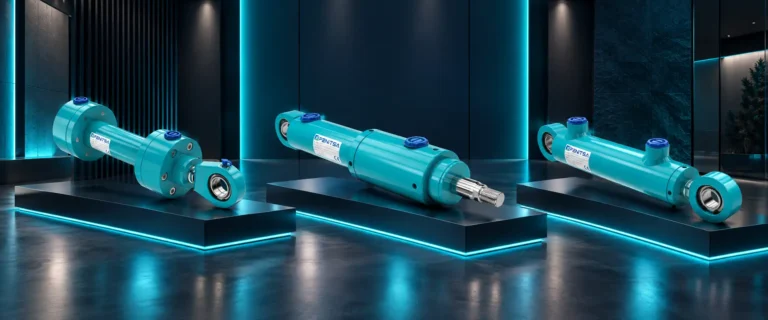
Fenitsa designs telescopic tipper cylinders per project, and builds welded THS and heavy duty KHS hydraulic cylinders (Ø40–Ø200 mm, strokes to 3,000 mm) for tailgates and other body functions.
Front-Mount Telescopic vs Underbody (Scissor) Cylinders
Where the hoist sits decides its force and stroke. The load acts at a lever arm a from the hinge, the cylinder at its own lever arm b, and at the start of the lift F = W × a / b: the further the cylinder is from the hinge, the less force and the more stroke it needs.
- H — Rear hinge
- W — Weight of body and load
- a — Hinge to centre of gravity
- b — Hinge to cylinder pin
- φ — Tipping angle
- 1 — Front-mount telescopic cylinder
- 2 — Underbody position (dashed)
| Front-mount telescopic | Underbody (direct or scissor) | |
|---|---|---|
| Position | In front of the body or on the trailer gooseneck | Under the body, between the chassis rails |
| Lever arm b | Close to the body length (4,800 mm) | A fraction of it (1,800 mm) |
| Start-of-lift force | 91.9 kN (9.37 t) | 245.2 kN (25.00 t) |
| Stroke for 50° | 3,967 mm | 1,468 mm |
| Cylinder | Single acting telescopic | Single-stage or telescopic, often with a scissor linkage |
| Typical use | Rigid tippers and tipping semi-trailers | Shorter bodies, light trucks, farm trailers |
A scissor hoist puts a linkage between cylinder and body so a short stroke lifts the body further, and the linkage braces the body sideways. The drawback is force: 2.67 times the front-mount value in this example. Fenitsa quotes cylinders for both layouts on request.
Choosing Stages for a Dump Trailer
Illustrative load and length table, computed from the formulas below.
S = L(φ) − Lcn = ⌈S / (Lc − c)⌉Fstart = W × a / bDmin = √(4F / (π × p))Assumptions: front-mount cylinder 300 mm behind the front wall, vertical at rest; centre of gravity at mid-length; tipping to 45°; allowance c = 150 mm per stage; 160 bar. The masses are examples, not limits.
| Body length | Load lifted | Start-of-lift force | Stroke (mm) | Stages at 1,400 mm collapsed | Stages at 1,700 mm collapsed | Min. first-stage Ø at 160 bar (mm) |
|---|---|---|---|---|---|---|
| 7.0 m | 26 t | 133.2 kN (13.6 t) | 5,044 | 5 | 4 | 103 |
| 8.0 m | 30 t | 152.8 kN (15.6 t) | 5,807 | 5 | 4 | 110 |
| 9.0 m | 33 t | 167.4 kN (17.1 t) | 6,570 | 6 | 5 | 115 |
| 10.0 m | 36 t | 182.0 kN (18.6 t) | 7,334 | 6 | 5 | 120 |
The stroke grows almost in proportion to body length, so long bodies need more stages or more collapsed length — and 300 mm more collapsed length saves a stage on every body here, which is worth agreeing with the trailer builder early. The last column is the theoretical minimum for the start of lift; the thinnest stage must then be checked where it takes over, as on the telescopic hydraulic cylinder page.
Dump Truck Hoist Cylinder Sizing Example
A rigid tipper, step by step (illustrative values).
- 1
Load lifted
Body 4 t plus payload 14 t = 18 t, so W = 176.5 kN.
- 2
Lever arms
Centre of gravity a = 2,500 mm, cylinder pin b = 4,800 mm from the hinge.
- 3
Start-of-lift force
F = W × a / b = 91.9 kN (9.37 t).
- 4
Stroke
Tipping to 50° with 1,250 mm collapsed length, cylinder vertical at rest: S = 3,967 mm.
- 5
Stages
n = ⌈3,967 / (1,250 − 150)⌉ = 4, about 992 mm each.
- 6
First-stage diameter
D = √(4F / (π × p)) at 160 bar = 85.5 mm; with a 1.25 margin, 95.6 mm.
- 7
Last stage
Check the thinnest stage at the body angle where it starts, as in the telescopic cylinder example.
The same body with an underbody cylinder 1,800 mm from the hinge and 900 mm collapsed length needs 245.2 kN at the start but only 1,468 mm of stroke: force and stroke trade against each other.
Replacement Cylinders: What to Measure
A replacement is built from measurements, not from the truck model. Lower the body or rest it on its mechanical prop first — never work under a body held up by the hydraulics alone.
- Collapsed lengthPin centre to pin centre, or trunnion centre to top pin, fully closed.
- StrokeMeasured on the old cylinder or taken from the tipping angle.
- StagesNumber of moving stages and the outside diameter of each.
- MountingsEye or trunnion type, pin diameters, eye widths, trunnion position.
- Oil portPosition and thread type.
- CircuitSingle or double acting, pump flow and relief setting.
- Retracted (closed) length
- Extended length = retracted length + total stroke
- Stage 1 (largest bore — extends first)
- Last stage (smallest bore — highest pressure for the same load)
- Base tube with oil port
- Mounting eyes / trunnion
Other cylinders: how to measure a hydraulic cylinder.
Materials and Seals for Tipping Duty
Tipping duty means high loads at low speed, long idle periods, cold starts, and road dirt and salt on every stage that slides out.
In Fenitsa’s standard FDH series, tubes are honed St52BK+S steel and rods are Ck45 with hard chrome of at least 20 µm, f7; hardened-and-chromed and stainless rods are options. Seals are NBR as standard or Viton, rated −20 °C to +80 °C, and special seals extend this to −30 °C … +200 °C. For telescopic tipper cylinders, materials, chrome and seals are specified per project and confirmed in the quotation.
Dirt wears a tipper cylinder fastest: an effective wiper at every stage mouth, chrome free of dents and weld spatter, and clean mineral oil matter more than any single material choice. Grease the pins and check for drift with the body on its prop. Every Fenitsa cylinder is tested for internal and external leakage.
Send Us Your Cylinder Data
Bore, rod, stroke, working pressure, mountings and quantity — or a drawing or photo of the cylinder you want to replace. Our engineers reply with a technical proposal and a quotation. info@fenitsa.com.
Dump Truck and Dump Trailer Cylinders – FAQ
Short answers from our engineers.
Why are dump truck hoist cylinders telescopic?
Because the hoist needs a long stroke from a short collapsed length. A front-mount cylinder lifts the front of the body by several metres, yet must fit under it when the body is down — only nested stages manage both.
How many stages does a dump trailer cylinder need?
The stroke divided by the stroke per stage, rounded up: n = S / (Lc − c). In the illustrative table, a 9 m body tipped to 45° needs about 6,570 mm of stroke — 6 stages with 1,400 mm collapsed length, 5 with 1,700 mm.
Is a tipper cylinder single or double acting?
Usually single acting: the body’s weight pushes the stages back and the oil returns through the tipping valve. Double acting telescopic cylinders are used where the stages must be powered back, as on push-out (ejector) bodies with a horizontal cylinder.
Why does a tipper body rise slowly at first and faster at the end?
The widest stage extends first and needs the most oil per millimetre. With a constant pump flow the speed, v = Q / A, rises as each thinner stage takes over — and so does the pressure.
Can you build a replacement for an existing tipper cylinder?
Yes. Send the collapsed length, stroke, number of stages, outside diameter of each stage and the mountings — or a drawing or photo of the old cylinder.
What bends a tipper cylinder?
Side load. Tipping on a slope or soft ground, a load stuck to one side of the body, or misaligned pins push the extended stages sideways, and the thin last stage bends first.
Related Pages
Telescopic Hydraulic Cylinders
How stages work and how to size them.
Single Acting Hydraulic Cylinders
Load-return cylinders and a force table.
How to Measure a Hydraulic Cylinder
Dimensions for a replacement.
Hydraulic Cylinders for Construction Machinery
Cylinders for mobile machines.