

 Türkçe
 Русский
 Español
 العربية
Single Acting Hydraulic Cylinders
A single acting hydraulic cylinder uses oil pressure to move the piston in one direction only, usually to extend the rod. It has one working port. The rod returns under the weight of the load, an internal spring or an external force, while the unpressurised chamber breathes through a vent. It is the simplest cylinder to plumb.
Fenitsa builds single acting cylinders to order within the frame of its FDH series of hydraulic cylinders: Ø40–Ø200 mm bore, 160 bar working pressure (250 bar option) and strokes up to 5,000 mm. Plunger, spring-return and telescopic designs are quoted on request.
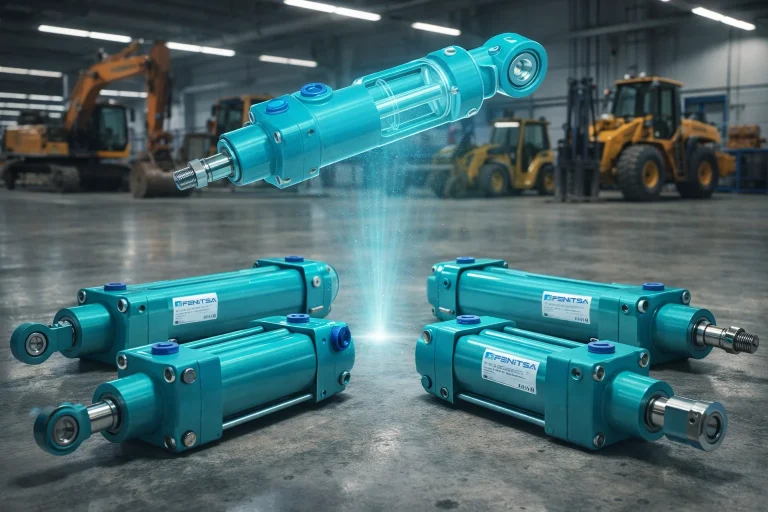
What Is a Single Acting Hydraulic Cylinder?
Hydraulically it is half of a double acting cylinder: oil enters one chamber only. In the usual push version that is the cap-end chamber, so pressure acts on the full piston area and the cylinder gives the highest push force its bore allows.
The rod-side chamber is open to atmosphere through a breather (item 14 in the drawing), so air moves in and out as the piston travels. On every return stroke it draws in air — and dust and moisture too, unless the vent is filtered, points downwards or is piped back to the tank.
- Rear cap (cap end)
- Rear clevis mounting
- Port A — cap end (full bore side)
- Barrel (honed cylinder tube)
- Tie rods and nuts
- Piston
- Piston seal
- Wear (guide) rings
- Piston rod (hard chrome plated)
- Front head (gland)
- Rod bearing (guide bush)
- Rod seal
- Wiper (scraper)
- Breather (vent) — rod side open to air
- Cushioning spear and adjusting screw
- Static O-rings
- Rod eye
Cap-side chamber — pressure acts on the full piston area
How It Works: Return by Load, Gravity or Spring
To extend, the directional valve connects the pump to the port. Oil fills the cap-end chamber and the rod moves out at v = Q / A with a force F = p × A, where A is the piston area — or the ram area in a plunger cylinder.
To retract, the valve connects the port to tank. The pressure falls and the rod is pushed back by the weight of the load, a built-in spring or the machine itself, while the oil returns through the same line. A 3/2 (three-way) valve is enough.
Return speed can only be controlled by throttling the return flow. Loads that lower under gravity need a flow control or counterbalance valve so they cannot run away; a spring return gives only the spring force, which pressure cannot increase.
Types of Single Acting Hydraulic Cylinders
| Type | Return by | Area that sets the force | Typical use |
|---|---|---|---|
| Plunger (ram) | Load or gravity | Ram diameter | Presses, heavy lifting, jacks |
| Spring return | Internal spring | Piston area minus spring force | Short strokes: clamping, holding |
| Load (gravity) return | Weight of the load | Full piston area | Vertical lifts, platforms, tailgates |
| Single acting telescopic | Weight of the load | Each stage in turn | Tipper trucks, dump trailers |
A plunger cylinder has no piston: the ram seals at the gland and its diameter sets the force, so it suits large push loads that gravity returns, as in presses and lifts. A spring return works in any position, but the spring costs length and force, so strokes stay short. Load-return and telescopic cylinders need the load on the rod at all times, so they work vertically or steeply inclined.
Available Bores and Strokes
The FDH catalogue frame within which Fenitsa builds single acting cylinders.
- BoreØ40–Ø200 mm
- RodØ25–Ø125 mm
- Working pressure160 bar (test 240 bar)
- Optional pressure250 bar
- Standard strokes100–500 mm, 100 mm steps
- Maximum stroke5,000 mm
- Max piston speed0.5 m/s
- Temperature−20 °C to +80 °C
| Bore (mm) | Piston area (cm²) | Rod options (mm) | Rod-end thread | Oil per 100 mm stroke (L) |
|---|---|---|---|---|
| Ø40 | 12.6 | 25 / 28 | M16×1.5 | 0.13 |
| Ø50 | 19.6 | 28 / 30 / 36 | M20×1.5 | 0.20 |
| Ø63 | 31.2 | 36 / 45 | M27×2 | 0.31 |
| Ø80 | 50.3 | 45 / 56 | M33×2 | 0.50 |
| Ø100 | 78.5 | 56 / 70 | M42×2 | 0.79 |
| Ø125 | 122.7 | 70 / 90 | M48×2 | 1.23 |
| Ø160 | 201.1 | 90 / 100 | M64×3 | 2.01 |
| Ø200 | 314.2 | 110 / 125 | M80×3 | 3.14 |
The last column is the oil the pump delivers per 100 mm of stroke — the whole volume per cycle, since only one chamber fills. Tubes are honed St52BK+S steel; rods are Ck45 with hard chrome of at least 20 µm and f7 tolerance, with hardened-and-chromed or stainless rods as options. Seals are NBR or Viton; special seals cover −30 °C … +200 °C. Every cylinder is tested for internal and external leakage. Series data: FDH type hydraulic cylinders.
Push Force Table: Ø40–Ø200 mm at 100, 160 and 250 bar
F [N] = p [bar] × 0.1 × A [mm²]A = π × D² / 4t = N / 9,806.65| Bore | kN at 100 bar | t at 100 bar | lbf at 100 bar | kN at 160 bar | t at 160 bar | lbf at 160 bar | kN at 250 bar | t at 250 bar | lbf at 250 bar |
|---|---|---|---|---|---|---|---|---|---|
| Ø40 | 12.6 | 1.28 | 2,825 | 20.1 | 2.05 | 4,520 | 31.4 | 3.20 | 7,063 |
| Ø50 | 19.6 | 2.00 | 4,414 | 31.4 | 3.20 | 7,063 | 49.1 | 5.01 | 11,035 |
| Ø63 | 31.2 | 3.18 | 7,008 | 49.9 | 5.09 | 11,213 | 77.9 | 7.95 | 17,520 |
| Ø80 | 50.3 | 5.13 | 11,300 | 80.4 | 8.20 | 18,080 | 125.7 | 12.81 | 28,250 |
| Ø100 | 78.5 | 8.01 | 17,656 | 125.7 | 12.81 | 28,250 | 196.3 | 20.02 | 44,141 |
| Ø125 | 122.7 | 12.51 | 27,588 | 196.3 | 20.02 | 44,141 | 306.8 | 31.28 | 68,971 |
| Ø160 | 201.1 | 20.50 | 45,201 | 321.7 | 32.80 | 72,321 | 502.7 | 51.26 | 113,001 |
| Ø200 | 314.2 | 32.04 | 70,626 | 502.7 | 51.26 | 113,001 | 785.4 | 80.09 | 176,565 |
250 bar is Fenitsa’s optional rating and the highest pressure listed; the standard series works at 160 bar. 100 bar = 1,450 psi · 160 bar = 2,321 psi · 250 bar = 3,626 psi.
Example: a Ø100 mm cylinder at 160 bar pushes 125.7 kN — 12.81 t or 28,250 lbf. Deduct seal friction and, on a spring return, the spring force, and leave a margin above the load. For a plunger cylinder read the ram diameter as the bore. Other sizes: hydraulic cylinder force calculator.
What Is the Difference Between Single and Double Acting Hydraulic Cylinders?
A single acting cylinder is powered one way and returned by the load or a spring; a double acting cylinder is powered both ways by oil.
| Feature | Single acting | Double acting |
|---|---|---|
| Oil ports | One, plus a breather | Two: A and B |
| Directional valve | 3/2 (three-way) | 4/2 or 4/3 (four-way) |
| Powered strokes | One, normally push | Push and pull |
| Return stroke | Load, gravity or spring | Oil on the annulus |
| Return speed | Throttled return flow only | Metered both ways |
| Mounting | Vertical for load return | Any position |
| Rod-side chamber | Vented to air | Full of oil, sealed |
| Holding a load | In one direction | In both directions |
Choose single acting when the load always returns the rod and no pull is needed: one hose and a simpler valve. Otherwise choose a double acting hydraulic cylinder.
Typical Applications
Tippers and dump bodies
The body’s weight lowers it, so the hoist only lifts. See dump truck cylinders.
Presses
Plunger cylinders press down and return by the ram’s weight or by return cylinders. See press cylinders.
Lifts and platforms
Lifting tables lower under the load through a lowering-speed valve. See heavy-load cylinders.
Jacks and clamping
Short rams for jacking; spring-return cylinders for clamping.
Mounting Options
FDH mounting dimensions follow CETOP RP 58 H. The mountings are front flange (FFM), rear flange (RFM), rear clevis (RSM), rear clevis with spherical bearing (RHM), rod-end clevis (FSM), rod-end spherical (FRM), centre trunnion (CTM) and foot (FMM); front and rear trunnions are also listed.
For a load-return cylinder, pivots at both ends let the cylinder follow the load without side load, while a flange suits a slide guided by the machine. Keep the breather where it cannot be flooded. All parts: hydraulic cylinder mounts and rod ends.
How to Order a Single Acting Cylinder
- Load and returnForce to push, return by load, gravity or spring, and the mounting angle.
- PressureWorking pressure of your power unit: 160 bar standard, 250 bar option.
- Bore and strokeOr let us size the bore. Standard strokes 100–500 mm in 100 mm steps; others up to 5,000 mm.
- MountingsMounting codes, pin diameters and retracted length between pin centres.
- Seals and rodNBR or Viton; Ck45 chrome, hardened and chromed, or stainless rod.
- ReplacementMeasure the old cylinder first: how to measure a hydraulic cylinder.
The FDH ordering code combines these as FDH-[bore]-[stroke]-[mounting]-[seal]-[rod type]. Fenitsa provides 10 years of service and spare-parts support for its hydraulic cylinders.
Send Us Your Cylinder Data
Bore, rod, stroke, working pressure, mountings and quantity — or a drawing or photo of the cylinder you want to replace. Our engineers reply with a technical proposal and a quotation. info@fenitsa.com.
Single Acting Hydraulic Cylinder – FAQ
Short answers from our engineers.
How does a single acting hydraulic cylinder retract?
By an external force. When the valve opens the port to tank, the weight of the load, a built-in spring or the machine pushes the rod back and the oil returns to the reservoir. Vertical loads need a flow control or counterbalance valve to limit the lowering speed.
How many hydraulic lines does a single acting cylinder need?
One. The same hose carries oil in on the working stroke and back to tank on the return. The other chamber breathes through a vent, which should be filtered or piped to the tank.
What is a ram (plunger) cylinder?
A single acting cylinder without a separate piston: the rod, or ram, is the working element and seals at the gland, so its diameter sets the force. Plunger cylinders carry heavy push loads in presses, lifts and jacks.
How much force does a single acting hydraulic cylinder produce?
Pressure times piston area. A Ø100 mm cylinder at 160 bar pushes 125.7 kN, about 12.81 tonnes-force or 28,250 lbf, before friction and any spring force are deducted.
Can a double acting cylinder be used as a single acting cylinder?
Yes. Feed the cap-end port only and connect the rod-end port to a breather filter or back to the tank, so the rod side breathes without drawing in dirt.
Can a single acting cylinder be mounted horizontally?
Only with a spring return or another mechanism that pushes the rod back. A load-return cylinder relies on gravity, so it must work vertically or steeply inclined.
Does Fenitsa build single acting hydraulic cylinders to order?
Yes, within the FDH catalogue frame: Ø40–Ø200 mm bore, 160 bar working pressure with a 250 bar option, and strokes up to 5,000 mm. Other designs are quoted on request.
Related Pages
Double Acting Hydraulic Cylinders
Push and pull force for every FDH bore and rod.
Telescopic Hydraulic Cylinders
Stages, collapsed length and force per stage.
How to Measure a Hydraulic Cylinder
Dimensions to take for a replacement.
Single Acting Pneumatic Cylinders
The same principle with compressed air.