

 Türkçe
 Русский
 Español
 العربية
Hydraulic Press Cylinders
A hydraulic press cylinder is the hydraulic cylinder that produces a press’s force: oil pressure acting on the piston area sets the tonnage. A Ø200 mm press cylinder gives about 51.3 tonnes at 160 bar and 80.1 tonnes at 250 bar. Bore, working pressure and mounting are the three choices that define a press cylinder.
Fenitsa builds hydraulic cylinders for presses from Ø40 to Ø200 mm bore on the FDH series — 160 bar working pressure, 250 bar option — with larger bores built to order. They are part of our hydraulic cylinders range, made in our own plant.
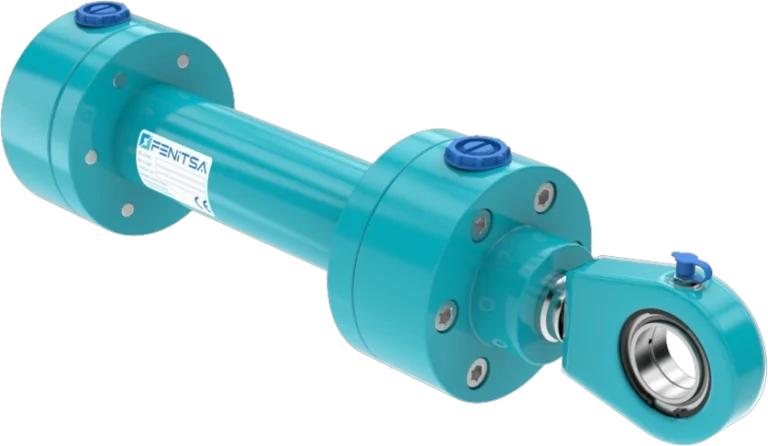
Press Cylinder Types: Ram, Double Acting and Plunger
Three designs cover almost every press; the difference is how the ram comes back.
| Type | Return stroke | Typical press | Notes |
|---|---|---|---|
| Single acting ram (piston type) | Gravity, springs or separate pull-back cylinders | Workshop, baling and some forming presses | One pressure port; simplest circuit |
| Double acting cylinder | Oil on the rod side | Production presses with a powered, controlled return | Return force and speed set by the annulus area |
| Plunger cylinder | Gravity or pull-back cylinders | Large down-acting presses | The rod is the piston; sealed only at the gland |
When the tool has to be pulled back against friction or a stripping load, a double acting cylinder is the safer choice. A single acting ram is simpler and needs only one pressure line.
Press Tonnage Table: Ø40 to Ø200 mm at 160 and 250 bar
Theoretical push force; t = metric tonnes-force, US tons = short tons-force.
F = p × π × D² / 4t = F [N] / 9,806.65| Bore | Piston area (cm²) | 160 bar (kN) | 160 bar (t) | 250 bar (kN) | 250 bar (t) | 250 bar (US tons) |
|---|---|---|---|---|---|---|
| Ø40 mm | 12.6 | 20.1 | 2.1 | 31.4 | 3.2 | 3.5 |
| Ø50 mm | 19.6 | 31.4 | 3.2 | 49.1 | 5.0 | 5.5 |
| Ø63 mm | 31.2 | 49.9 | 5.1 | 77.9 | 7.9 | 8.8 |
| Ø80 mm | 50.3 | 80.4 | 8.2 | 125.7 | 12.8 | 14.1 |
| Ø100 mm | 78.5 | 125.7 | 12.8 | 196.3 | 20.0 | 22.1 |
| Ø125 mm | 122.7 | 196.3 | 20.0 | 306.8 | 31.3 | 34.5 |
| Ø160 mm | 201.1 | 321.7 | 32.8 | 502.7 | 51.3 | 56.5 |
| Ø200 mm | 314.2 | 502.7 | 51.3 | 785.4 | 80.1 | 88.3 |
Above Ø200 mm at 250 bar (80.1 t) there are two routes: a special bore built to order, or several cylinders on one platen. Two Ø160 mm cylinders at 250 bar give 102.5 t together — see the 100 ton hydraulic cylinder page.
| Press force | Bore needed at 160 bar | Standard bore | Bore needed at 250 bar | Standard bore |
|---|---|---|---|---|
| 10 t | 88.3 mm | Ø100 mm (12.8 t) | 70.7 mm | Ø80 mm (12.8 t) |
| 20 t | 124.9 mm | Ø125 mm (20.0 t) | 99.9 mm | Ø100 mm (20.0 t) |
| 30 t | 153.0 mm | Ø160 mm (32.8 t) | 122.4 mm | Ø125 mm (31.3 t) |
| 50 t | 197.5 mm | Ø200 mm (51.3 t) | 158.0 mm | Ø160 mm (51.3 t) |
| 100 t | above Ø200 mm | Built to order | above Ø200 mm | Built to order |
Theoretical values ignore seal friction and pressure losses. Where a standard bore gives barely more than the target — 20, 30 and 50 t in the table — choose the next bore up or confirm the losses first. The 50 ton hydraulic cylinder page covers that size in detail, and the hydraulic force and tonnage calculator handles any other combination.
Selecting a Press Cylinder: Speed, Stroke and Mounting
| Bore | 10 mm/s | 50 mm/s | 100 mm/s | 200 mm/s |
|---|---|---|---|---|
| Ø40 mm | 0.8 | 3.8 | 7.5 | 15.1 |
| Ø50 mm | 1.2 | 5.9 | 11.8 | 23.6 |
| Ø63 mm | 1.9 | 9.4 | 18.7 | 37.4 |
| Ø80 mm | 3.0 | 15.1 | 30.2 | 60.3 |
| Ø100 mm | 4.7 | 23.6 | 47.1 | 94.2 |
| Ø125 mm | 7.4 | 36.8 | 73.6 | 147.3 |
| Ø160 mm | 12.1 | 60.3 | 120.6 | 241.3 |
| Ø200 mm | 18.8 | 94.2 | 188.5 | 377.0 |
| Mounting | Code | Use in a press |
|---|---|---|
| Front flange | FFM | First choice: rigid, on axis, short unsupported rod |
| Rear flange | RFM | Rigid and on axis, but the free length is longer; check buckling |
| Foot | FMM | Avoid at high force: the load acts off the mounting plane |
| Centre trunnion or rear clevis | CTM / RSM | Not for presses: pivots suit loads moving through an arc |
| Rod end | thread, FSM, FRM | Thread to the platen; clevis or spherical end only with a separately guided platen |
Let the press frame guide the platen. The cylinder rod should push, not guide: off-centre work puts side load on the rod bearing and seals. Standard mountings are listed under mounting equipment; tie-rod cylinders with flange mountings are the usual build for presses.
Seals and Rod Finish for Press Duty
High pressure on every cycle, dwell under full load and dirt from the tool.
- Rod finishCk45 rod with hard chrome ≥ 20 µm and f7 tolerance. The chrome is the sealing surface: a score in it leaks on every stroke.
- Hardened rod (HR)Hardened and chrome-plated rod for presses where scale, tools or impacts can dent the rod.
- Stainless rod (SS)For washdown or corrosive areas, such as food and chemical presses.
- TubeHoned St52BK+S steel tube; the honed bore is the running surface of the piston seal.
- SealsNBR standard for −20 °C to +80 °C; Viton for hot presses; special seals for −30 °C to +200 °C. Fluid: mineral oil.
- TestingTest pressure 240 bar, and every cylinder is checked for internal and external leakage. Internal leakage is what makes a loaded ram drift during dwell.
The wiper keeps scale and dust out of the rod seal; replace it together with the rod seal, and keep the rod clean where the press sheds lubricant or chips. If the ram hits the top of its stroke at speed, specify end cushioning or slow the return in the circuit.
Send Us Your Cylinder Data
Bore, rod, stroke, working pressure, mountings and quantity — or a drawing or photo of the cylinder you want to replace. Our engineers reply with a technical proposal and a quotation. info@fenitsa.com.
Hydraulic Press Cylinders – FAQ
Short answers from our engineers.
What is the ram in a hydraulic press?
The ram is the moving member that carries the upper tool and delivers the press force. In a direct-acting press it is the cylinder rod or plunger, often with a guided platen bolted to it. In British usage, hydraulic ram also means the whole cylinder.
How do I calculate the tonnage of a hydraulic press cylinder?
Multiply the pressure by the piston area, F = p × π × D² / 4, and divide the newtons by 9,806.65 for metric tonnes. A Ø160 mm cylinder gives 32.8 t at 160 bar and 51.3 t at 250 bar. The tonnage calculator does this for any bore.
Single acting ram or double acting cylinder for a press?
Workshop and baling presses often use single acting rams returned by gravity, springs or pull-back cylinders. Production presses use double acting cylinders for a powered, controlled return stroke, which also pulls the tool free when it sticks.
Can one press use several cylinders?
Yes. Several cylinders on one platen share the load; they must be synchronised or guided so the platen stays level. Two Ø160 mm cylinders at 250 bar, for example, give 102.5 t together.
Which mounting should a press cylinder use?
A flange mounting on the cylinder axis, usually the front flange, with the flange arranged so the press force pushes its face against the frame. Foot mountings bend under high force, and pivot mountings such as clevises and trunnions do not suit presses.
Does a higher pressure give more press force?
Yes, in direct proportion, because F = p × A. Going from 160 to 250 bar raises the force of the same bore by 56 %: a Ø125 mm cylinder goes from 20.0 t to 31.3 t. Cylinder, hoses and valves must all be rated for it; Fenitsa FDH cylinders are rated 160 bar with a 250 bar option.
How fast can a hydraulic press cylinder move?
As fast as the oil flow allows, within the speed rating: speed = flow ÷ piston area. Extending at 100 mm/s takes 73.6 L/min for a Ø125 mm cylinder and 188.5 L/min for Ø200 mm. Fenitsa FDH cylinders are rated for a maximum piston speed of 0.5 m/s.
Related Pages
50 Ton Hydraulic Cylinder
Bore, rod and pressure options for 50 tonnes.
100 Ton Hydraulic Cylinder
Special bores and cylinder pairs for 100 tonnes.
Heavy Duty Hydraulic Cylinders
Specifications and a worked buckling check.
Hydraulic Cylinder Sizes and Tonnage Chart
Standard bores and their force at a glance.