

 Türkçe
 Русский
 Español
 العربية
30 Ton Hydraulic Cylinder
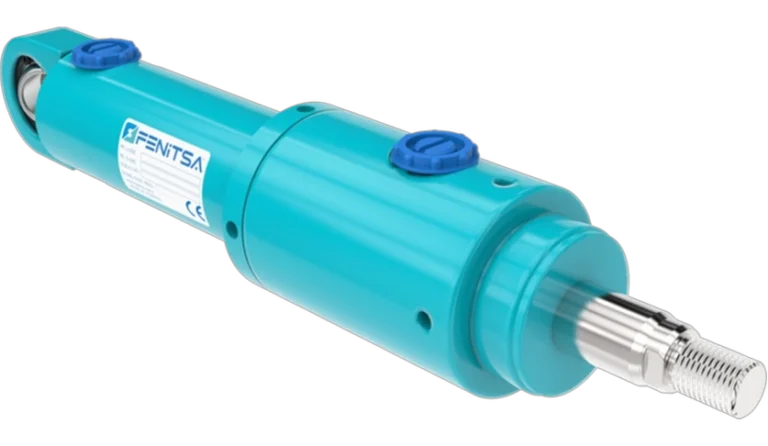
A 30 ton hydraulic cylinder needs a bore of 153.0 mm at 160 bar, so the standard size is Ø160 mm, pushing 32.8 t with a 9 % reserve. With the 250 bar option Ø125 mm gives 31.3 t. The catch is the return stroke: at 160 bar a Ø160 mm cylinder pulls only 22.4 t.
Cylinders of this class come from the standard FDH series of hydraulic cylinders, for presses and bending machines. Below: the bore table, which bore and rod pull 30 t, retract speed, buckling from 600 to 1,800 mm and the 700 bar comparison.
What Bore Does a 30 Ton Cylinder Need?
A = F / (0.1 × p)D = √(4A / π)To press exactly 30 t the Ø160 mm piston needs 146.3 bar, leaving 13.7 bar for losses in valves and hoses — a 9.3 % reserve, just under the 10 % many designers keep. If the load estimate is uncertain, step up to Ø200 mm at 160 bar or Ø160 mm with the 250 bar option; both give 51.3 t. At 250 bar Ø125 mm is enough, but its 4.3 % reserve is thinner still.
Bore vs Pressure Table for 30 Tons
Separate rows for metric tonnes and US tons (1 US ton = 0.907 t).
| Pressure | Target | Calculated bore | Standard bore | Force of the standard bore | Reserve |
|---|---|---|---|---|---|
| 100 bar | 30 t | Ø193.5 mm | Ø200 mm | 32.0 t | +6.8 % |
| 100 bar | 30 US tons | Ø184.3 mm | Ø200 mm | 35.3 US tons | +17.7 % |
| 160 bar | 30 t | Ø153.0 mm | Ø160 mm | 32.8 t | +9.3 % |
| 160 bar | 30 US tons | Ø145.7 mm | Ø160 mm | 36.2 US tons | +20.5 % |
| 210 bar (reference only) | 30 t | Ø133.6 mm | Ø160 mm | 43.1 t | +43.5 % |
| 210 bar (reference only) | 30 US tons | Ø127.2 mm | Ø160 mm | 47.5 US tons | +58.2 % |
| 250 bar | 30 t | Ø122.4 mm | Ø125 mm | 31.3 t | +4.3 % |
| 250 bar | 30 US tons | Ø116.6 mm | Ø125 mm | 34.5 US tons | +15.0 % |
Counted in US tons, both standard choices have more room: 21 % for Ø160 mm at 160 bar and 15 % for Ø125 mm at 250 bar. At 100 bar a 30 t job already takes Ø200 mm, the top of the standard series. The 210 bar lines are a reference; Fenitsa cylinders run at 160 bar, or 250 bar as an option. Every size: hydraulic cylinder sizes.
Push vs Pull at 30 Tons
| Bore / rod | Pressure | Push (t) | Pull (t) | Pulls 30 t? |
|---|---|---|---|---|
| Ø160 / Ø90 mm | 160 bar | 32.8 | 22.4 | No |
| Ø160 / Ø100 mm | 160 bar | 32.8 | 20.0 | No |
| Ø160 / Ø90 mm | 250 bar | 51.3 | 35.0 | Yes |
| Ø160 / Ø100 mm | 250 bar | 51.3 | 31.2 | Yes |
| Ø200 / Ø110 mm | 160 bar | 51.3 | 35.8 | Yes |
| Ø200 / Ø125 mm | 160 bar | 51.3 | 31.2 | Yes |
Many 30 t jobs only push. If yours also pulls — stripping a punch, drawing a part, dragging a tool back against friction — the annulus must deliver the force. At 160 bar only the Ø200 mm bore does it, with either rod; at 250 bar Ø160 mm does, pulling 35.0 t with the Ø90 mm rod.
Stroke, Speed and Flow
| Extend speed | Pump flow (L/min) | Retract speed | Out and back, 400 mm stroke (s) | Power (kW) |
|---|---|---|---|---|
| 0.02 m/s | 24.1 | 0.029 m/s | 33.7 | 6.4 |
| 0.05 m/s | 60.3 | 0.073 m/s | 13.5 | 16.1 |
| 0.10 m/s | 120.6 | 0.146 m/s | 6.7 | 32.2 |
On a fixed pump flow the rod comes back φ = 1.46 times faster than it goes out, which suits press work: a controlled pressing stroke and a quicker return. Many presses add a fast, low-force approach by switching pumps or valves; the cylinder simply follows the flow it is given, within the 0.5 m/s piston speed limit.
Buckling Check for Long Strokes
This example is pinned at both ends — rear clevis and rod eye, mounting factor 1 — with free length = 2 × stroke + an assumed 400 mm dead length. Buckling load Fk = π² × E × I / Lk² with E = 210,000 N/mm², divided by the usual safety factor of 3.5.
| Stroke | Free length (mm) | Ø90 rod (t) | Ø100 rod (t) | Ø125 rod (t) | Lightest rod for 30 t |
|---|---|---|---|---|---|
| 600 mm | 1,600 | 76.0 | 115.8 | 282.7 | Ø90 |
| 1,200 mm | 2,800 | 24.8 | 37.8 | 92.3 | Ø100 |
| 1,800 mm | 4,000 | 12.2 | 18.5 | 45.2 | Ø125 (Ø200 bore) |
At 1,800 mm only Ø200 / Ø125 mm passes; it then needs just 94 bar for 30 t, so the bigger cylinder runs at an easy pressure. The alternative is a front flange with a guided rod end, which shortens the buckling length — see long stroke hydraulic cylinders.
Where 30 Ton Cylinders Are Used
30 ton hydraulic presses
C-frame and H-frame presses for forming, stamping and assembly. Press cylinders
Press brakes
Usually two synchronised cylinders, one at each end of the beam.
Balers and compactors
Scrap, paper and waste compressed by a guided platen over a long stroke.
Mould clamping and core pulling
Auxiliary cylinders on moulding machines. Injection moulding cylinders
Industrial (160–250 bar) vs Jack-Type (700 bar) 30 Ton Cylinders
A 700 bar jack-type cylinder gets 30 t from about Ø73 mm. For a press, force is only half the story. Most jack-type cylinders return by spring or load — too slow and too weak to pull a tool out of the work — while a double acting industrial cylinder returns under oil pressure: Ø160 / Ø90 mm pulls 22.4 t.
- Cycle rateJack-type cylinders are made for intermittent lifting and pressing; a press cylinder cycles all shift.
- SpeedA hand or small electric pump moves little oil; a power unit is sized for the stroke speed you need.
- MountingPress frames load the cylinder through flanges or trunnions; a jack stands on its base.
Fenitsa builds the industrial type, rated 160 bar with a 250 bar option.
How to Order a 30 Ton Cylinder
Say whether 30 t is needed on push, pull or both — that decides between Ø160 and Ø200 mm. A straightening-press cylinder with a centre trunnion might read FDH-160-600-CTM-NS-CR (600 mm stroke, NBR seals, Ck45 chrome rod), with the rod diameter stated. Details: FDH type hydraulic cylinders, double acting cylinders.
Send Us Your Cylinder Data
Bore, rod, stroke, working pressure, mountings and quantity — or a drawing or photo of the cylinder you want to replace. Our engineers reply with a technical proposal and a quotation. info@fenitsa.com.
30 Ton Hydraulic Cylinder – FAQ
Short answers from our engineers.
What size cylinder does a 30 ton hydraulic press need?
Ø160 mm at 160 bar (32.8 t) or Ø125 mm at 250 bar (31.3 t). If the press also strips or pulls with 30 t, use Ø200 mm at 160 bar or Ø160 mm at 250 bar.
Can a 30 ton cylinder pull 30 tonnes?
Not the standard Ø160 mm at 160 bar, which pulls 22.4 t with a Ø90 mm rod. Ø200 / Ø110 mm at 160 bar pulls 35.8 t; Ø160 / Ø90 mm at 250 bar pulls 35.0 t.
Why does the cylinder retract faster than it extends?
The rod fills part of the rod-side chamber, so the same flow moves the piston further. For Ø160 / Ø90 mm the ratio is 1.46: 0.05 m/s out means 0.073 m/s back.
Is 30 US tons the same as 30 tonnes?
No. 30 US tons are 27.22 t, and 30 tonnes are 33.1 US tons. Ø160 mm at 160 bar covers either, with 36.2 US tons.
Can a 160 bar cylinder be run at 210 bar?
No. The standard FDH rating is 160 bar working pressure; 240 bar is the test pressure, not a working pressure. For a 210 bar circuit, order the 250 bar option.
Related Pages
Hydraulic Cylinder Sizes
Tonnage chart for every standard bore.
20 Ton Hydraulic Cylinder
Reserve, the 250 bar route and guided buckling.
50 Ton Hydraulic Cylinder
The top of the standard series: Ø200 at 160 bar.
Hydraulic Cylinder Force Calculator
Pull force for any bore, rod and pressure.