

 Türkçe
 Русский
 Español
 العربية
50 Ton Hydraulic Cylinder
A 50 ton hydraulic cylinder needs a 197.5 mm bore at 160 bar, so the standard size is Ø200 mm, which pushes 51.3 t. With the 250 bar option a Ø160 mm bore gives exactly the same 51.3 t. Both leave only a 2.5 % reserve, so the pressure setting deserves attention.
Ø200 mm is the top bore of the standard FDH series of hydraulic cylinders, so 50 t is where the catalogue range ends. Below: tonnage table, pulling 50 t, press flow and power, buckling, and the 700 bar jack question.
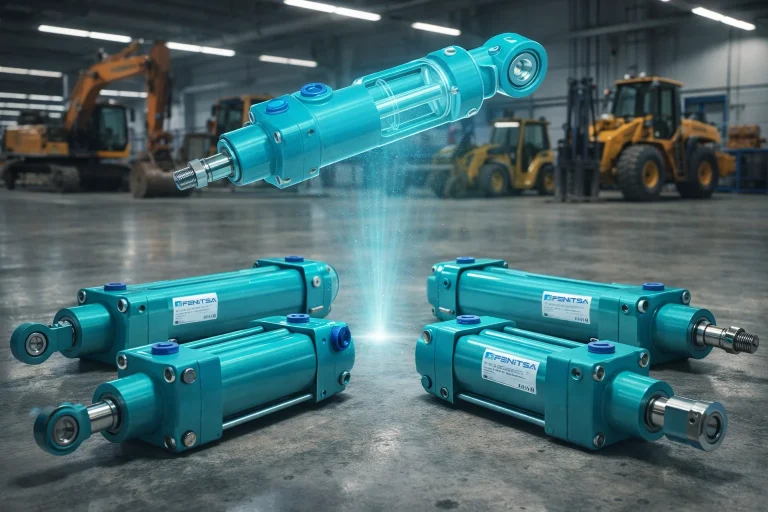
What Bore Does a 50 Ton Cylinder Need?
D = √(4F / (π × 0.1 × p))Why do Ø200 mm at 160 bar and Ø160 mm at 250 bar give the same force? Force is pressure times area, and 200² × 160 = 160² × 250 = 6,400,000. The smaller cylinder is lighter and uses 36 % less oil per stroke; the larger one runs with standard 160 bar components.
For a 10 % reserve (55 t) no standard bore is enough at 160 bar. Order Ø200 mm with the 250 bar option and set the relief valve to about 172 bar.
Bore vs Pressure Table for 50 Tons
Metric tonne and US ton rows at 100–250 bar (1 US ton = 0.907 t).
| Pressure | Target | Calculated bore | Standard bore | Force of the standard bore | Reserve |
|---|---|---|---|---|---|
| 100 bar | 50 t | Ø249.9 mm | Above Ø200 — outside the standard series | — | — |
| 100 bar | 50 US tons | Ø238.0 mm | Above Ø200 — outside the standard series | — | — |
| 160 bar | 50 t | Ø197.5 mm | Ø200 mm | 51.3 t | +2.5 % |
| 160 bar | 50 US tons | Ø188.1 mm | Ø200 mm | 56.5 US tons | +13.0 % |
| 210 bar (reference only) | 50 t | Ø172.4 mm | Ø200 mm | 67.3 t | +34.5 % |
| 210 bar (reference only) | 50 US tons | Ø164.2 mm | Ø200 mm | 74.2 US tons | +48.3 % |
| 250 bar | 50 t | Ø158.0 mm | Ø160 mm | 51.3 t | +2.5 % |
| 250 bar | 50 US tons | Ø150.5 mm | Ø160 mm | 56.5 US tons | +13.0 % |
Measured in US tons, the reserve of Ø200 mm at 160 bar grows to 13 %. At 100 bar no single standard cylinder reaches 50 t. The 210 bar lines are for comparison only; our rating is 160 bar, 250 bar optional. Full chart: hydraulic cylinder sizes.
Push vs Pull at 50 Tons
| Bore / rod | Pressure | Push (t) | Pull (t) | Pull (US tons) | Area ratio φ |
|---|---|---|---|---|---|
| Ø200 / Ø110 mm | 160 bar | 51.3 | 35.8 | 39.4 | 1.43 |
| Ø200 / Ø125 mm | 160 bar | 51.3 | 31.2 | 34.4 | 1.64 |
| Ø160 / Ø90 mm | 250 bar | 51.3 | 35.0 | 38.6 | 1.46 |
| Ø160 / Ø100 mm | 250 bar | 51.3 | 31.2 | 34.4 | 1.64 |
| Ø200 / Ø110 mm | 250 bar | 80.1 | 55.9 | 61.6 | 1.43 |
At 160 bar no 50 t cylinder pulls 50 t; the strongest pull comes from Ø200 / Ø110 mm with 35.8 t, plenty for lifting a press tool. To pull 50 t — stripping or drawing — use Ø200 / Ø110 mm with the 250 bar option (55.9 t).
Stroke, Speed and Flow
Press speeds are low, but the bore is large: every 0.01 m/s on a Ø200 mm piston takes 18.8 L/min.
| Pressing speed | Flow (L/min) | Power (kW) | Time for 200 mm (s) | Return speed, same flow |
|---|---|---|---|---|
| 0.01 m/s | 18.8 | 5.0 | 20.0 | 0.014 m/s |
| 0.02 m/s | 37.7 | 10.1 | 10.0 | 0.029 m/s |
| 0.05 m/s | 94.2 | 25.1 | 4.0 | 0.072 m/s |
At 0.05 m/s the drive already needs 25 kW. So presses approach fast at low pressure and switch to the slow, full-force stroke near the part, within the 0.5 m/s limit.
Buckling Check for Long Strokes
A flange-mounted press cylinder driving a guided platen rarely buckles. Lifting frames differ: the cylinder is often pinned at both ends. Example: rear clevis and rod eye (factor 1), free length = 2 × stroke + an assumed 400 mm; Euler load Fk = π² × E × I / Lk², safety factor 3.5.
| Stroke | Free length (mm) | Ø100 rod, Ø160 bore (t) | Ø125 rod, Ø200 bore (t) | Result for 50 t |
|---|---|---|---|---|
| 500 mm | 1,400 | 151.2 | 369.2 | Both pass |
| 1,000 mm | 2,400 | 51.5 | 125.6 | Both pass |
| 1,500 mm | 3,400 | 25.6 | 62.6 | Only Ø200 / Ø125 |
At 1,000 mm the Ø100 mm rod passes with almost nothing to spare (51.5 t); at 1,500 mm only Ø200 / Ø125 mm is allowed the full load (62.6 t). Guided layouts: long stroke hydraulic cylinders.
Where 50 Ton Cylinders Are Used
50 ton shop presses
H-frame workshop presses for bearings, straightening and assembly. Press cylinders
Forming presses
Embossing, flanging and forming of plate parts on a guided platen.
Mining machinery
Heavy-duty cylinders exposed to dust, shock and water. Mining equipment cylinders
Lifting and jacking frames
Machines, moulds and structures lifted by one or more cylinders. Heavy-load cylinders
Industrial (160–250 bar) vs Jack-Type (700 bar) 50 Ton Cylinders
Is a 700 bar 50-ton jack cylinder the same as an industrial 50-ton cylinder?
No. Both push 50 t, but they are built for different jobs. A 700 bar jack-type cylinder reaches 50 t with about Ø94.4 mm and is made for intermittent lifting and pressing with a portable pump. An industrial 50 t cylinder is a machine component: flange, clevis or trunnion mounted, driven both ways by a power unit, built for continuous cycling.
| 700 bar jack-type | Ø160 mm at 250 bar | Ø200 mm at 160 bar | |
|---|---|---|---|
| Piston area (cm²) | 70.0 | 201.1 | 314.2 |
| Oil per 100 mm stroke (L) | 0.70 | 2.01 | 3.14 |
| Flow for 0.02 m/s (L/min) | 8.4 | 24.1 | 37.7 |
| Power at 0.02 m/s (kW) | 9.8 | 10.1 | 10.1 |
| Return stroke | Spring or load on most models | Oil (double acting) | Oil (double acting) |
The power row is nearly the same in every column, because power is force times speed. Higher pressure makes a cylinder smaller for the same force, not stronger; the cost moves into high-pressure pumps, hoses and valves.
How to Order a 50 Ton Cylinder
For a press, give us the rated force, relief setting, working and approach stroke, and how the platen is guided. Example: FDH-200-400-FFM-NS-HR — Ø200 mm, 400 mm stroke, front flange, NBR seals, hardened and chromed rod — plus the rod diameter and the 250 bar option if needed. See FDH type and tie-rod cylinders.
Send Us Your Cylinder Data
Bore, rod, stroke, working pressure, mountings and quantity — or a drawing or photo of the cylinder you want to replace. Our engineers reply with a technical proposal and a quotation. info@fenitsa.com.
50 Ton Hydraulic Cylinder – FAQ
Short answers from our engineers.
What size is a 50 ton hydraulic press cylinder?
Ø200 mm at 160 bar or Ø160 mm at 250 bar; both push 51.3 t. The Ø200 mm version works with standard 160 bar components, the Ø160 mm version is smaller and lighter.
How many US tons does a 50 ton cylinder push?
Ø200 mm at 160 bar pushes 56.5 US tons (51.3 t).
What pump does a 50 ton press cylinder need?
For a Ø200 mm bore, 37.7 L/min gives a pressing speed of 0.02 m/s, which is 10.1 kW at 160 bar. Faster approach strokes are normally run at lower pressure.
Can a Ø160 mm cylinder at 160 bar do 50 tonnes?
No. It pushes 32.8 t at 160 bar and would need 244 bar for 50 t. Order it with the 250 bar option, or use Ø200 mm.
Which mounting suits a 50 ton press cylinder?
Usually a front flange (FFM) on the press crown, with the rod fixed to a guided platen. The flange carries the reaction force, and the guided platen keeps side loads off the rod and the buckling length short.
Related Pages
Hydraulic Cylinder Sizes
Bore-to-tons chart, Ø40–Ø200 mm.
30 Ton Hydraulic Cylinder
Which bores pull 30 t, and retract speed.
100 Ton Hydraulic Cylinder
Twin Ø160 cylinders or a special bore.
Hydraulic Cylinder Force Calculator
Required bore for any force and pressure.