


Key Criteria for Selecting Pneumatic Cylinders in Industrial Automation
- Home
- Key Criteria for Selecting Pneumatic Cylinders in Industrial Automation
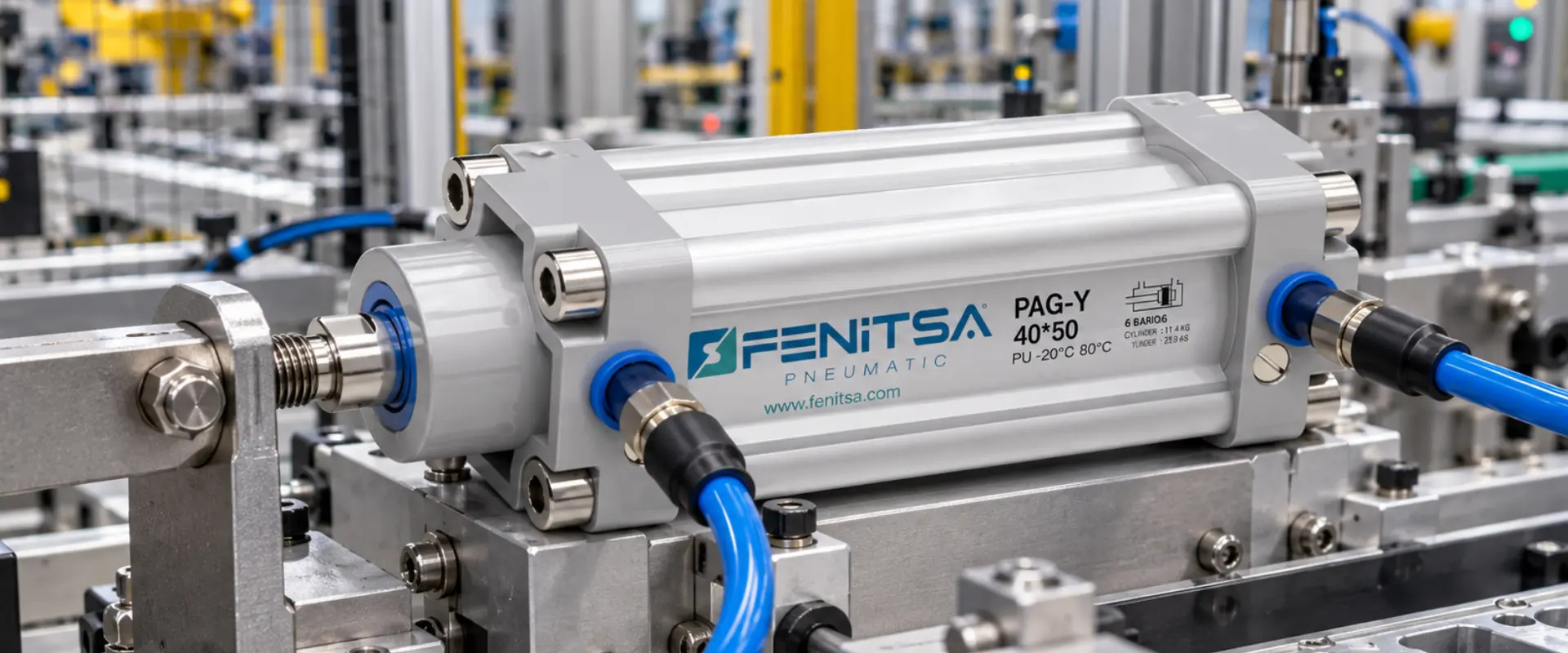
Pneumatic cylinders are widely used in industrial automation systems to perform linear motion quickly, precisely, and repeatedly. From packaging machines and assembly lines to product pushing, clamping, and positioning applications, they enable compressed air to be converted into mechanical motion across a wide range of machinery.
However, selecting a pneumatic cylinder for an automation project should not be based solely on the required stroke length. The force the cylinder must generate, operating pressure, piston bore, cycle frequency, movement speed, mounting configuration, and sensor requirements should all be evaluated as part of the overall system design.
In applications where standardized mounting dimensions and machine integration are particularly important, ISO 15552 cylinders are often preferred. Fenitsa’s ISO 15552 cylinder FMY series is among the solutions developed for general industrial automation applications, offering various piston bore and stroke options.
Piston Bore Should Be Determined According to the Required Force
One of the first factors to evaluate when selecting a pneumatic cylinder is the amount of force required by the application.
Compressed air acts on the piston surface to generate linear motion. Therefore, the theoretical force a cylinder can produce mainly depends on the system pressure and the effective piston area. As the piston bore increases, the theoretical force available at the same operating pressure also increases.
For this reason, selecting the smallest possible cylinder bore based only on the available installation space may not always be the correct approach.
For example, if a product only needs to be pushed forward on an automation line, the required force may be relatively low. In contrast, applications involving clamping, lifting, or moving a heavier mechanism may require a larger piston bore.
Fenitsa’s FMY series is available with Ø32, Ø40, Ø50, Ø63, Ø80, and Ø100 mm piston bore options. The product page specifies separate extension and retraction forces for different bore sizes under an operating pressure of 6 bar.
It is important to understand that extension and retraction forces are not equal.
During the return stroke, the piston rod occupies part of the effective piston area. As a result, the usable surface area is reduced, meaning that the retraction force of a double-acting pneumatic cylinder is generally lower than its extension force under the same operating conditions.
In applications where the machine carries a load in both directions, calculations should therefore not be based solely on the extension stroke.
It should also be considered that theoretical force may differ from the force actually available under real operating conditions. Pressure losses in the air line, friction, movement speed, and mechanical resistance can all affect system performance. For this reason, all operating conditions of the application should be taken into account when determining the appropriate cylinder bore.
Stroke Length Represents More Than Just Travel Distance
The stroke of a pneumatic cylinder refers to the linear distance travelled by the piston rod. However, stroke selection should not be limited to answering the question, “How far does the component need to move?”
The available installation space inside the machine should also be considered.
The cylinder must fit within the machine when fully retracted and must not collide with surrounding mechanical components when fully extended. Proper alignment of the piston rod becomes particularly important in long-stroke applications.
In addition to standard stroke options, Fenitsa’s FMY series can be manufactured with different stroke lengths according to application requirements. This can be especially useful in projects where standard dimensions do not fully match the machine design.
However, choosing the longest possible stroke is not always the correct approach.
If side loads are applied to the piston rod in a long-stroke application, unwanted forces may occur on the rod and bearing components. For this reason, the cylinder should operate as axially as possible.
If the machine movement is not completely linear or the mounting angle changes during operation, suitable joints and mounting accessories should be considered.
Stroke length also affects cycle time. If a cylinder with a long travel distance is required to operate at a high cycle rate, the air flow capacity, valve sizing, and pneumatic line diameters must also be suitable for the application.
Therefore, stroke should be evaluated not as an isolated cylinder specification but as a parameter that directly interacts with the entire pneumatic system.
Why Are Movement Speed, Cushioning, and Sensor Selection Important?
In industrial automation, it is not sufficient for a pneumatic cylinder to simply move from one position to another. The speed of the movement and the way the piston stops at the end of the stroke also affect overall machine performance.
In high-speed production lines, the piston may reach the cylinder end cap with considerable impact if the movement is not properly controlled. Repeated impact over many cycles can increase mechanical stress on both the cylinder and the connected mechanism.
This is where cushioning becomes important.
Fenitsa FMY cylinders are equipped with adjustable cushioning. Cushioning helps the piston decelerate in a more controlled manner as it approaches the end of the stroke.
However, cushioning should not be considered a complete speed control solution on its own.
Valves, flow control components, hose diameters, and pressure settings within the pneumatic circuit directly affect cylinder speed. To achieve the required machine cycle time, the pneumatic cylinder and the surrounding pneumatic components should be sized together as part of the same system.
Another important factor in automation systems is the use of sensors.
In a PLC-controlled machine, the control system may need to determine whether the piston has reached its extended or retracted position. Pneumatic cylinders with magnetic pistons can be used together with suitable sensors to detect piston position.
This information can be used to trigger the next machine operation, verify the completion of a cycle, or control the sequence of an automated process.
Since Fenitsa’s FMY series is designed with a magnetic piston and sensor slots, this feature can be considered during the project stage for applications where position feedback must be transferred to the automation system.
Identifying sensor requirements during the initial machine design stage rather than after the machine has been completed can simplify both electrical and mechanical integration.
Mounting, Operating Environment, and Air Quality Should Not Be Overlooked
Even when the correct bore and stroke have been selected, improper mounting can negatively affect the operating life of a pneumatic cylinder.
The primary function of a pneumatic cylinder is to generate axial linear motion. Continuous side loading on the piston rod can create unnecessary stress on the rod, bearing components, and sealing elements.
For this reason, the cylinder mounting method should be determined during the machine design stage.
Foot mounts, flange mounts, clevis connections, and articulated mounting systems can be considered for different machine geometries. A fixed mechanism that operates in a completely linear direction may not require the same mounting arrangement as a system whose operating angle changes during movement.
The operating environment is also an important part of the selection process.
In production environments exposed to dust, moisture, or fluctuating temperatures, the suitability of the sealing elements and overall cylinder construction for the surrounding conditions should be evaluated.
Compressed air quality also has a direct effect on pneumatic system performance. According to the Fenitsa FMY product page, the cylinder operates with filtered and lubricated air. For this reason, air preparation equipment should not be viewed merely as auxiliary components but as an important part of maintaining reliable pneumatic system operation.
For the Fenitsa FMY Ø32–Ø100 product range, an operating pressure range of 1.5–10 bar is specified on the product page. However, this does not mean that a machine should always operate at the highest possible pressure. The required operating pressure should be determined according to the necessary force, cylinder bore, and overall pneumatic system design.
Ultimately, selecting the correct pneumatic cylinder for industrial automation does not depend on a single technical parameter. The piston bore should be selected according to the required force, the stroke according to the actual movement distance, the mounting type according to the mechanical geometry, and the sensor configuration according to the automation requirements.
When movement speed, cycle frequency, cushioning, environmental conditions, and compressed air quality are also included in the selection process, the pneumatic system can be designed in a more balanced and reliable manner.
Especially in high-cycle production machinery, a pneumatic cylinder should not be considered merely as a “bore × stroke” component. Treating it as an integrated motion element within the overall automation system forms the foundation of selecting the right pneumatic cylinder.

