

 Türkçe
 Русский
 Español
 العربية
Hydraulic Cylinders for Dam Gate Systems
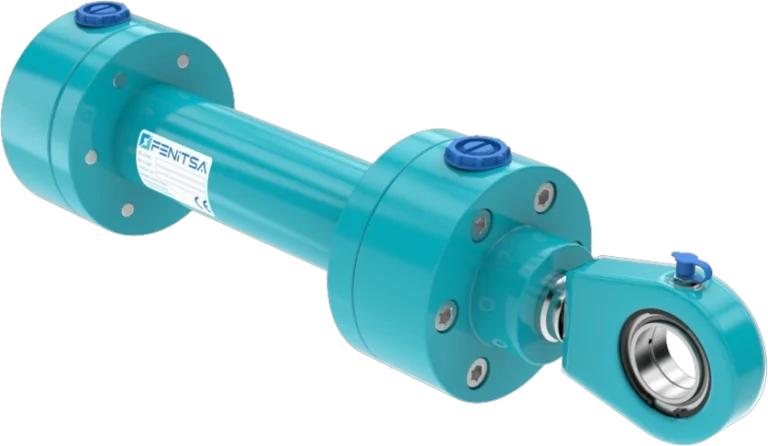
Gate hoist cylinders work slowly and rarely — but when they are needed, they must work first time, often after months of standing still next to water. Long strokes, reliable load holding and corrosion protection are the design priorities.
Fenitsa builds long-stroke hoist cylinders for vertical lift, sluice and irrigation gates, designed to the gate geometry and water load you specify.
Gate Types and Cylinder Arrangements
| Gate type | Cylinder arrangement | Design focus |
|---|---|---|
| Vertical lift / sluice gate | One or two vertical cylinders lifting the leaf | Long stroke, buckling, synchronisation of twin cylinders |
| Radial (tainter) gate | Cylinders pivoting at the pier, rotating the gate | Pivot mountings, changing force along the stroke |
| Flap gate | Cylinder under or beside the flap | Submerged or wet mounting, corrosion |
Worked Example: Lifting Force for a Sluice Gate
Illustrative calculation — every project is checked against its own data.
A 4 m wide gate holds back 3 m of water. The horizontal water force is ρ·g·h²/2·w = 176.6 kN. With a friction coefficient of 0.4 on the guides, lifting must overcome 70.6 kN of friction plus a 30 kN gate weight.
With a 1.5 safety factor the hoist force is about 151 kN. At 160 bar the theoretical bore is 110 mm, so a Ø125 mm cylinder is chosen — then the rod is checked for buckling over the full stroke, which usually decides the rod size on tall gates.
Design Points for Gate Cylinders
- Load holdingPilot-operated check or counterbalance valves on the cylinder hold the gate at any position.
- SynchronisationTwin-cylinder gates need flow dividers or position control so the leaf does not jam.
- Long idle periodsRod boots, corrosion-protective paint and regular exercise cycles keep seals and rods healthy.
- Stroke and bucklingStrokes up to 5,000 mm in the standard series; the rod is sized for buckling at full extension.
Our standard hydraulic series are built for 160 bar working and 240 bar test pressure with a 250 bar option, bores from Ø40 to Ø200 mm and strokes up to 5,000 mm, using honed St52 tube and Ck45 rods hard-chrome plated to at least 20 µm. Anything outside that envelope is engineered as a custom cylinder.
Which Fenitsa Cylinder Fits Which Function?
Inspection Routine
What to check, and how often, in this application.
- MonthlyRun each gate through a full cycle to keep seals and valves working.
- QuarterlyInspect rods, boots and paint; clean debris from guides.
- YearlyTest load-holding valves and synchronisation of twin cylinders.
- Every few yearsReseal and repaint during planned outages.
Hydraulic Cylinders for Dam Gate Systems – FAQ
How do you calculate the force needed to lift a dam gate?
Water force = ρ·g·h²/2 × gate width; lifting force = guide friction on that water force + gate weight, times a safety factor.
Can a gate cylinder hold the gate if the pump stops?
Yes, with pilot-operated check or counterbalance valves mounted directly on the cylinder.
How are two gate cylinders kept in step?
With flow dividers, a mechanical link or electronic position control, depending on accuracy and gate width.
How long can a gate hoist cylinder be?
Strokes up to 5,000 mm in our standard series; longer strokes are engineered with buckling-resistant rod sizes or intermediate supports.
Send Your Application Data
Bore, rod, stroke, pressure, mountings and quantity — or a drawing or photo of the existing cylinder. We reply with a technical proposal and quotation from our plant in Konya, Türkiye.