

 Türkçe
 Русский
 Español
 العربية
Marine Hydraulic Cylinders
Salt spray, humidity and long idle periods followed by sudden heavy duty — marine service attacks a hydraulic cylinder from the outside as much as from the inside. Corrosion on the chrome rod, paint breakdown and seized mountings are the typical failures.
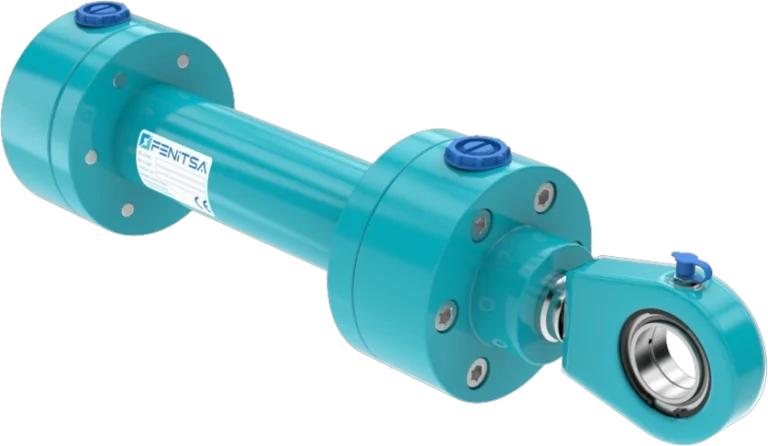
Fenitsa supplies hydraulic cylinders for deck machinery and vessel equipment built to your drawing, with paint systems, rod protection and seals selected for marine exposure.
Marine Applications
| Equipment | Cylinder role | Watch-out |
|---|---|---|
| Hatch covers | Opening and closing heavy covers | Long idle times, then high loads |
| Steering gear | Rudder actuation | Continuous duty, reliability-critical |
| Deck cranes, davits | Luffing, lifting, slewing assist | Load holding, splash zone exposure |
| Ramps and doors | Opening/closing stern and side ramps | Very long strokes, buckling |
| Winches and mooring | Brake and clutch actuation | Wet, salty environment |
Protecting a Cylinder Against Salt and Water
- Paint systemA multi-layer marine paint system on the tube, heads and mountings.
- Rod and body materialHard chrome of at least 20 µm on Ck45 as standard; stainless cylinders are available for ship-industry applications where the exposure requires them.
- Rod bootsProtective gaiters keep salt and grit off the rod when the cylinder is idle.
- Mounting pinsGreased, corrosion-protected pins avoid seized clevises after long idle periods.
- Seal selectionSeals chosen for the fluid and temperature, including biodegradable oils where required.
Worked Example: Hatch Cover Cylinder
A hatch cover panel needs 80 kN to start opening at the hinge geometry. At 160 bar (16 N/mm²) the area is 5,000 mm², a theoretical bore of 79.8 mm — so a Ø80 mm cylinder (80.4 kN) is chosen, with a load-holding valve so the panel cannot drop if a hose fails.
Because the cylinder pivots through the opening arc, a rear clevis and a rod eye are used to avoid side load on the rod bearing.
Our standard hydraulic series are built for 160 bar working and 240 bar test pressure with a 250 bar option, bores from Ø40 to Ø200 mm and strokes up to 5,000 mm, using honed St52 tube and Ck45 rods hard-chrome plated to at least 20 µm. Anything outside that envelope is engineered as a custom cylinder.
Which Fenitsa Cylinder Fits Which Function?
Inspection Routine
What to check, and how often, in this application.
- Before each voyageVisual check for rod corrosion, paint damage and oil leaks.
- MonthlyExercise idle cylinders through a full stroke to keep seals flexible.
- QuarterlyGrease pins, check boots and wipers, test load-holding valves.
- At dry-dockReseal and repaint; renew rods with pitting.
Marine Hydraulic Cylinders – FAQ
Do you supply stainless steel marine cylinders?
Yes — stainless cylinders for the ship industry are part of the application range in our hydraulic catalogue. Describe the exposure (splash zone, deck, enclosed space) and we will specify body, rod and seal materials in the technical offer.
How do I prevent rod corrosion on idle cylinders?
Retract the rod where possible, fit rod boots, and keep a film of oil on exposed chrome during long idle periods.
Can marine cylinders hold a load if a hose bursts?
Yes, with a load-holding (counterbalance or pilot-operated check) valve mounted directly on the cylinder.
Can you build long-stroke ramp cylinders?
Yes — strokes up to 5,000 mm in the standard series, with a buckling check for the real mounting geometry.
Send Your Application Data
Bore, rod, stroke, pressure, mountings and quantity — or a drawing or photo of the existing cylinder. We reply with a technical proposal and quotation from our plant.