

 Türkçe
 Русский
 Español
 العربية
How Hydraulic Cylinders Are Made: Step-by-Step Manufacturing
A hydraulic cylinder is made in nine stages: sizing, material selection, tube honing, rod machining and chrome plating, head and piston machining, welding, seal assembly, pressure testing and painting. Every stage decides how long the cylinder will hold pressure without leaking.
This guide follows the route a Fenitsa cylinder takes through our plant, where casting, CNC machining, robotic processing, painting, assembly and quality control are all done in-house.
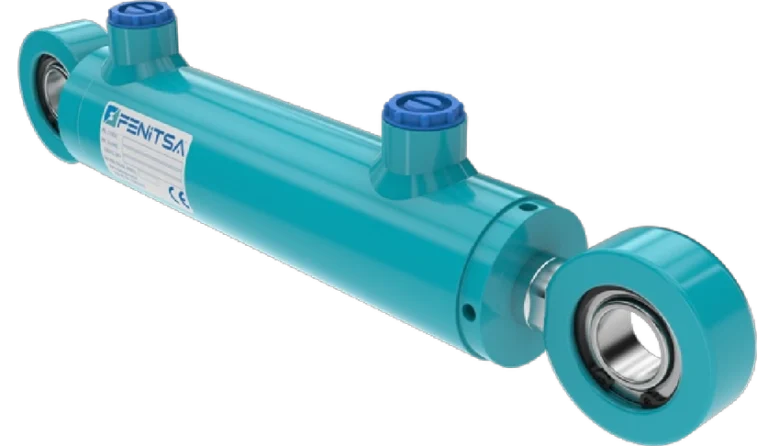
The 9 Manufacturing Steps
- Design and sizing — bore, rod and stroke are calculated from the load, pressure and rod buckling.
- Material selection — honed St52BK+S steel tube, Ck45 rod steel, NBR or Viton seals.
- Tube preparation — the tube is cut to length and its bore is honed to a smooth, accurate surface for the piston seal.
- Rod machining — the rod is turned, ground to f7 tolerance and hard-chrome plated (≥ 20 µm).
- Heads, piston and bushings — machined on CNC lathes and machining centres.
- Welding — base and ports are welded on welded designs; the FDH series uses flanged heads bolted to the tube.
- Seal assembly — piston, rod, wiper seals and O-rings are fitted in a clean area.
- Pressure and leakage test — every cylinder is tested for internal and external leakage; FDH test pressure is 240 bar for 160 bar working pressure.
- Painting and protection — primer and top coat, ports plugged, rod protected for shipping.
Critical Values in Production
| Item | Value |
|---|---|
| Tube | Honed St52BK+S steel |
| Rod | Ck45, hard chrome ≥ 20 µm, f7 tolerance |
| Working / test pressure | 160 bar / 240 bar (250 bar option) |
| Bores | Ø40–Ø200 mm |
| Max. stroke | 5,000 mm |
| Temperature | −20 °C to +80 °C (special seals −30 °C to +200 °C) |
Example: Sizing a 10-Ton Cylinder
Required bore D = √(4F / πp). For 10 t at 160 bar the minimum is Ø88.3 mm, so the next catalogue bore Ø100 mm is chosen; it delivers 12.8 t at 160 bar. The rod (Ø56 or Ø70 mm) is then checked for buckling against the stroke. Full tables are on the 10-ton hydraulic cylinder page.
Common Manufacturing Mistakes
- An unhoned or poorly honed tube: the piston seal wears within weeks.
- Chrome that is too thin or a rod that is not ground: pitting and rod-seal leaks.
- No buckling check on long strokes: the rod bends under the first full load.
- Skipping the pressure test: internal leakage only shows up on the machine.
Frequently Asked Questions
What materials are hydraulic cylinders made of?
The tube is honed St52BK+S steel, the rod is Ck45 steel with hard chrome of at least 20 µm, and the seals are NBR as standard or Viton for higher temperatures.
Why is the cylinder tube honed?
Honing gives the bore the accuracy and surface finish the piston seal needs. A rough bore cuts the seal and causes internal leakage.
Why is the rod chrome plated?
Hard chrome protects the rod against corrosion and wear and gives the rod seal a smooth running surface.
How is a hydraulic cylinder tested?
Each cylinder is pressurised on a test bench and checked for internal and external leakage. For the FDH series the test pressure is 240 bar.
Send Us Your Cylinder Data
Bore, rod, stroke, working pressure, mountings and quantity — or a drawing or photo of the cylinder you want to replace. Our engineers reply with a technical proposal and a quotation.
Related Pages
Hydraulic Cylinders
All series and bores
FDH series
Ø40–Ø200 standard series
Hydraulic cylinder seals
Seal types and leak tests
Force calculator
Bore, pressure and force