


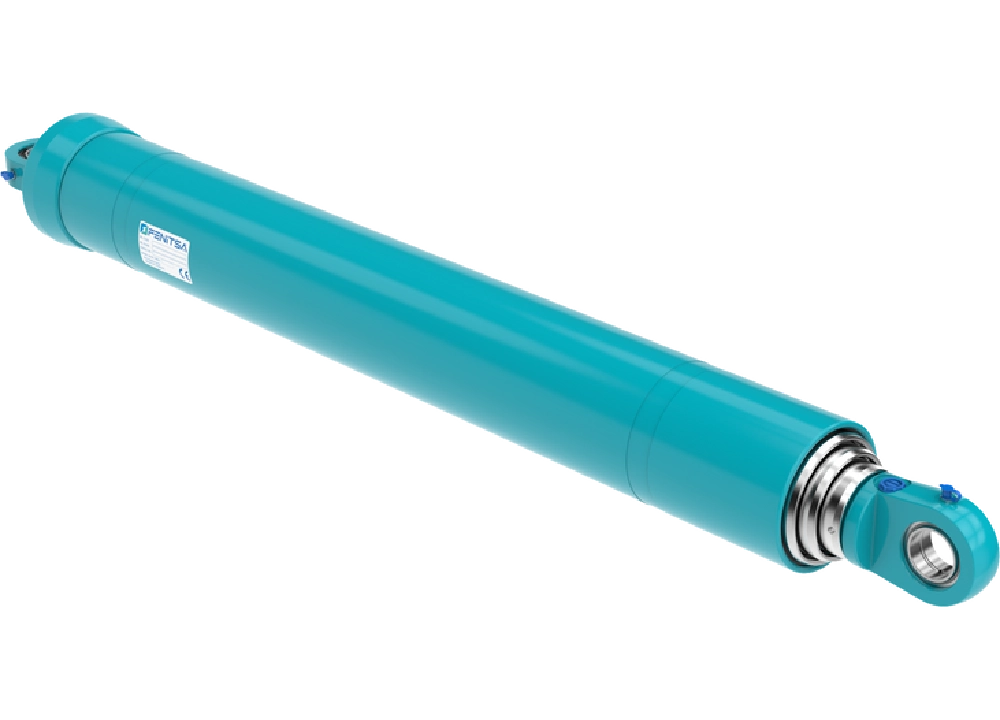


How to Size a Telescopic Cylinder
A telescopic cylinder is made of nested stages and delivers a stroke several times its closed length. More stages give more stroke from the same closed length, but each stage is smaller in diameter, so force drops on the last stages. That is why tipper and lifting applications are calculated for the smallest stage and the highest load point.
| Stages | Approx. stroke | Stroke / closed length |
|---|---|---|
| 2 | 1,700 mm | 1.70 |
| 3 | 2,550 mm | 2.55 |
| 4 | 3,400 mm | 3.40 |
| 5 | 4,250 mm | 4.25 |
The table only illustrates the relationship; the real stroke depends on stage overlap and head dimensions and is calculated per project.
Typical Applications
Tipper trucks and trailers, refuse bodies, lifting platforms and any machine that needs long travel from a short body. Single-acting telescopic cylinders retract under the weight of the load; double-acting versions also retract under pressure. See single acting hydraulic cylinders.
Frequently Asked Questions
What is a telescopic hydraulic cylinder?
A hydraulic cylinder built from several nested stages that gives a stroke several times its closed length.
How is telescopic cylinder force calculated?
Separately for each stage: pressure × that stage’s area. The load is usually highest while the smallest stage extends, so the calculation is made for that stage.
How many stages do I need?
The required stroke and the closed-length limit of the machine decide it. More stages mean more stroke but less force and side-load capacity on the last stage.
Are telescopic cylinder sizes standard?
No — stage diameters, number of stages and stroke are engineered per application.