


What Technical Criteria Should Be Considered When Selecting a Telescopic Hydraulic Cylinder?
- Home
- What Technical Criteria Should Be Considered When Selecting a Telescopic Hydraulic Cylinder?
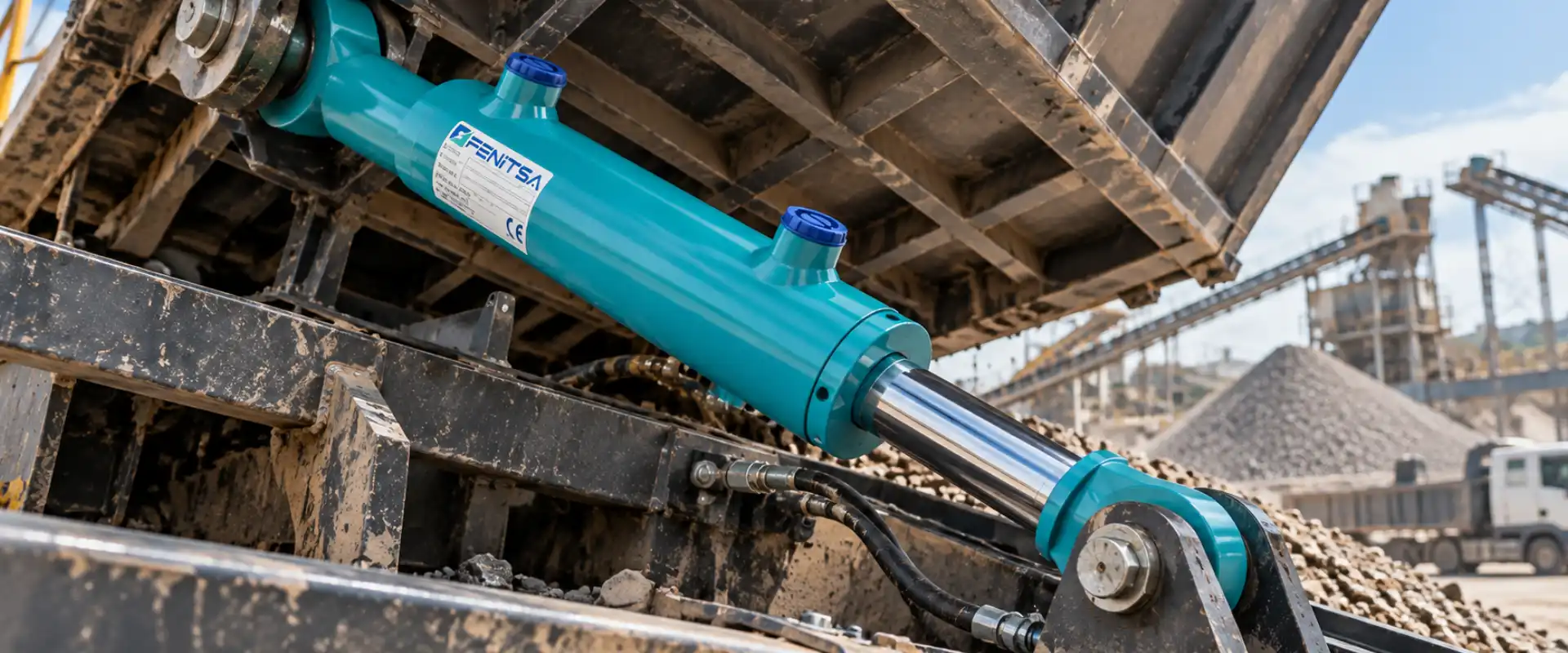
Telescopic hydraulic cylinders are an important solution for machines that require a long travel distance within a limited installation space. Used in applications ranging from tipping systems and lifting platforms to trailers and refuse bodies, these cylinders operate through the sequential extension of multiple nested stages.
In a standard hydraulic cylinder, increasing the stroke length also increases the retracted length of the cylinder. However, when there is not enough space on the machine for a long cylinder body, a telescopic design provides a significant advantage. By integrating multiple stages into a single cylinder assembly, the retracted length can be kept relatively compact while achieving a much longer overall stroke.
However, selecting a telescopic cylinder should not be based solely on the question, “How many millimeters of stroke are required?” The load to be lifted, operating pressure, number of stages, retracted length, mounting configuration, and the way the load acts on the cylinder should all be evaluated together.
When considering project-specific telescopic hydraulic cylinders solutions, it is equally important to define the mechanical and hydraulic requirements of the system accurately from the beginning.
Stroke and Retracted Length Should Be Calculated Together
One of the main reasons for using a telescopic cylinder is to achieve a long stroke within a restricted installation space. For this reason, one of the first steps in the selection process is to determine both the required travel distance and the maximum retracted length that can be accommodated by the machine.
For example, if a lifting mechanism needs to travel several meters, a conventional single-stage cylinder may occupy more space than the machine can provide. With a telescopic design, the required travel can be distributed across multiple stages.
This is where the number of stages becomes important.
Increasing the number of stages can make it possible to achieve a longer stroke from the same retracted length. However, this does not mean that using as many stages as possible is always the best solution. Each additional stage affects the mechanical design, diameter progression, and force characteristics of the cylinder.
For this reason, the required total stroke should first be established, followed by the maximum allowable retracted length within the machine. The appropriate number of stages can then be determined according to the relationship between these two values.
It is also important to consider not only the fully extended and fully retracted dimensions of the cylinder, but also the clearance between the cylinder and surrounding machine components throughout the entire working cycle.
If hoses, mounting components, chassis structures, or moving mechanisms are present in the installation area, the telescopic cylinder must be able to complete its full travel without interference or collision.
Why Should Force Calculations Be Carried Out Down to the Smallest Stage?
One of the important differences between telescopic hydraulic cylinders and standard hydraulic cylinders is that the effective piston area may change from one stage to another during operation.
In hydraulic systems, the available force primarily depends on the operating pressure and the effective piston area. Since the outer large stage and the smaller inner stages of a telescopic cylinder have different diameters, the force available at each stage can also vary.
As a general rule, the smaller the stage diameter, the lower the force that can be generated at the same hydraulic pressure.
For this reason, selecting a cylinder based only on the force available from the first and largest stage can be misleading. It is also necessary to determine which stage is active at the most demanding point of the application.
In tipping and lifting applications in particular, the load geometry may change throughout the movement. The force required at the initial lifting point may be very different from the force required once the mechanism has already been raised.
When selecting the cylinder, the following questions should be answered:
What is the maximum load to be lifted? Does the cylinder lift the load directly, or does it operate through a lever mechanism? What is the system operating pressure? Can the required force still be achieved when the smallest stage is active?
Without evaluating these parameters together, selecting a cylinder solely according to the outer body diameter or total stroke length would not represent a sound engineering approach.
Should a Single-Acting or Double-Acting Cylinder Be Selected?
Another important factor to consider when selecting a telescopic hydraulic cylinder is the operating principle.
In single-acting telescopic cylinders, hydraulic pressure generally provides movement in one direction. Retraction may then occur under the weight of the load or through the mechanical forces present in the application.
Tipping systems are one of the most common examples. Hydraulic pressure raises the body, while the geometry of the system and the effect of the load help the cylinder retract.
However, natural or gravity-assisted retraction is not possible in every application.
If the machine requires controlled cylinder movement in both extension and retraction directions, a double-acting configuration should be considered. In this design, hydraulic pressure can be applied in both directions.
Therefore, the selection process should not only answer the question, “How much load must the cylinder lift?” It should also answer, “How will the cylinder retract?”
Selecting the wrong operating type in applications that require controlled retraction can create additional problems within the overall system design.
Why Are Mounting Configuration and Load Direction Important?
A hydraulic cylinder is primarily designed to operate under axial loading. However, in real machine applications, installation errors or mechanical geometry can introduce side loads into the cylinder.
This becomes even more important in telescopic cylinders because of their long extended length.
When the cylinder is fully extended, the combined length of the stages can increase significantly. In this condition, misaligned mounting points or off-axis loading can create undesirable forces on the cylinder stages.
For this reason, the mounting method should be selected according to the movement geometry of the machine.
When clevis mounts, pin connections, trunnion arrangements, or other mounting solutions are used, the cylinder should be able to follow its natural working axis throughout the entire movement. It is not sufficient for the mounting points to be aligned only when the cylinder is retracted; mechanical compatibility must also be checked when the system is fully or partially extended.
This is particularly important in moving tipping bodies, where the angle between the chassis and the body changes continuously throughout the lifting cycle.
Reducing side loads is important not only for overall cylinder performance but also for the reliable operation of bearing and sealing components.
Operating Pressure and the Hydraulic System Should Be Evaluated Together
A telescopic cylinder should not be considered as an independent component separate from the hydraulic system.
Pump capacity, system pressure, valve configuration, hose sizing, and connection dimensions all directly affect the operating characteristics of the cylinder. In order for the cylinder to deliver its theoretical force, the hydraulic system must also be capable of providing the required operating conditions.
The assumption that higher hydraulic pressure always provides a better solution is incorrect. The cylinder, mounting components, and all other components within the hydraulic circuit must be rated for the intended operating pressure.
Movement speed is another important criterion.
If the cylinder extends or retracts too quickly, impact loads may be created within the mechanical system. Controlled movement becomes especially important in applications involving heavy loads.
For this reason, flow rate, cylinder volume, and the desired movement time should be evaluated together.
If the machine must complete its movement within a specific cycle time, the project should not focus only on changing the cylinder dimensions. Pump flow rate and valve selection should also be considered as part of the overall system design.
What Information Should Be Provided When Ordering a Telescopic Cylinder?
When a custom telescopic hydraulic cylinder is being developed for a specific project, providing accurate technical information to the manufacturer can significantly simplify the design and production process.
The required total stroke and the maximum allowable retracted length should first be defined. In addition, the maximum load, operating pressure, mounting points, and operating direction of the cylinder should be specified.
The requirement for single-acting or double-acting operation should also be clarified at the beginning of the project.
If the cylinder is being manufactured as a replacement for an existing component, measuring only the overall dimensions may not be sufficient. Stage diameters, mounting dimensions, port positions, pin diameters, and mounting center distances should also be considered.
In new machine projects, the cylinder design should be developed together with the mechanical system. This allows the stroke length, retracted length, and mounting geometry to be optimized before production begins.
In conclusion, selecting the correct telescopic hydraulic cylinder is not simply a matter of achieving a long stroke. Retracted length, number of stages, required force, operating pressure, mounting geometry, and retraction method should all be evaluated as part of the same system.
Especially in machines that lift heavy loads or require reliable motion control, a properly sized telescopic cylinder becomes one of the key components for ensuring efficient, stable, and balanced hydraulic system operation.

