

 Türkçe
 Русский
 Español
 العربية
100 Ton Hydraulic Cylinder
A single 100 ton hydraulic cylinder needs a bore of about 279.4 mm at 160 bar or 223.5 mm at 250 bar — both above the Ø200 mm top of Fenitsa’s standard series. The standard route is two Ø160 mm cylinders at 250 bar in parallel, 102.5 t together; a single special-bore cylinder is quoted per project.
Below, both designs of hydraulic cylinders this size compared: bore table, load sharing, pull, flow, buckling and 700 bar jacks.
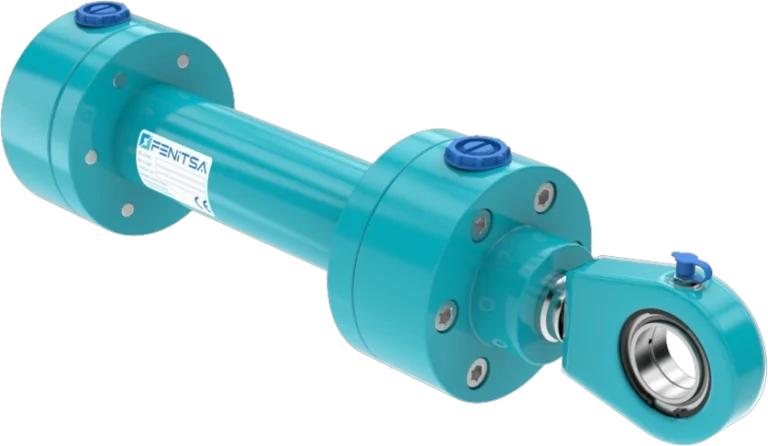
What Bore Does a 100 Ton Cylinder Need?
D = √(4F / (π × 0.1 × p))One hundred tonnes is 980.7 kN. At 160 bar that needs 61,292 mm² of piston — a 279.4 mm bore, with 1.95 times the area of Ø200 mm, the top of the standard series. At 250 bar it is still 223.5 mm.
Worked example — twin-cylinder press. A 100 t press uses two Ø160 mm cylinders with the 250 bar option under one guided platen. Each carries 50 t and needs 243.9 bar for the full rating; at 250 bar the pair delivers 102.5 t, a 2.5 % reserve. At 160 bar, two Ø200 mm cylinders do the same.Bore vs Pressure Table for 100 Tons
One cylinder or two sharing the load; metric tonne and US ton rows.
| Pressure | Target | Single cylinder | Each of two cylinders | Standard pair | Pair force |
|---|---|---|---|---|---|
| 100 bar | 100 t | Ø353.4 mm | Ø249.9 mm | Above Ø200 | — |
| 100 bar | 100 US tons | Ø336.6 mm | Ø238.0 mm | Above Ø200 | — |
| 160 bar | 100 t | Ø279.4 mm | Ø197.5 mm | 2 × Ø200 mm | 102.5 t |
| 160 bar | 100 US tons | Ø266.1 mm | Ø188.1 mm | 2 × Ø200 mm | 113.0 US tons |
| 210 bar (reference only) | 100 t | Ø243.8 mm | Ø172.4 mm | 2 × Ø200 mm | 134.5 t |
| 210 bar (reference only) | 100 US tons | Ø232.2 mm | Ø164.2 mm | 2 × Ø200 mm | 148.3 US tons |
| 250 bar | 100 t | Ø223.5 mm | Ø158.0 mm | 2 × Ø160 mm | 102.5 t |
| 250 bar | 100 US tons | Ø212.9 mm | Ø150.5 mm | 2 × Ø160 mm | 113.0 US tons |
Every single-cylinder figure exceeds Ø200 mm, even for 100 US tons (90.7 t). Split between two cylinders, it fits the standard series from 160 bar up. 210 bar is a reference point only (rating: 160 bar, 250 bar optional). Other sizes: hydraulic cylinder sizes.
Two Ways to Reach 100 Tons
| Two Ø160 mm cylinders at 250 bar | One special-bore cylinder | |
|---|---|---|
| Force | 102.5 t together | Designed for the load |
| Where the load acts | Two points: wide platens, frames, bridges | One point: a central load |
| Synchronisation | Needed | Not needed |
| Parts | Standard FDH series | Project-specific tube, rod and heads |
| Handling | Two lighter units | One heavy unit |
The twin set must move in step (see the FAQ below), and on vertical loads each cylinder needs its own load-holding valve.
The single cylinder is engineered for the project: bore, rod, tube wall and head fixing are calculated for the load, and like every Fenitsa cylinder it is leakage-tested inside and out. Size and pressure are confirmed in the quotation; see custom hydraulic cylinders.
Push vs Pull at 100 Tons
| Pair | Pressure | Push (t) | Pull (t) | Pull (US tons) |
|---|---|---|---|---|
| 2 × Ø160 / Ø90 mm | 250 bar | 102.5 | 70.1 | 77.2 |
| 2 × Ø160 / Ø100 mm | 250 bar | 102.5 | 62.5 | 68.9 |
| 2 × Ø200 / Ø110 mm | 160 bar | 102.5 | 71.5 | 78.8 |
| 2 × Ø200 / Ø110 mm | 250 bar | 160.2 | 111.7 | 123.2 |
Twin Ø160 / Ø90 mm cylinders pull 70.1 t — enough to return a platen, not to pull 100 t. For that, two Ø200 / Ø110 mm with the 250 bar option give 111.7 t.
Stroke, Speed and Flow
| Platen speed | Flow per cylinder (L/min) | Total pump flow (L/min) | Power (kW) | Return flow, both (L/min) |
|---|---|---|---|---|
| 0.010 m/s | 12.1 | 24.1 | 10.1 | 16.5 |
| 0.025 m/s | 30.2 | 60.3 | 25.1 | 41.2 |
| 0.050 m/s | 60.3 | 120.6 | 50.3 | 82.5 |
Two Ø160 mm pistons add up to 402 cm², so every 0.01 m/s of platen speed takes 24.1 L/min. The flow must split evenly, or the cylinder that runs ahead twists the platen. Piston speed limit: 0.5 m/s.
Buckling Check for Long Strokes
Each cylinder of a twin set carries 50 t. Example: a lifting frame, each cylinder pinned at both ends (factor 1), free length = 2 × stroke + an assumed 450 mm dead length; Euler load Fk = π² × E × I / Lk², safety factor 3.5.
| Stroke | Free length (mm) | Ø100 rod, Ø160 bore (t) | Ø125 rod, Ø200 bore (t) | Result for 50 t each |
|---|---|---|---|---|
| 600 mm | 1,650 | 108.9 | 265.8 | Both pass |
| 1,000 mm | 2,450 | 49.4 | 120.6 | Only Ø200 / Ø125 |
| 1,400 mm | 3,250 | 28.1 | 68.5 | Only Ø200 / Ø125 |
At 1,000 mm the Ø100 mm rod falls just short (49.4 t). Guiding the rod ends (factor 0.7) lifts its limit to 100.8 t; otherwise use the Ø200 / Ø125 mm pair at 160 bar. See long stroke hydraulic cylinders.
Where 100 Ton Cylinders Are Used
Heavy presses
Forming, compacting and moulding under a guided platen. Press cylinders
Bridge and structure lifting
Decks raised for bearing work by synchronised cylinders. Heavy-load cylinders
Marine and port equipment
Hatch, ramp and handling gear in salt water. Marine cylinders
Dam and sluice gates
Large gate leaves lifted by two cylinders moving in step. Dam gate cylinders
Industrial (160–250 bar) vs Jack-Type (700 bar) 100 Ton Cylinders
At 700 bar one cylinder of about Ø133.6 mm reaches 100 t, so 100 ton jacks are compact enough to carry. Structures are often lifted with several at once from a shared pump and manifold.
| 700 bar jacks | Industrial twin cylinders | |
|---|---|---|
| Size for 100 t | One unit, about Ø134 mm | 2 × Ø160 mm at 250 bar |
| Holding the load | Mechanical lock nut on many models | Pilot-operated check or counterbalance valve |
| Moving in step | Manifold and operator, or a synchronous lifting system | Guided platen, flow divider or position control |
| Installation | Placed for the lift, then removed | Built into the machine or structure |
Jacks suit a one-off lift. A press, gate or platform that moves every day needs the industrial type that Fenitsa builds.
How to Order a 100 Ton Cylinder
Send the total force, the number of lifting points, stroke, mountings, guidance and whether 250 bar is acceptable. Each cylinder of a twin set is ordered like any FDH cylinder, e.g. FDH-160-600-FFM-NS-HR with the 250 bar option; a special-bore cylinder is quoted as a project. See FDH type hydraulic cylinders.
Send Us Your Cylinder Data
Bore, rod, stroke, working pressure, mountings and quantity — or a drawing or photo of the cylinder you want to replace. Our engineers reply with a technical proposal and a quotation. info@fenitsa.com.
100 Ton Hydraulic Cylinder – FAQ
Short answers from our engineers.
Can you build a single 100 ton hydraulic cylinder?
A single cylinder above the Ø200 mm standard series is a special design, quoted per project after we check load, stroke and mountings. The standard alternative is two Ø160 mm cylinders at 250 bar, 102.5 t together.
How do two cylinders share a 100 ton load evenly?
Through a rigid, guided platen that ties them together, a flow divider that splits the pump flow, or position sensors with proportional valves. The more uneven the load, the more precise the control has to be.
What pressure do two Ø160 mm cylinders need to lift 100 tonnes?
243.9 bar each, within the 250 bar option. At the full 250 bar they deliver 102.5 t.
How many US tons is 100 tonnes?
100 t is 110.2 US tons, and 100 US tons are 90.7 t. The twin Ø160 mm set at 250 bar pushes 113.0 US tons.
What is a 100 ton double acting hydraulic cylinder?
A cylinder, or a synchronised pair, that pushes 100 t on extension and is driven back by oil. Its pull is lower than its push, because the rod takes up part of the piston area.
Related Pages
Hydraulic Cylinder Sizes
The full tonnage chart and the 200 t case.
50 Ton Hydraulic Cylinder
Ø200 at 160 bar, the top of the standard series.
Industrial Hydraulic Cylinders for Heavy Loads
Multi-cylinder lifting and load holding.
Hydraulic Cylinder Force Calculator
Force per cylinder for twin or single designs.