

 Türkçe
 Русский
 Español
 العربية
Hydraulic Cylinders for Mining Equipment
Mining machines put hydraulic cylinders through the harshest service there is: shock loads from rock, abrasive dust on every exposed rod, long shifts and very little time for maintenance. A cylinder that would last years in a factory can fail in months underground or in an open pit.
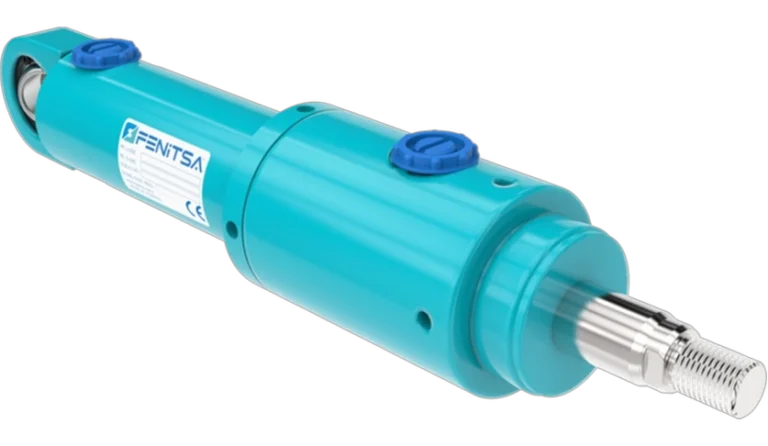
Fenitsa builds heavy-duty cylinders for loaders, haul trucks, drill rigs, crushers and conveyors, and custom replacements for mining equipment whose original cylinders are no longer available.
Where Cylinders Work on Mining Equipment
Typical functions and what each one demands.
| Machine | Cylinder function | Main demand |
|---|---|---|
| Wheel loaders, LHDs | Lift and tilt (bucket) | Shock loads at the bucket, high cycle count |
| Haul and dump trucks | Body hoist, steering | Long stroke, heavy payload, road vibration |
| Drill rigs | Feed, boom positioning, stabilisers | Precise feed force, dust and water ingress |
| Crushers | Setting adjustment, tramp release | Very high peak loads when uncrushable material enters |
| Conveyors | Belt tensioning, gates | Continuous duty, outdoor exposure |
What Makes a Mining Cylinder Last
- Robust wiper sealAbrasive dust is carried in on the rod; the wiper is the first line of defence.
- Rod protectionChrome damage from flying rock ruins seals — protective boots or guards help on exposed rods.
- Force marginSize for peak, not average, loads: 30 % or more above the calculated force for shock-loaded functions.
- Buckling checkLong hoist and boom cylinders are checked for rod buckling in the fully extended position.
- Clean oilContaminated oil scores the tube and rod from the inside; filtration matters as much as the cylinder.
Worked Example: Sizing a Loader Lift Cylinder
A lift cylinder must deliver 150 kN at the worst point of the lift. At 250 bar (25 N/mm²) the required area is 6,000 mm², giving a theoretical bore of 87.4 mm. With margin for friction and shock, the next standard bore is Ø100 mm, which produces 196 kN at 250 bar.
The rod is then selected for buckling at full extension with the real pin-to-pin mounting — on long boom cylinders that often means a thicker rod than force alone would suggest.
Our standard hydraulic series are built for 160 bar working and 240 bar test pressure with a 250 bar option, bores from Ø40 to Ø200 mm and strokes up to 5,000 mm, using honed St52 tube and Ck45 rods hard-chrome plated to at least 20 µm. Anything outside that envelope is engineered as a custom cylinder.
Which Fenitsa Cylinder Fits Which Function?
| Function | Series | Why |
|---|---|---|
| Loader lift and tilt | KHS / Custom | Shock loads and high cycle count call for the heavy-duty design |
| Haul truck hoist | Telescopic | Long stroke from a short closed length |
| Drill feed and positioning | FDH / Tie-rod | Standard dimensions, precise motion, easy resealing |
| Crusher setting / tramp release | Custom | Peak loads and special mountings are engineered per machine |
Inspection Routine
What to check, and how often, in this application.
- Every shiftLook for oil on rods and around heads; a wet rod is the first sign of a failing seal.
- WeeklyGrease pins, check for play in mounting eyes, inspect rods for scoring.
- MonthlyCheck drift under load (internal leakage) on lift and hoist cylinders.
- At overhaulReseal, measure rod and bore wear, re-test at test pressure before refitting.
Hydraulic Cylinders for Mining Equipment – FAQ
Which seals are best for mining cylinders?
Seal packages with a heavy-duty wiper and a piston seal suited to shock loads. Tell us about dust, water and temperature so the package can be matched to the site.
Can you replace an obsolete mining cylinder?
Yes. Send the old cylinder or its dimensions and photos; we reverse-engineer it and send a drawing for approval before production.
What pressure do mining cylinders need?
Many mining machines work at 250 bar or higher. Our standard series have a 250 bar option; higher pressures are handled as custom designs.
How do I stop rods from being damaged?
Keep wipers in good condition, fit rod boots or guards where rock can strike the rod, and avoid side loads with pivot mountings and rod eyes.
Send Your Application Data
Bore, rod, stroke, pressure, mountings and quantity — or a drawing or photo of the existing cylinder. We reply with a technical proposal and quotation from our plant.