

 Türkçe
 Русский
 Español
 العربية
20 Ton Hydraulic Cylinder
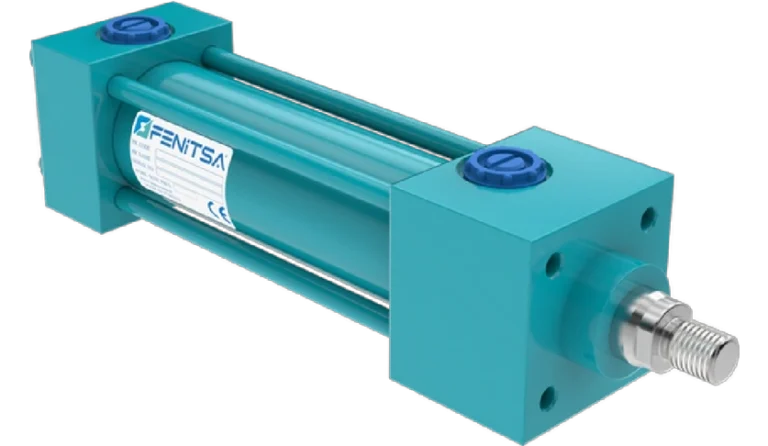
A 20 ton hydraulic cylinder needs a 124.9 mm bore at 160 bar. The standard Ø125 mm bore delivers exactly 20.0 t — no reserve at all — so for a 10 % margin choose Ø160 mm at 160 bar (32.8 t), or Ø125 mm with the 250 bar option (31.3 t).
We build them in the FDH series of hydraulic cylinders. Below: why “just enough” fails, what 250 bar saves, which rods pull 20 t, and buckling up to 3,000 mm.
What Bore Does a 20 Ton Cylinder Need?
D = √(4F / (π × 0.1 × p))Twenty tonnes is 196.1 kN; at 160 bar that takes 12,258 mm² of piston, a 124.9 mm bore. Ø125 mm produces 196.3 kN, but seal friction, hose losses or a relief valve set slightly low take more than the 0.1 % it has in hand, and the cylinder stalls just short.
Worked example — bending tool. A bending tool must close with 20 t, plus 10 % for friction and die wear: 22 t, or 215.7 kN. At 160 bar the bore works out at 131.0 mm, so Ø160 mm (32.8 t). At 250 bar it is 104.8 mm, so Ø125 mm (31.3 t).A third route keeps the compact Ø125 mm: order the 250 bar option and set the relief valve to about 176 bar, which gives the 22 t with pressure in hand.
Bore vs Pressure Table for 20 Tons
Metric tonnes and US tons at 100, 160, 210 and 250 bar; 1 US ton = 0.907 t.
| Pressure | Target | Calculated bore | Standard bore | Force of the standard bore | Reserve |
|---|---|---|---|---|---|
| 100 bar | 20 t | Ø158.0 mm | Ø160 mm | 20.5 t | +2.5 % |
| 100 bar | 20 US tons | Ø150.5 mm | Ø160 mm | 22.6 US tons | +13.0 % |
| 160 bar | 20 t | Ø124.9 mm | Ø125 mm | 20.0 t | +0.1 % |
| 160 bar | 20 US tons | Ø119.0 mm | Ø125 mm | 22.1 US tons | +10.4 % |
| 210 bar (reference only) | 20 t | Ø109.0 mm | Ø125 mm | 26.3 t | +31.4 % |
| 210 bar (reference only) | 20 US tons | Ø103.9 mm | Ø125 mm | 29.0 US tons | +44.8 % |
| 250 bar | 20 t | Ø99.9 mm | Ø100 mm | 20.0 t | +0.1 % |
| 250 bar | 20 US tons | Ø95.2 mm | Ø100 mm | 22.1 US tons | +10.4 % |
The US-ton rows tell a different story: 20 US tons are 18.14 t, so at 160 bar Ø125 mm already carries a 10 % reserve. If a request says “20 ton” without a unit, ask which ton. 210 bar is for reference; our rating is 160 bar, or 250 bar as an option. All bores: hydraulic cylinder sizes.
Push vs Pull at 20 Tons
| Bore / rod | Pressure | Push (t) | Pull (t) | Pull (US tons) | Area ratio φ |
|---|---|---|---|---|---|
| Ø160 / Ø90 mm | 160 bar | 32.8 | 22.42 | 24.72 | 1.46 |
| Ø160 / Ø100 mm | 160 bar | 32.8 | 19.99 | 22.04 | 1.64 |
| Ø125 / Ø70 mm | 250 bar | 31.3 | 21.47 | 23.67 | 1.46 |
| Ø125 / Ø90 mm | 250 bar | 31.3 | 15.07 | 16.61 | 2.08 |
Two combinations pull more than 20 t at their rated pressure: Ø160 / Ø90 mm at 160 bar and Ø125 / Ø70 mm at 250 bar. With the Ø100 mm rod the Ø160 cylinder pulls 196.0 kN, a fraction under the 196.1 kN of 20 t. Take the thicker rods only when buckling calls for them.
Stroke, Speed and Flow
| Rod speed | Ø160 at 160 bar: flow (L/min) | Ø160: power (kW) | Ø125 at 250 bar: flow (L/min) | Ø125: power (kW) |
|---|---|---|---|---|
| 0.03 m/s | 36.2 | 9.7 | 22.1 | 9.2 |
| 0.08 m/s | 96.5 | 25.7 | 58.9 | 24.5 |
| 0.15 m/s | 181.0 | 48.3 | 110.4 | 46.0 |
Q = A × v sizes the pump. The 250 bar route needs 39 % less flow for the same speed, so pump, valves and pipes shrink — but the power barely changes, because power is force times speed and both cylinders deliver 31.3–32.8 t. Standard strokes are 100–500 mm; piston speed is limited to 0.5 m/s.
Buckling Check for Long Strokes
Here the layout is press-like: front flange (FFM), rod end pinned to a guided slide, mounting factor 0.7. Free length = stroke + an assumed 250 mm from flange face to rod pin; Euler load Fk = π² × E × I / (0.7 × L)², divided by 3.5 as is common practice.
| Stroke | Free length (mm) | Ø70 rod, Ø125 bore (t) | Ø90 rod, Ø160 bore (t) | Result for 20 t |
|---|---|---|---|---|
| 1,000 mm | 1,250 | 93.0 | 254.0 | Both rods pass |
| 2,000 mm | 2,250 | 28.7 | 78.4 | Both rods pass |
| 3,000 mm | 3,250 | 13.8 | 37.6 | Ø90 rod only |
Guidance is what makes this work. The same Ø160 / Ø90 mm cylinder at 2,000 mm with a free, unguided rod end (factor 2) may push only 9.6 t — less than half the load. Guide first, then choose the rod; see long stroke hydraulic cylinders.
Where 20 Ton Cylinders Are Used
Press brakes and folding
Sheet bending with repeatable force on short strokes. Press cylinders
Bending and straightening
Tubes, profiles, bars and shafts: high force over a short working stroke.
Forming and joining
Punching, embossing, riveting and press-fitting assemblies.
Mobile machinery
Booms, outriggers and attachments; the KHS series is built for mobile equipment. Construction machinery
Industrial (160–250 bar) vs Jack-Type (700 bar) 20 Ton Cylinders
A 700 bar cylinder reaches 20 t with about Ø59.7 mm, under half the diameter of the industrial Ø125 mm. The pressure is the catch: every hose, fitting, valve and gauge must be rated for 700 bar, while machine circuits are built from industrial components rated far lower.
| Question | 700 bar jack-type | Industrial, 160–250 bar |
|---|---|---|
| Can it cycle all shift in a machine? | Not its purpose | Yes — that is its purpose |
| Does it pull? | Most only push; spring or load returns the rod | Yes: Ø160 / Ø90 mm pulls 22.4 t at 160 bar |
| What drives it? | Hand pump or small electric pump | Power unit sized for the speed |
| How is it fixed? | On its base or a collar thread | Flange, clevis, trunnion or foot |
Portable pressing or lifting: the jack. A press brake or bending machine: the industrial cylinder.
How to Order a 20 Ton Cylinder
Send Us Your Cylinder Data
Bore, rod, stroke, working pressure, mountings and quantity — or a drawing or photo of the cylinder you want to replace. Our engineers reply with a technical proposal and a quotation. info@fenitsa.com.
20 Ton Hydraulic Cylinder – FAQ
Short answers from our engineers.
Is a Ø125 mm cylinder enough for 20 tonnes?
Only on paper. At 160 bar it produces 20.02 t, so any friction or pressure loss leaves it short of the load. Choose Ø160 mm at 160 bar (32.8 t) or Ø125 mm with the 250 bar option.
What pressure does a Ø100 mm cylinder need for 20 tonnes?
249.7 bar — the very top of the 250 bar option, with nothing in hand. Ø125 mm at 250 bar (31.3 t) is the safer choice.
How many US tons is a 20 ton cylinder?
Twenty tonnes are 22.0 US tons. A Ø160 mm cylinder at 160 bar pushes 36.2 US tons.
Can I use a 20 ton hydraulic cylinder on a dump truck?
On small tipping bodies, if stroke and closed length fit. Most dump bodies need a long stroke from a short closed length, which is why dump truck cylinders are usually telescopic.
Which seals should a 20 ton cylinder have?
NBR seals (code NS) are standard for mineral oil from −20 °C to +80 °C. Viton seals (code VS) are the option for hot oil or hot surroundings; with special seals the range extends to −30 °C … +200 °C.
Related Pages
Hydraulic Cylinder Sizes
All bores, rods and forces at 100–250 bar.
10 Ton Hydraulic Cylinder
Ø100 at 160 bar, and the 700 bar jack difference.
30 Ton Hydraulic Cylinder
Ø160 at 160 bar and which bores pull 30 t.
Hydraulic Cylinder Force Calculator
Check the reserve at your own pressure setting.