

 Türkçe
 Русский
 Español
 العربية
How to Measure a Hydraulic Cylinder for Replacement
To measure a hydraulic cylinder for replacement, record eight things: the retracted pin-to-pin length, the stroke, the bore, the rod diameter, the ports, the mountings with their pin sizes, whether it is single or double acting, and the working pressure. Together they let a manufacturer build a cylinder that fits the same space and does the same job.
You need a tape measure, a caliper and a thread gauge. Follow the 8 steps below, copy the checklist and send it with your enquiry. Fenitsa builds standard and custom hydraulic cylinders and quotes replacements from these measurements.
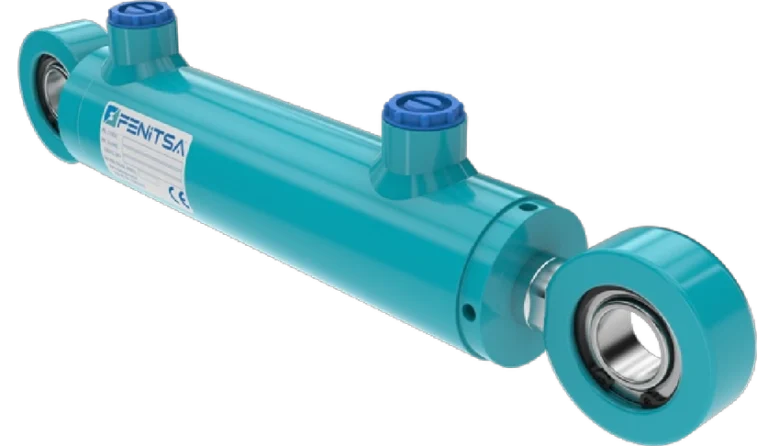
Before You Start
- Make it safeLower or support the load, stop the power unit and relieve the pressure by operating the valve both ways. Never loosen a fitting on a cylinder that is holding a load.
- Clean the cylinderDirt and paint hide stamped part numbers and distort caliper readings.
- Look for a nameplateA nameplate or stamped code often gives bore, rod, stroke and pressure directly. Photograph it first.
- Tools and unitsTape measure, vernier or digital caliper, thread gauge and a phone camera. Record everything in one unit; 1 in = 25.4 mm.
Measure the Cylinder in 8 Steps
Letters A–G refer to the drawing.
- A — Retracted length, pin centre to pin centre
- B — Stroke (extended length minus retracted length)
- C — Barrel outside diameter — bore = outside diameter − 2 × wall thickness
- D — Rod diameter
- E — Port size, thread type and position
- F — Pin (or bore) diameter of the mountings
- G — Mounting width / clevis gap
- 1
Retracted length, pin to pin (A)
Retract the cylinder fully and measure from the centre of the rear pin hole to the centre of the rod-end pin hole. This closed length matters most, because the new cylinder must fit between the same pins. For a flange or foot mounting, measure from the mounting face and note which face you used.
- 2
Stroke (B)
Extend the cylinder fully under control and measure pin to pin again: stroke = extended length − retracted length. If the cylinder cannot be operated, do not guess the stroke from the rod length; take it from the machine drawing or the nameplate.
- 3
Bore (C)
The bore is the inside diameter of the barrel. Measure the outside diameter with a caliper and find the wall thickness at an open port or the tube end: bore = outside diameter − 2 × wall. Example: 95 mm outside with a 7.5 mm wall gives a bore of 80 mm. Round to the nearest standard bore.
- 4
Rod diameter (D)
Measure the rod on a clean, undamaged section near the head, taking two readings at right angles. Rods come in round millimetre sizes or inch fractions: a reading of 44.45 mm is a 1.75 in rod, not a worn metric one.
- 5
Ports (E)
Note the thread type and size of both ports — BSP, NPT, metric, SAE O-ring boss or flange — and the distance from each end of the cylinder to the port centre. Photograph the port orientation relative to the mountings.
- 6
Mountings and pin diameter (F, G)
Identify the mounting at each end: clevis, eye, spherical bearing, trunnion, flange, foot or threaded rod end. Measure the pin or hole diameter, the eye width or clevis gap and the rod-end thread, and note whether the two mountings are in line or at right angles.
- 7
Single or double acting
Count the ports with hoses. Two working ports mean double acting; one port, often with a breather at the other end, means single acting.
- 8
Working pressure
Read it from the machine plate, the relief valve setting or the manual; otherwise give the machine type and pump data. Fenitsa’s standard FDH cylinders work at 160 bar, with a 250 bar option.
Measurement Checklist
Copy the table, fill in the last column and send it with your photos.
| Field | How to measure | Unit | Your value |
|---|---|---|---|
| Retracted length (A) | Fully retracted, pin centre to pin centre | mm | |
| Extended length | Fully extended, pin centre to pin centre | mm | |
| Stroke (B) | Extended length − retracted length | mm | |
| Barrel outside diameter (C) | Caliper, two readings | mm | |
| Barrel wall thickness | At an open port or the tube end | mm | |
| Bore | Outside diameter − 2 × wall | mm | |
| Rod diameter (D) | Caliper on a clean part of the rod | mm | |
| Rod-end thread | Thread gauge, e.g. M27×2 | size × pitch | |
| Port A and port B (E) | Thread type and size; distance from each end | type / mm | |
| Rear mounting (F, G) | Type, pin diameter, width or clevis gap | mm | |
| Rod-end mounting (F, G) | Type, pin diameter, width or clevis gap | mm | |
| Orientation | Mountings in line or at right angles; port position | degrees | |
| Action | Two working ports = double acting | — | |
| Working pressure | Machine plate, relief valve or manual | bar or psi | |
| Environment | Temperature, outdoor use, dirt, water | °C / notes | |
| Quantity | Cylinders needed | pcs |
Match Your Reading to a Standard Bore
Round the calculated bore to the nearest standard size. Fenitsa’s FDH series is built in the 8 metric bores below; if an inch reading falls between sizes, say so and the fit is confirmed in the quotation. The hydraulic cylinder sizes chart and the hydraulic cylinder force calculator give the force of the bore you measured.
| Bore (mm) | Bore (in) | Rod options (mm) | Rod options (in) |
|---|---|---|---|
| Ø40 | 1.57 | 25 / 28 | 0.98 / 1.10 |
| Ø50 | 1.97 | 28 / 30 / 36 | 1.10 / 1.18 / 1.42 |
| Ø63 | 2.48 | 36 / 45 | 1.42 / 1.77 |
| Ø80 | 3.15 | 45 / 56 | 1.77 / 2.20 |
| Ø100 | 3.94 | 56 / 70 | 2.20 / 2.76 |
| Ø125 | 4.92 | 70 / 90 | 2.76 / 3.54 |
| Ø160 | 6.30 | 90 / 100 | 3.54 / 3.94 |
| Ø200 | 7.87 | 110 / 125 | 4.33 / 4.92 |
Common Measuring Mistakes
Measuring the rod, not the stroke
Part of the rod always sits inside the head and piston, so the rod is longer than the stroke.
Calling the barrel diameter the bore
The outside diameter includes two walls: a barrel measuring 95 mm outside is not a Ø95 mm cylinder.
Measuring a partly extended cylinder
Take the retracted length with the piston fully bottomed, or the new cylinder will be too long.
Calculating the closed length
Stop tubes, cushions and heavy heads add length; copy the measured closed length instead.
Ignoring orientation
Port position and the angle between mountings matter as much as their size.
Measuring worn parts
A worn pin hole or pitted rod gives a false diameter; measure unworn sections.
Send Us Your Measurements
Send the checklist with photos of the whole cylinder, the nameplate, both mountings and both ports — ideally with a tape measure in the picture. Our engineers reply with a technical proposal and a quotation. info@fenitsa.com.
Measuring a Hydraulic Cylinder – FAQ
Short answers from our engineers.
How is a hydraulic cylinder measured pin to pin?
With the cylinder fully retracted, measure from the centre of the rear pin hole to the centre of the rod-end pin hole. This retracted pin-to-pin length, together with the stroke, tells you whether a replacement will fit between the existing mounting points.
How do you measure a hydraulic cylinder for seals?
For seals you need the rod diameter, the bore and the groove dimensions in the head and on the piston, so the cylinder has to be opened. Measure the grooves rather than the old seals, which are often worn or swollen. The hydraulic cylinder parts page explains each seal.
How can I find the bore without taking the cylinder apart?
Measure the outside diameter of the barrel and subtract two wall thicknesses, which can often be seen at an open port or the tube end: 95 mm outside with a 7.5 mm wall gives a bore of 80 mm. Then round to the nearest standard size.
What if my old cylinder is in inches?
Measure in inches and say so: 1 in = 25.4 mm, so a 3 in bore is 76.2 mm and a 1.5 in rod 38.1 mm. Fenitsa’s standard bores are metric, so the nearest metric bore and rod are proposed and the fit is confirmed in the quotation.
Can a replacement cylinder be built from photos only?
Photos alone are not enough: they show mounting types, ports and orientation, but not exact lengths and diameters. Send them together with the retracted length, stroke, rod diameter, barrel outside diameter and pin sizes, and a quotation can be prepared.
Why does the working pressure matter for a replacement?
The pressure decides the wall thickness, seals and rod the new cylinder needs, and whether a smaller bore at a higher pressure would do the same job. Fenitsa’s standard FDH cylinders are rated for 160 bar working pressure and tested at 240 bar, with a 250 bar option.
Related Pages
Hydraulic Cylinder Sizing
Calculate bore, rod and stroke for a new application.
Hydraulic Cylinder Parts and Components
Every part on a labelled diagram, including the seals.
Types of Hydraulic Cylinders
Identify the type of cylinder you are replacing.
Custom Hydraulic Cylinders
Replacement and new cylinders built to your data.