

 Türkçe
 Русский
 Español
 العربية
Types of Hydraulic Cylinders
Hydraulic cylinders are grouped on three axes: how they act (single or double acting), how they are built (tie rod, welded, telescopic or plunger) and what extra function they have (double rod, tandem or multi-position). Almost every cylinder combines one choice from each axis — for example, a double acting welded cylinder on an excavator arm.
This guide explains each type of hydraulic cylinder, where it is used and how to choose, with a link to the matching product or guide page in every section. Fenitsa has built hydraulic cylinders since 1979; the standard FDH series covers Ø40–Ø200 mm bores at 160 bar.
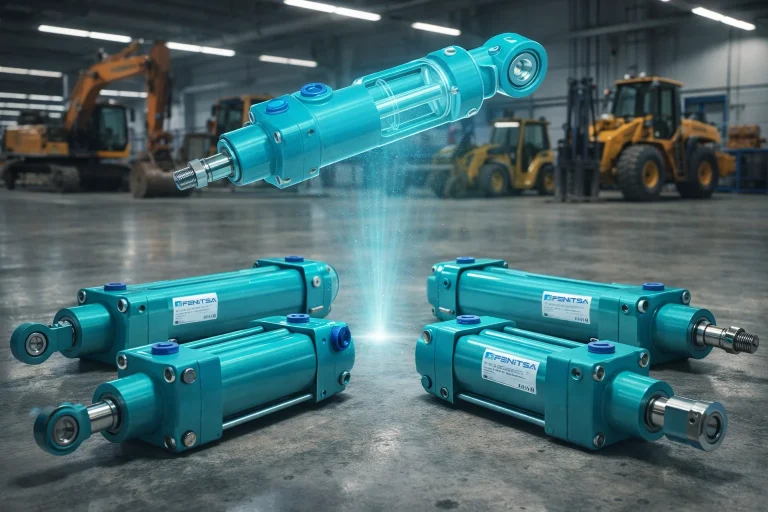
How Many Types of Hydraulic Cylinder Are There?
There are two types by action and four main types by construction, plus special functions built on top of them. Three questions classify any cylinder:
- How does it act? Single acting cylinders are powered one way and returned by the load, gravity or a spring; double acting cylinders are powered both ways.
- How is it built? Tie rod, welded, telescopic or plunger (ram). Heavy industrial designs with bolted flanges instead of tie rods are called mill type.
- What extra function does it have? Double rod, tandem, multi-position or adjustable stroke.
The axes are independent — a tie rod or telescopic cylinder can be single or double acting — so a supplier asks all three questions, plus bore, rod, stroke and mountings, before quoting.
Hydraulic Cylinder Types Compared
Action, construction, pressure class and typical use at a glance.
| Type | Action | Construction | Pressure class | Typical uses |
|---|---|---|---|---|
| Single acting | One way; load, gravity or spring returns it | Tie rod, welded, telescopic or plunger | Set by the construction | Tippers, jacks, lifting tables, presses |
| Double acting | Both ways; pull force below push force | Tie rod, welded or telescopic | Set by the construction | Loaders, presses, automation |
| Telescopic | Single or double acting | Nested stages in one body | Set per design | Dump trucks, tipping trailers, platforms |
| Tie rod | Single or double acting | Head and cap clamped by external tie rods | Medium to high (industrial) | Presses, moulding machines, machine tools |
| Welded | Single or double acting | Cap welded to the barrel; threaded or bolted head | High (mobile, heavy duty) | Excavators, loaders, cranes, farm machinery |
| Plunger (ram) | Single acting only | Rod is the working area; no piston | High; very stiff in compression | Press rams, vehicle lifts, jacks |
| Double rod | Double acting, equal areas | Rod through both heads | As the base cylinder | Steering, machine tables |
| Tandem / multi-position | Double acting | Two cylinders in line on one axis | As the base cylinder | More force in a small diameter; extra stop positions |
Pressure class shows where each design is usually applied; the actual rating depends on the specific cylinder. Fenitsa’s FDH series works at 160 bar, is tested at 240 bar and is available for 250 bar; the tie rod range uses the same Ø40–Ø200 mm, 160 bar frame.
Single Acting Cylinders
A single acting cylinder has one working port. Oil pressure extends the rod; when the valve opens the port to tank, the load, gravity or an internal spring pushes the piston back, while the other chamber breathes through a filter.
It needs one hose and a simpler valve, and a Ø100 mm single acting cylinder at 160 bar lifts 12.8 t — as much as a double acting cylinder of the same bore. But it cannot pull, its return speed depends on the load, and a spring return suits short strokes only.
Typical jobs are tipping bodies, scissor lifts, jacks and press rams that return under their own weight. See single acting hydraulic cylinders for the return options and a force table.
Double Acting Cylinders
A double acting cylinder has a port at each end. Oil into port A acts on the full piston area and extends the rod; oil into port B acts on the annulus around the rod and retracts it. Force and speed can be controlled both ways, and the cylinder holds its position when the valve blocks both ports.
Because the rod takes up part of the piston face, the pull force is lower and the retract speed higher: a Ø80 mm cylinder with a Ø45 mm rod at 160 bar pushes 8.20 t and pulls 5.61 t. See double acting hydraulic cylinders and the hydraulic cylinder force calculator for any size.
Telescopic Cylinders
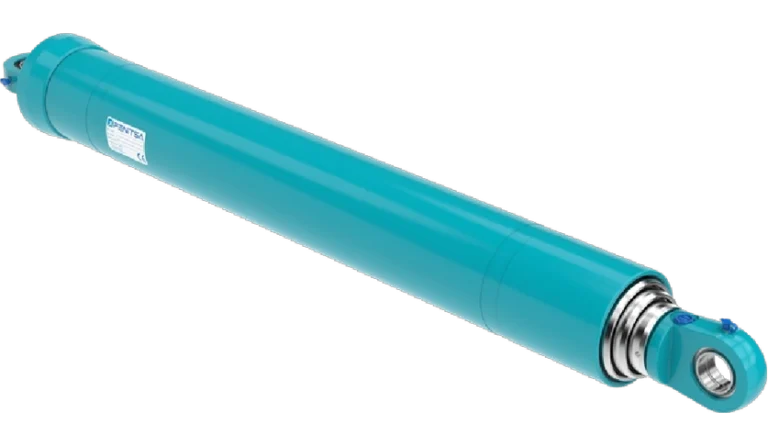
A telescopic cylinder has several nested tubes, or stages, that extend one after another, the widest first. Its stroke is several times its closed length, which makes it the standard answer where a long stroke must fit a short space, such as under the front of a tipper body.
At constant pressure each smaller stage gives less force and moves faster, so every stage must still have enough force where it takes over — usually the smallest stage is critical.
Tipper cylinders are mostly single acting and retract under the weight of the body; double acting versions are used where the load cannot push them back. Fenitsa designs the bore and stages of each telescopic hydraulic cylinder per project — see also hydraulic cylinders for dump trucks.
Tie Rod Cylinders
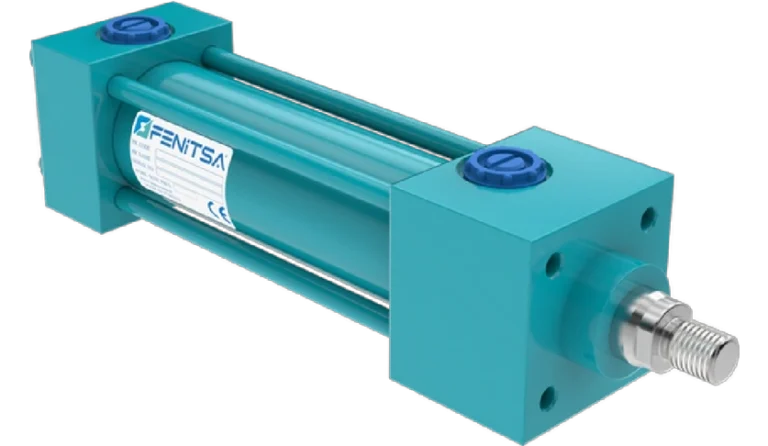
In a tie rod cylinder the head and cap are clamped against the barrel by steel tie rods running along the outside. Nothing is welded, so the cylinder can be dismantled with hand tools, resealed and rebuilt part by part.
Tie rod cylinders dominate industrial hydraulics — presses, injection moulding machines, machine tools — because standardised mounting dimensions make replacement easy. They are bulkier, and their tie rods stretch under shock, so mobile machines prefer welded cylinders.
Fenitsa tie rod hydraulic cylinders cover Ø40–Ø200 mm bores at 160 bar, with double rod, tandem and adjustable-stroke versions; the FDH series has mounting dimensions to CETOP RP 58 H and strokes up to 5,000 mm. The tie rod page compares tie rod and welded designs point by point.
Welded Cylinders
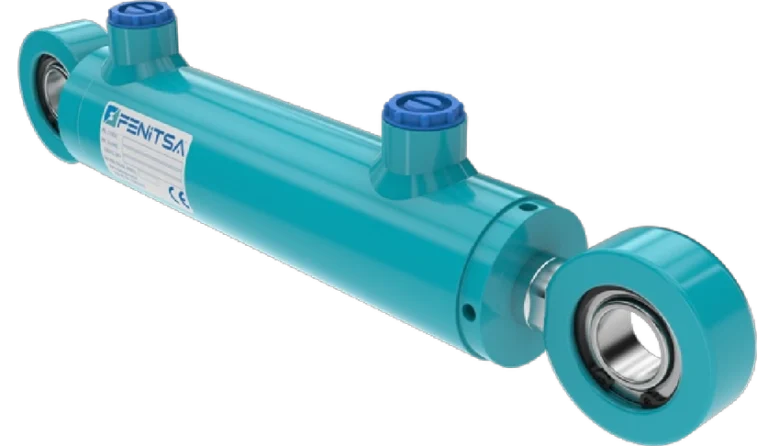
A welded cylinder has its rear cap welded to the barrel, usually together with the port bosses and mountings. The front head is threaded in or held by a bolted ring, so the seals can still be replaced. Without tie rods the body is slimmer, lighter and better at absorbing shock and vibration.
Welded cylinders are therefore standard on excavators, loaders, cranes, tippers and farm machinery, where space is tight. Cross tubes, clevises and trunnions are welded on to suit the machine, so most are built to the machine builder’s drawing.
Fenitsa builds welded hydraulic cylinders in two series — THS with a compact welded body and KHS for heavy duty and mobile equipment — with Ø40–Ø200 mm bores, Ø22–Ø110 mm rods and strokes up to 3,000 mm.
Plunger (Ram) Cylinders
A plunger or ram cylinder has no separate piston: the rod itself is the working area, and the only moving seal is in the head. It is always single acting and returns by gravity or by the load.
Because the rod diameter equals the working diameter, a plunger is very stiff against buckling, and its barrel needs no honed bore. A Ø100 mm plunger at 160 bar gives 12.8 t, the same as a Ø100 mm piston. Typical uses are press rams, vehicle lifts and jacks; in British and Australian English, “hydraulic ram” is also used for any hydraulic cylinder.
Compare plunger, spring-return and load-return designs on the single acting cylinder page, and see hydraulic cylinders for press machines.
Double Rod (Through Rod) Cylinders
A double rod cylinder has a rod that passes through both heads. The effective area is equal on both sides of the piston, so it gives the same force and speed in both directions; the second rod end can also carry a sensor or an adjustable stop.
With a Ø80 mm bore and Ø45 mm rods the force at 160 bar is 5.61 t each way. Typical uses are steering cylinders and machine tool tables. Double rod is an option in the Fenitsa FDH and tie rod ranges.
Tandem and Multi-Position Cylinders
A tandem cylinder puts two cylinders in line on one axis with their pistons joined by a common rod. Both pistons are pressurised together, so their forces add up — close to double the push force from the same outside diameter when the connecting rod is slim.
A Ø100 mm tandem with Ø56 mm rods pushes about 21.6 t at 160 bar, against 12.8 t for a single Ø100 mm cylinder, because the second piston works on the annulus around the connecting rod.
A multi-position cylinder joins two cylinders back to back with separate strokes, giving three positions, or four when the strokes differ. An adjustable-stroke cylinder instead uses a threaded stop to shorten one stroke.
Tandem and adjustable-stroke versions are FDH options; in Fenitsa’s pneumatic range the same idea appears as the two-position tandem cylinder.
How to Choose the Right Type
A decision flow in six questions.
- 1
Does the load return on its own?
If gravity, the load or a spring can return the rod and the cylinder never pulls, single acting is enough. Otherwise choose double acting.
- 2
Is the stroke long compared with the space?
If the retracted cylinder must be much shorter than its stroke, choose telescopic. Otherwise a single-stage cylinder is stiffer, simpler and cheaper.
- 3
Industrial or mobile machine?
Fixed machines with standard mountings suit tie rod cylinders; mobile machines with shock, dirt and tight space suit welded cylinders.
- 4
Compression only, very high force?
A plunger (ram) gives the stiffest column for presses and lifts.
- 5
Equal force and speed both ways?
Choose a double rod cylinder.
- 6
Too little force from the space, or extra stops?
A tandem cylinder adds force without a larger bore; a multi-position cylinder adds intermediate stops.
Then size the bore, rod and stroke with the hydraulic cylinder sizing guide; for a replacement, start with how to measure a hydraulic cylinder.
Send Us Your Cylinder Data
Bore, rod, stroke, working pressure, mountings and quantity — or a drawing or photo of the cylinder you want to replace. Our engineers reply with a technical proposal and a quotation. info@fenitsa.com.
Types of Hydraulic Cylinders – FAQ
Short answers from our engineers.
How do rephasing hydraulic cylinders work?
They are double acting cylinders connected in series so that they move together: oil from the rod side of the first feeds the cap side of the second, with areas matched for equal strokes. At the end of the stroke a small bypass lets oil past the piston, cancelling any drift between the two.
Which type of hydraulic cylinder is the strongest?
No type is stronger by itself: force is pressure times piston area, so it depends on bore and pressure, not on construction. A Ø200 mm cylinder at 160 bar pushes 51.3 t whether it is tie rod or welded. For a given outside diameter, a tandem gives the most force and a plunger the stiffest rod.
What type of hydraulic cylinder is used on excavators?
Excavators use double acting welded cylinders for the boom, arm and bucket. They are pinned at both ends, take heavy shock and side loads and must fit a tight space, which suits the slim welded body. See hydraulic cylinders for excavators.
What type of hydraulic cylinder does a dump truck use?
Most dump trucks and tipping trailers use a single acting telescopic cylinder at the front of the body: a long stroke from a short closed length, retracting under the body’s own weight. Smaller tippers often use an underbody scissor linkage instead. See dump truck cylinders.
Can a double acting cylinder be used as a single acting one?
Yes. Pressurise one port only and let the other chamber breathe through a line to the tank or a breather filter. Never plug the unused port: trapped oil blocks the stroke, and on the rod side it can be squeezed to a pressure far above the supply pressure.
What is a mill type hydraulic cylinder?
A heavy industrial cylinder whose head and cap are bolted to thick barrel flanges instead of being clamped by tie rods. It suits continuous heavy work such as steel mills and large presses, and it can be dismantled for service like a tie rod cylinder.
Related Pages
Hydraulic Cylinder Parts and Components
Labelled diagram of every part, with seal materials and failure signs.
How Does a Hydraulic Cylinder Work?
Pascal’s law, the extend and retract cycle and force = pressure × area.
Hydraulic Cylinder Sizing
Bore, rod and stroke in five steps, with a worked example.
Custom Hydraulic Cylinders
Cylinders built to your drawing, sample or application data.