

 Türkçe
 Русский
 Español
 العربية
Hydraulic Cylinders for Excavators
An excavator has three working cylinders on its front end — boom, arm and bucket — plus blade, swing or offset cylinders on many models. Each sees different loads, and each fails for different reasons.
Fenitsa builds heavy-duty and custom excavator cylinders and reproduces cylinders for older machines from samples or measurements.
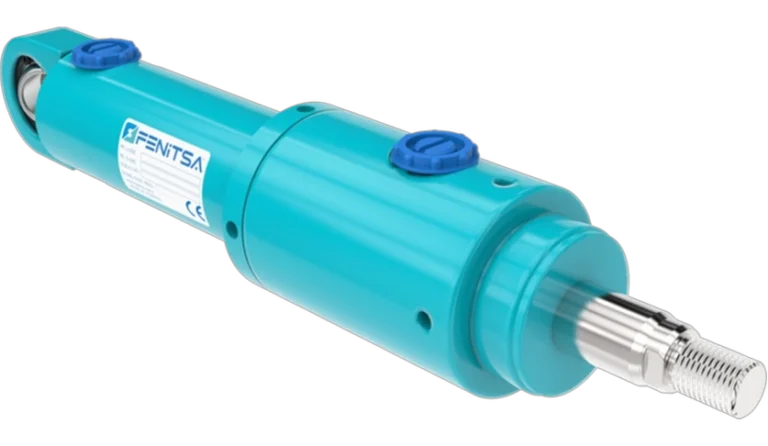
Excavator Cylinders and Their Loads
| Cylinder | Motion | Typical load pattern |
|---|---|---|
| Boom | Raises and lowers the boom | Highest force, holding loads over long periods |
| Arm (stick) | Pulls the arm in to dig | High digging force, frequent reversals |
| Bucket | Curls the bucket | Shock loads at the teeth, rod exposure |
| Dozer blade | Raises the blade | Shock and side loads, mud and dirt |
| Boom swing / offset | Lateral boom movement | Side forces, compact installation |
Why Excavator Cylinders Fail
Scored rods
Rock strikes and grit damage the chrome; the wiper and rod seal then leak.
Bent rods
Overloads or side impacts on long boom and arm cylinders.
Internal leakage
Worn piston seals cause the boom to drift down under load.
Worn pin bores
Lack of greasing ovalises mounting eyes and adds play.
A Note on Pressure
Excavator circuits commonly operate above the 250 bar of our standard series, so excavator cylinders are designed per project: bore, wall thickness, rod and seals are selected for the machine’s relief pressure and loads. Send the model, the cylinder position and its dimensions, or the old cylinder itself. Our standard hydraulic series are built for 160 bar working and 240 bar test pressure with a 250 bar option, bores from Ø40 to Ø200 mm and strokes up to 5,000 mm, using honed St52 tube and Ck45 rods hard-chrome plated to at least 20 µm. Anything outside that envelope is engineered as a custom cylinder.
Which Fenitsa Cylinder Fits Which Function?
Inspection Routine
What to check, and how often, in this application.
- DailyGrease all cylinder pins and check rods for scoring.
- WeeklyCheck for boom drift with the bucket raised and engine off.
- Every 500 hoursInspect wipers and rod seals; replace at first sign of leakage.
- At rebuildMeasure rod straightness and chrome wear before resealing.
Hydraulic Cylinders for Excavators – FAQ
Can you make a replacement cylinder for my excavator?
Yes — send the machine model, the cylinder position (boom, arm, bucket, blade) and the old cylinder or its dimensions and photos.
Why does my excavator boom drift down?
Usually internal leakage past worn piston seals, or a leaking load-holding valve. The cylinder should be tested and resealed.
What pressure do excavator cylinders work at?
Often above 250 bar; that is why excavator cylinders are engineered for the specific machine’s pressure.
How can rod damage be reduced?
Replace worn wipers early, avoid striking rods on rock, and keep pins greased to prevent side loads from play.
Send Your Application Data
Bore, rod, stroke, pressure, mountings and quantity — or a drawing or photo of the existing cylinder. We reply with a technical proposal and quotation from our plant in Konya, Türkiye.